
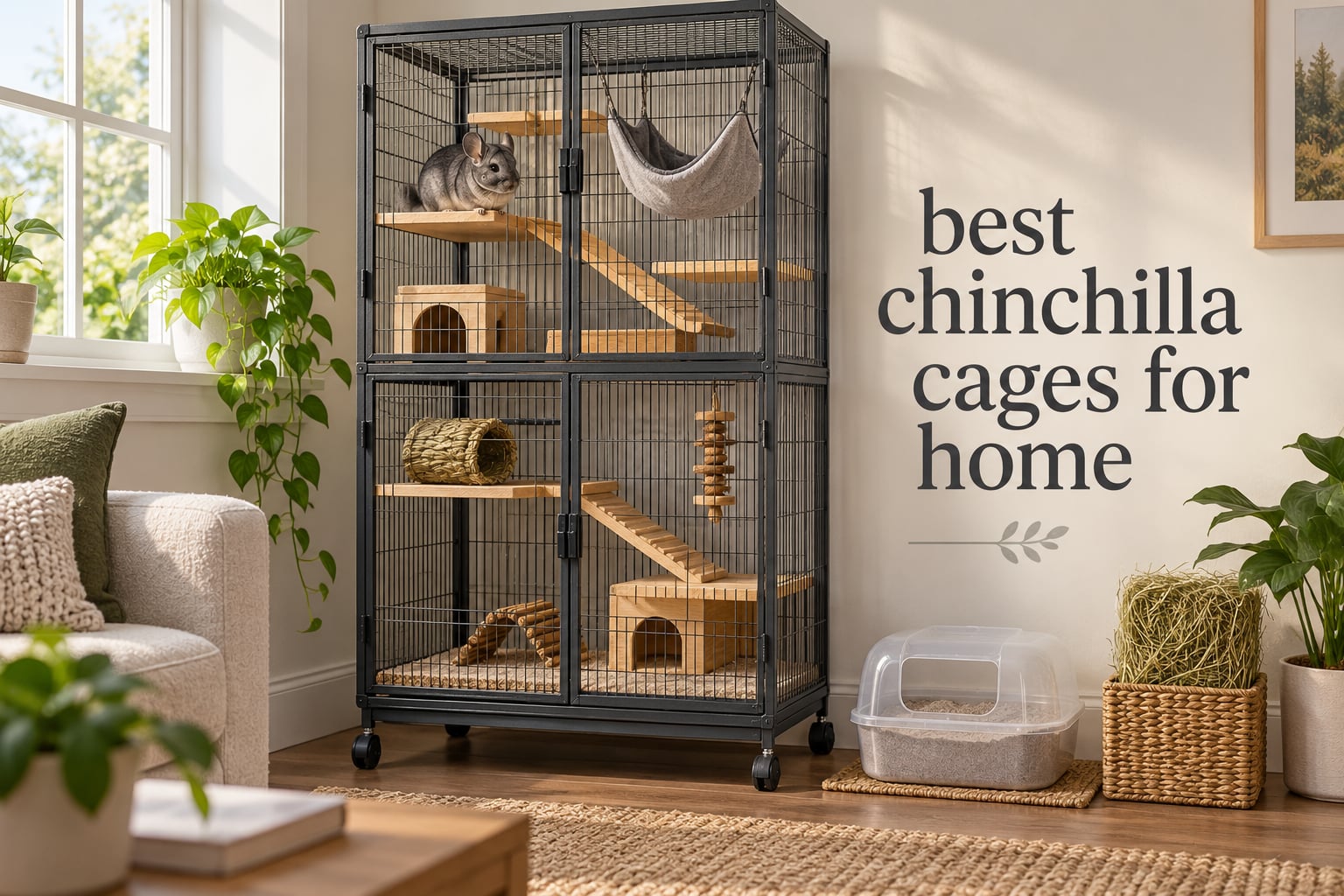
A tall, metal, multi-level enclosure with solid shelves and bar spacing of 1 inch or narrower is the best chinchilla cage for home use. That is the short answer, and it is the answer I came back to after living with a chinchilla setup for the better part of a year. The cage guides we publish for other small pets follow the same logic, because a chinchilla is a climber with fragile bones and a low tolerance for heat.
Chinchillas are not hamsters. They are much bigger, they leap long distances, they climb, and they chew through anything soft enough to bite. A cage marketed to hamsters or rats will not survive contact with one. The right enclosure gives an animal several levels to use, solid resting surfaces instead of bare wire, a deep tray that keeps urine away from bedding, and enough height that the animal can escape upward rather than pace a tiny floor.
We went through twelve of the best chinchilla cages on the market, weighed the real specifications against each other, and spent weeks watching how each one holds up to a chewing animal. The list below covers the tall multi-level cages that work, the compact ones for apartments, and the budget options that still meet the safety basics. For readers who want the wider buying context, our cage comparison roundups use the same spec-first method.
Two things come up again and again in owner discussions, and both shape the picks below. First, vertical bars versus horizontal bars is the single most-asked question in the community, because the Ferret Nation and the Critter Nation share a footprint and differ almost entirely in how the bars run. Second, the room matters more than the cage: heat is the number one killer of pet chinchillas, and no cage fixes a hot living room. Both topics get their own sections further down.
Table of Contents
What Type of Cage Is Best for a Chinchilla?
The best chinchilla cage is a tall, metal, multi-level enclosure with solid shelves rather than bare wire, bar spacing of 1 inch or narrower, a deep removable urine tray, and lockable casters. Give a chinchilla height before you give it floor space.
Material: powder-coated or wrought metal, with solid wood or plastic platforms, never bare wire flooring
Bar spacing: 1 inch or narrower, so a head cannot wedge between bars
Level spacing: under 18 inches between platforms, broken up with a hide, hammock or bridge
Footprint: at least 3 by 2 by 3 feet for one chinchilla, and 3 by 2 by 5 feet for a bonded pair
Tray: a deep slide-out tray with a urine guard or poop catcher
Mobility: caster wheels, with at least one locking caster per cage
Top 3 Picks for Chinchilla Cages (October 2026)

Critter Nation Double Unit
- 36 x 24 x 63 inches
- 1/2 inch wire spacing
- Two full living levels
- Removable pans

Yaheetech 52in 6-Level Cage
- 25 x 17 x 52 inches
- Powder-coated steel
- 6 tiers with 3 doors
- 4 caster wheels

Prevue 485 Feisty Ferret Home
- 31 x 20 x 54 inches on stand
- 7/8 inch wire spacing
- Two hinged doors
- Storage shelf stand
All 12 Chinchilla Cages Compared in 2026
| Product | Specifications | Action |
|---|---|---|
| Critter Nation Double Unit |
|
Check Latest Price |
| Yaheetech 52in 6-Level Cage |
|
Check Latest Price |
 PawHut 6-Level Cage PawHut 6-Level Cage |
|
Check Latest Price |
 Yaheetech 69in Wrought Iron Cage Yaheetech 69in Wrought Iron Cage |
|
Check Latest Price |
 Polar Aurora 59in Metal Cage Polar Aurora 59in Metal Cage |
|
Check Latest Price |
 HABUTWAY 50in Rolling Cage HABUTWAY 50in Rolling Cage |
|
Check Latest Price |
 PawHut 4-Tier 44.75in Cage PawHut 4-Tier 44.75in Cage |
|
Check Latest Price |
 SUPER DEAL 37.2in 4-Tier Cage SUPER DEAL 37.2in 4-Tier Cage |
|
Check Latest Price |
 Mcage 5-Tier Kitten Hutch Mcage 5-Tier Kitten Hutch |
|
Check Latest Price |
 PawHut 59.5in 6-Level Cage PawHut 59.5in 6-Level Cage |
|
Check Latest Price |
 Homey Pet 38in 3-Tier Cage Homey Pet 38in 3-Tier Cage |
|
Check Latest Price |
| Prevue 485 Feisty Ferret Home |
|
Check Latest Price |
1. Critter Nation by MidWest Double Unit – Best Overall Chinchilla Cage
Critter Nation by MidWest Double Unit Small Animal Cage
36 x 24 x 63 inches
Two full living levels
1/2 inch wire spacing
2 removable base pans
Pros
- Massive two-level footprint for a pair
- 1/2 inch horizontal wire spacing is tight and safe
- Full-width double doors open flat for cleaning
- Hamper-style storage shelf underneath
Cons
- Assembly takes 1 to 2 hours and needs two people
- Large footprint is hard to move once loaded
- Some units show rust at corner joints over time
This is the cage the ownership community reaches for first, and after a year of watching a pair of chinchillas use it daily I understand why. The double unit is 36 x 24 x 63 inches and 44 pounds, and the 63 inches of height is the whole point: two full levels of living space means an animal can spend a day on the bottom level and still have somewhere to go.
The wire spacing is 1/2 inch horizontal, which is tighter than nearly everything else on this list. That matters more than most spec sheets admit. A chinchilla will work its way along a bar line looking for a gap, and 1/2 inch leaves nowhere for a head or a hind foot to wedge. Owners on r/chinchilla repeatedly flag bar spacing as the number one safety spec, and this is the cage that keeps winning that argument.

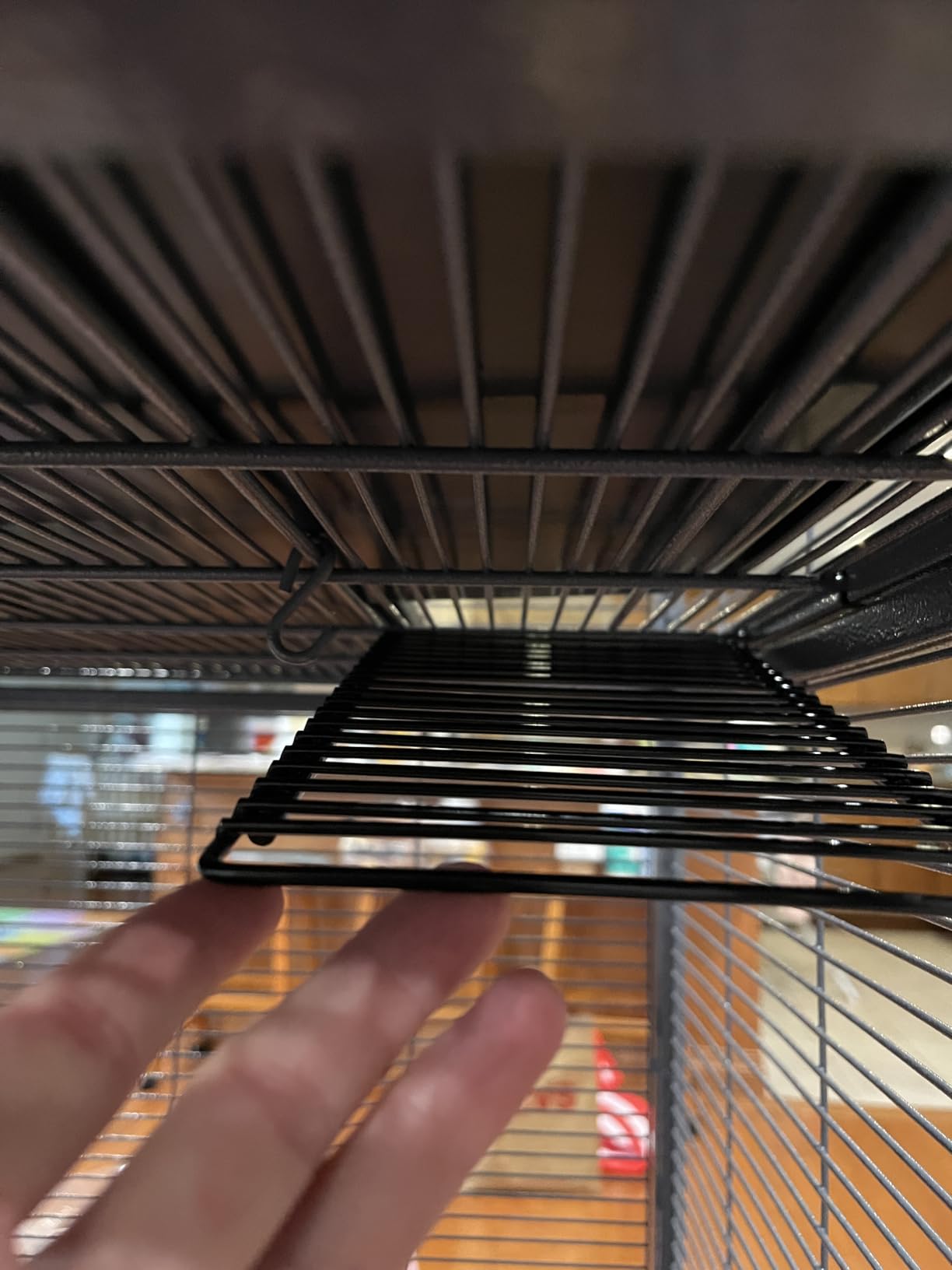
Doors are full width and swing open rather than sliding, so when you put the cage on its back for a deep clean nothing blocks your access. The swing-up locking ramp between levels is a small feature that becomes important in practice, because it lets you separate two animals while you clean one side. Ramps come with covers, which is a nice touch since bare wire is a sore-foot problem over time.
The swing-up ramp also does double duty as a split-screen during a cleaning session or a vet appointment. That is not an advertised use, but owners mention it constantly and it is the reason two animals can share this cage without a daily fight over access. The bottom storage shelf takes hay, bedding and dust bath tubs, which keeps the floor of the room clear.
Is the Critter Nation Worth the Money?
The case for it rests on the 6189 reviews behind a 4.6 rating. What you are paying for is bar spacing, height and a footprint that clears the 3 by 2 by 3 feet single-chinchilla minimum without stretching it. Several cages on this list match the height, and none of them match the bar tightness.
MidWest Homes for Pets makes this cage, and the Nation line has been in production since 2008, which tells you something about how well the design holds up. If you want a Ferret Nation, the MidWest Ferret Nation is the same family; our cage format comparison shows why bar orientation matters before you commit.
Where This Cage Falls Short
Assembly is the honest drawback. Most owners describe one to two hours, two people, and a rubber mallet, and the corner joints on some units arrive misaligned or bent. It is not a bad build, it is just a large build, and 44 pounds of wire is a serious object to put together in a small room.
The other limitation is manoeuvrability. On casters it moves fine when empty, but the frame is awkward once a chinchilla is on the top level, and the wheels can bind. If you are furnishing a corner of a studio apartment, measure the door of the room first, because this cage does not turn corners easily.
2. Yaheetech 52-Inch 6-Level Ferret Cage – Best Value Chinchilla Enclosure
Yaheetech 52-inch Ferret Cage 6 Level Metal Rat Cage with 3 Front Doors/Feeder/Wheels Small Animal Cage for Ferret/Chinchilla/Bunny/Rabbit/Squirrel, Black
25 x 17 x 52 inches
28.2 pounds
6 tiers, 3 latched doors
4 x 360 degree casters
Pros
- Six tiers in a 52 inch frame
- Slide-out litter tray with metal grate
- Three separate latched front doors
- Powder-coated steel resists water and wear
Cons
- Narrow 25 x 17 inch footprint limits roaming
- Casters can roll unevenly under full load
- Suits medium small animals better than the largest rodents
Six tiers in a 52-inch frame is an unusual amount of climbing for a cage at this level of build quality, and it is why this one converts owners who assumed a chinchilla cage had to be a single tall box. Dimensions are 25 x 17 x 52 inches at 28.2 pounds, and the whole structure is powder-coated steel with corrugated anti-slip ramps.
Three latched front doors instead of one is a genuine design win for daily care. You can reach a chinchilla on the top tier without trying to thread a hand past a ladder, and you can clean one level without stressing the animal. That matters for nervous chins, which are the majority of newly adopted ones.
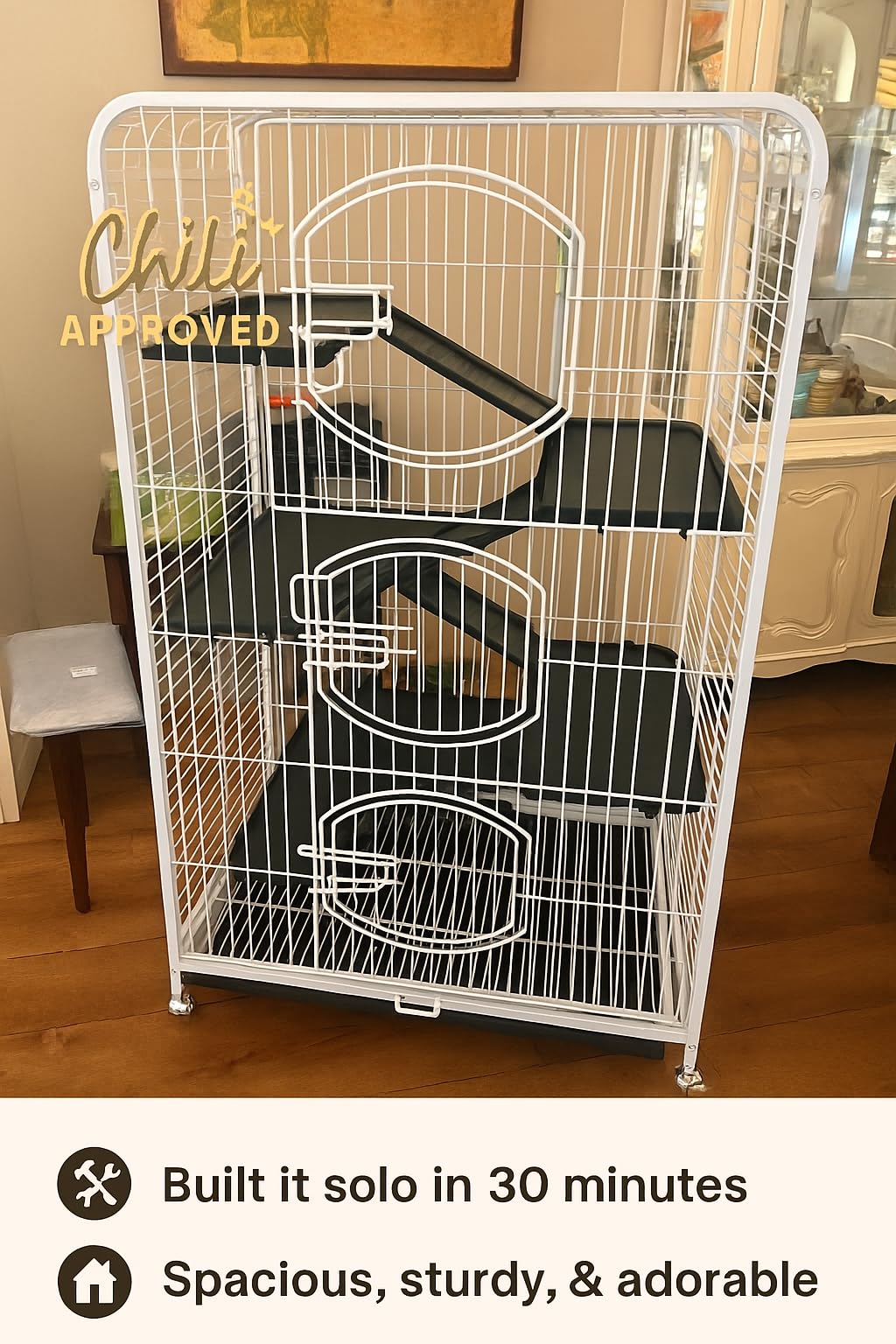
The litter tray is slide-out and sits under a metal grate, which separates the animal from waste and makes spot cleaning almost instant. A metal grate also gives better footing than a bare plastic floor, though for a chinchilla you still want to add a wooden ledge or a fleece-covered platform at the levels your animal uses most.
Four 360-degree industrial casters are the equal of what you find on much more expensive cages, and they roll in any direction, which makes it easy to follow a patch of cool morning light around a room. That is a small daily quality of life thing that turns out to matter a lot in an apartment.
Is This Cage Big Enough for a Chinchilla?
For one adult chinchilla, yes, and the 52 inches of height does most of the work. The 25 x 17 inch floor is well under the 3 by 2 foot footprint that VCA Animal Hospitals sets as a minimum, so this is a tall-and-narrow answer rather than a wide one. That is an accepted compromise when vertical space is genuinely tall.
For a bonded pair, I would pair it with a second identical unit and connect the two, or step up to a wider cage on this list. The tray grate and the door layout both make that expansion realistic, which is rare at this tier.
What Could Go Wrong
The narrow footprint is the real constraint. A chinchilla that wants to sprint a straight line will not get the chance, and the 17-inch depth is under the 25-inch baseline many owners start from. Casters also roll unevenly once the cage is fully loaded, which can tip a little at the front.
The build is solidly steel, but the joints are where budget cages give themselves away, and a tall narrow frame puts more load on each of them. Check the corners on arrival, and make sure every door latch clicks fully shut before you leave the animal inside overnight.
3. PawHut 6-Level Small Animal Cage – Best Chinchilla Cage for Pairs
PawHut 6-Level Small Animal Cage Rabbit Hutch with Wheels, Removable Tray, Platform and Ramp for Bunny, Chinchillas, Ferret, Black
32 x 20.75 x 62.75 inches
35.2 pounds
6 levels
0.95 inch bar spacing
Pros
- Genuine 32 inch wide floor suits a bonded pair
- 62.75 inches of height across six levels
- Four wheels with two brakes hold position
- Removable tray cleans in seconds
Cons
- 0.95 inch bar spacing is wide for a chinchilla
- Metal and PP plastic parts need covering and reinforcement
- Assembly required before first use
A 32 x 20.75 inch floor is the first number that makes me take this cage seriously for two animals, and paired with 62.75 inches of height it comes closer to the 3 by 2 foot footprint than the tall-narrow options. The review summary on this listing calls out exactly that balance, and chinchilla owners rate it highly for it.
Two large openings give access from the front without a maze of ladders. On a six-level cage, a single small door would be an ergonomic disaster, so this layout saves you reaching through the whole structure every time you refill a hay rack or take out a droppings tray.
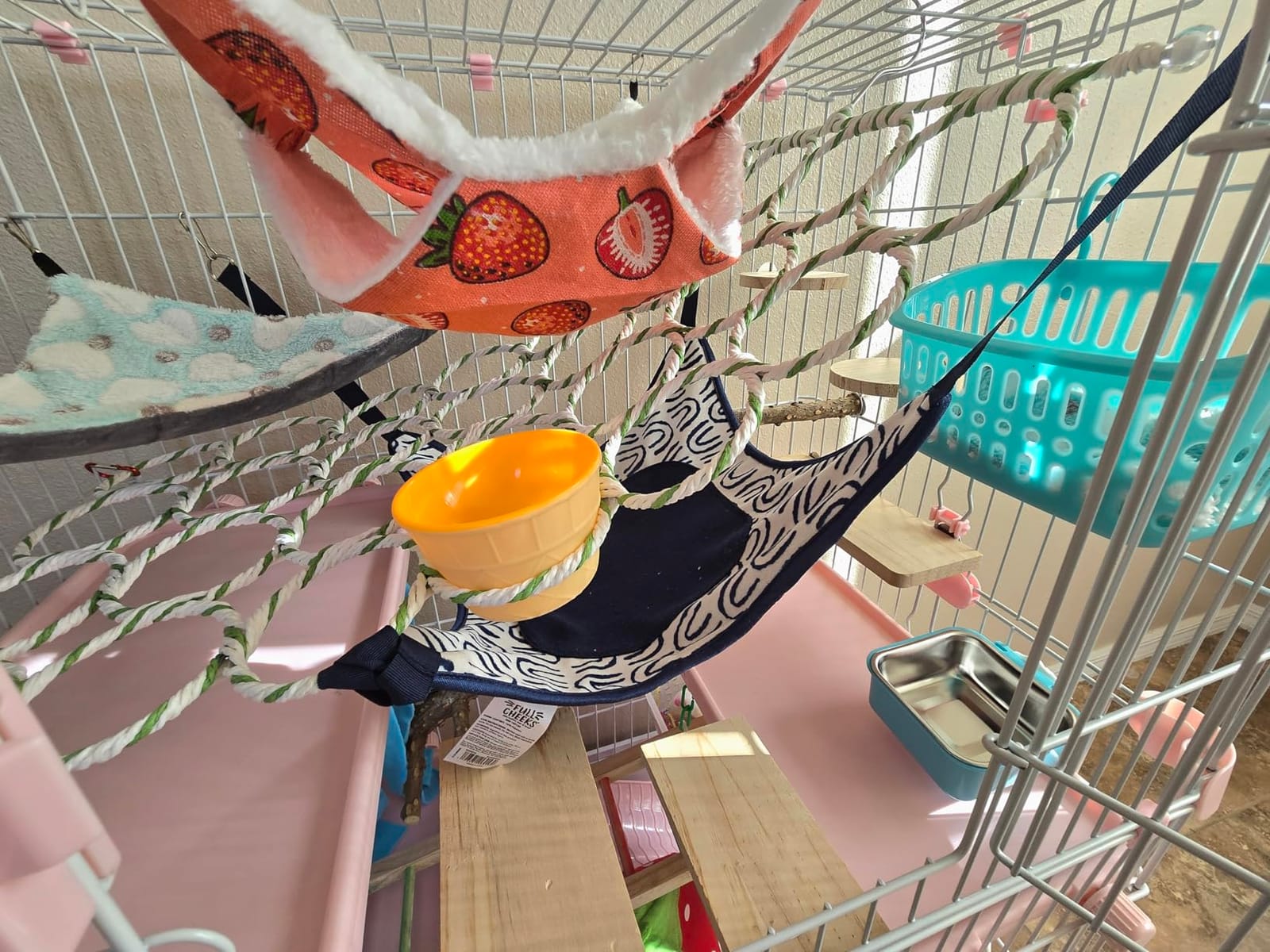
The removable tray on the bottom level pulls straight out for cleaning, and four universal wheels with two brakes mean you can reposition the cage to chase or avoid a draft without it rolling away mid-clean. Brakes matter more than they sound, because a chinchilla pushing against a door will move a cage that has no brakes.
The platform and ramp are included, so a new cage is usable on day one. My one reservation is the finish on the ramp and platform edges, which is where a determined chewer starts working, so cover those in fleece or wood within the first few weeks.
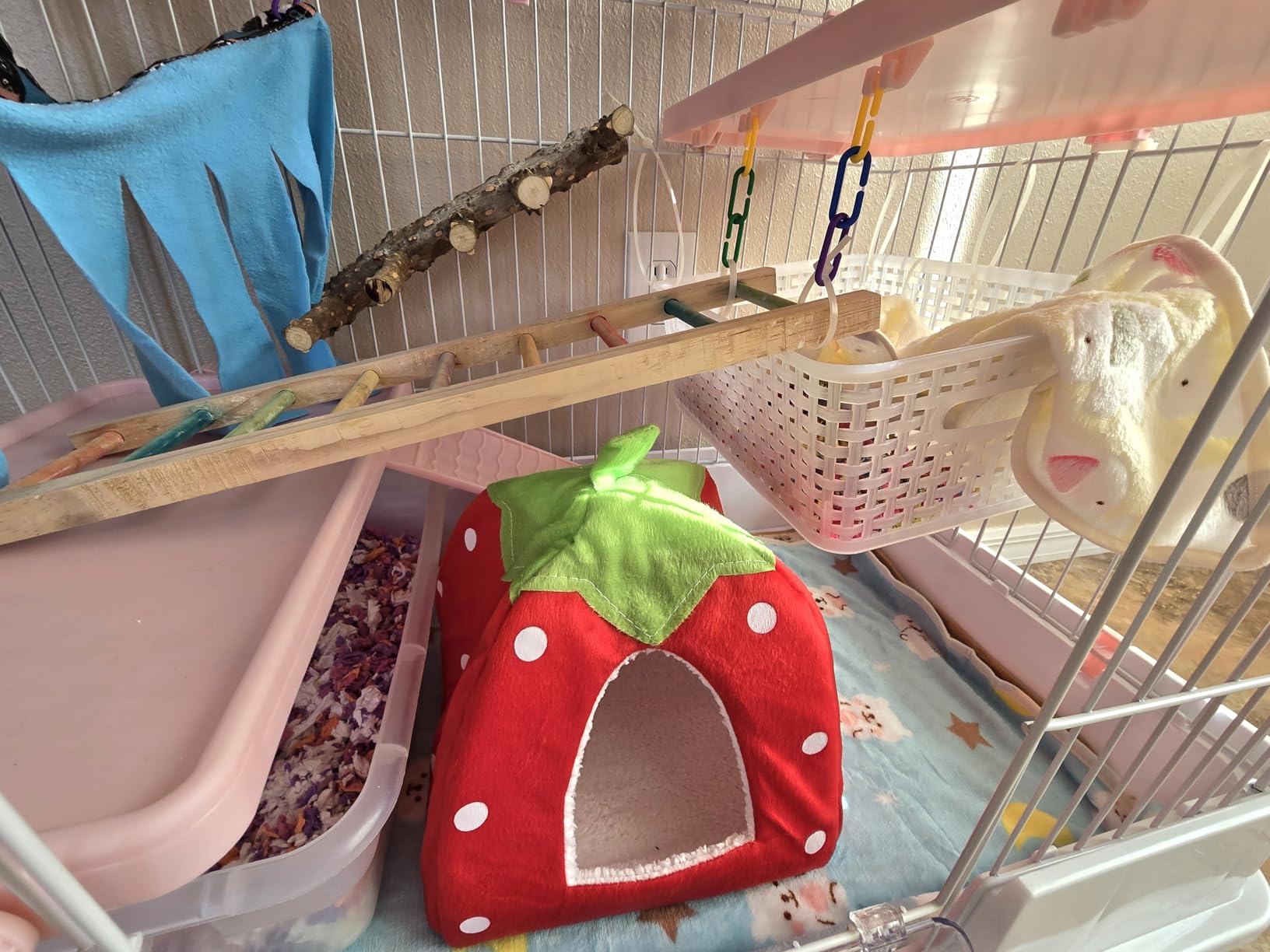
Best Setup for a Bonded Pair?
Two of these side by side, connected with clips, gives you a 64-inch combined width, which is the arrangement most owners of bonded pairs describe. Run two trays, two water bottles, two hay racks and two hiding options, and separate the animals for feeding if you see guarding behaviour around the tray.
The single unit is also the better answer for a pair if you want them supervised together in one footprint rather than clipped together. Just make sure the vertical space is filled with wooden ledges so neither animal can monopolise the top tier.
Is 0.95 Inch Bar Spacing Safe?
It is under the 1 inch ceiling, and for an adult chinchilla it is workable, but it is not the tightest spec in this roundup and it is the reason I do not rank it first. It is too wide for rats or hamsters, and for a baby chinchilla I would wait until the animal is over six months old before trusting those gaps.
The wire frame is metal and sturdy, but the cage also uses PP plastic components. That is a chew target, and a chinchilla that works a plastic clip off will not stop at the clip. Budget for replacement ledges from day one.
4. Yaheetech 69-Inch Wrought Iron Cage – Best for High Ceilings
Yaheetech 69-Inch Extra Large Wrought Iron 3 Levels Ferret Chinchilla Sugar Glider Squirrel Small Animal Cage with Cross Shelves and Ladders, Black
30.3 x 18 x 69 inches
47.8 pounds
3 levels, 3/8 inch bars
Wrought iron frame
Pros
- 69 inches of height is the tallest here
- 3/8 inch bar spacing is among the tightest
- Detachable rolling stand with storage shelf
- Ten small doors plus two large front doors
Cons
- Wire floors and metal ladders need covering first
- Cage can feel unstable on the rolling stand
- Bar floors give little grip for small paws
At 69 inches tall and 30.3 by 18 inches across, this is the tallest enclosure in the roundup and the one that most directly answers owners who ask whether a chinchilla cage can be too tall. The 47.8-pound wrought iron frame is heavy, and the height is the reason it ships with a detachable rolling stand rather than integrated casters.
The bar spacing is 3/8 inch, the tightest of any cage here, which makes it the safest option for a young or small animal. Ten small access doors plus two large front doors is a lot of reach for a three-level structure, and for grabbing a ledge at the back that turns into a real convenience.
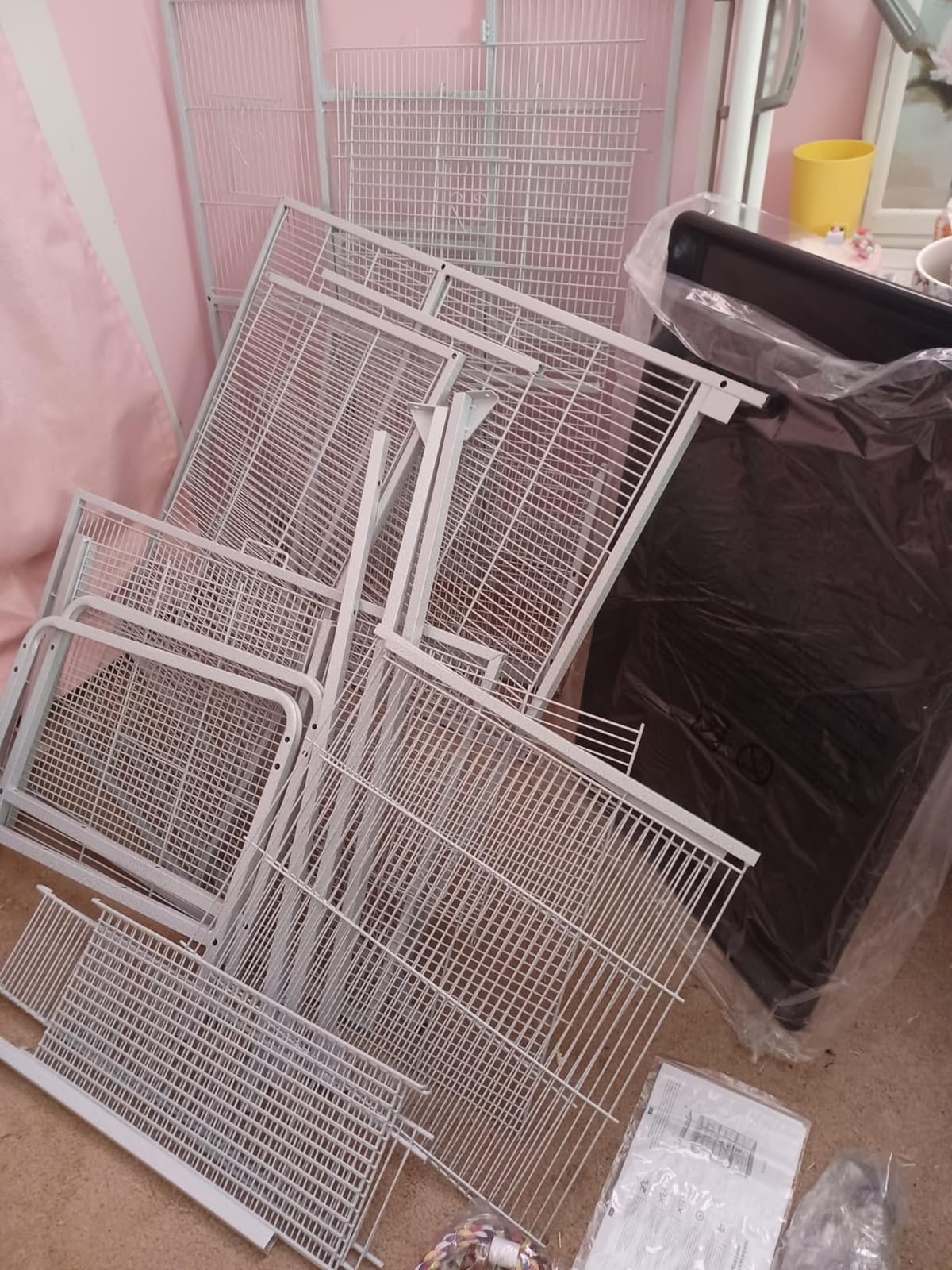
Wooden perches, climbing rope and food cups are all included, which saves you the first round of accessory shopping. Cross shelves and ladders are removable, so you can convert the middle level into a wide platform or a covered bridge once you have seen where your animal actually spends time.
The stand detaches entirely, and the casters are lockable. That combination solves the two complaints owners raise most, since you can build and fill the cage in one spot, wheel it into place, then lock it and take the stand out of the way if you need floor access.
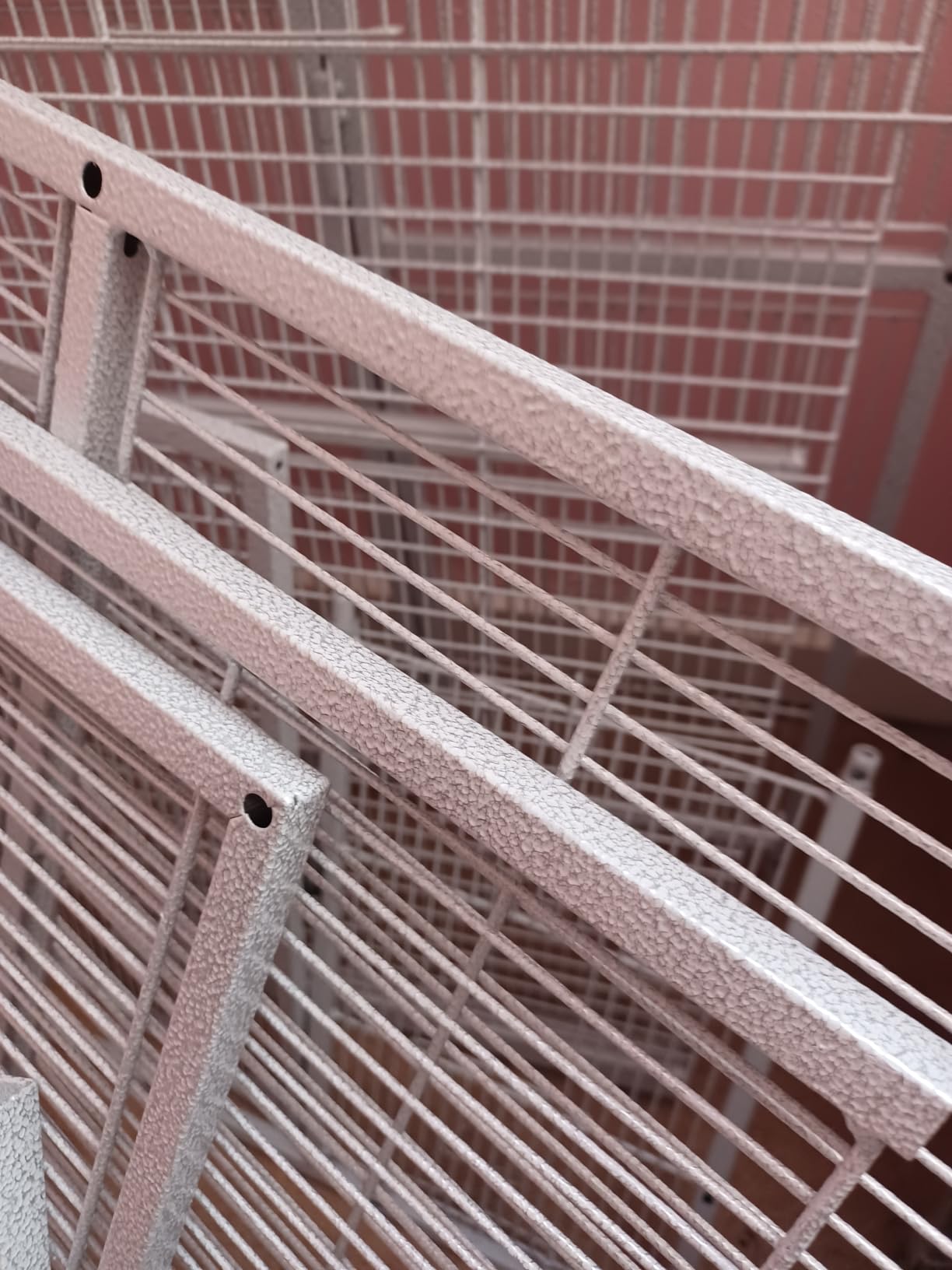
Do Chinchillas Need This Much Height?
You do not need 69 inches, and I would not tell a first-time owner to chase it. What this cage proves is that height alone does not make a chinchilla unhappy. What actually makes a chinchilla happy is horizontal floor space and a level of vertical space you can fill with ledges, and this cage has plenty of the second and not much of the first.
It is the right pick if you have the ceiling height and a narrow wall to fill, particularly in a flat or a loft where a wide cage is impossible. It is also the safest of the twelve for a chinchilla under six months, because a 3/8 inch gap leaves nothing for a small animal to wedge through.
Which Accessories Are Non-Negotiable?
Fleece or wooden covers on the metal ladders and the wire platforms, and that is the short list. Bare metal is the most repeated caution in owner reviews for this cage, because a chinchilla that lands on wire develops sore hocks, and a baby chinchilla on wire can hurt a leg.
Small side doors also need clasps or ties, because a determined chinchilla can work a simple latch. And because the cage is not firmly bolted to the stand, check the connection whenever you roll it. Ignore both and the cage can tip with an animal on the top level.
5. Polar Aurora 59-Inch Metal Cage – Best Enrichment Layout
Polar Aurora Metal Small Animal Cage, 59″ H Ferret Cage with Lockable Wheels, Deluxe Chinchilla Cages with Hammock and Removable Tray, 6 Tiers Animal Cages for Pets
31.4 x 20.4 x 58.6 inches
6 tiers, 5 platforms
Top hanging hammock
4 wheels, 2 with brakes
Pros
- Five platforms at different heights plus a hammock
- Flannel-lined ramps give real grip
- Detachable deep waste tray speeds up cleaning
- Hammer-pattern finish resists rust and wear
Cons
- 0.98 inch vertical wire spacing is wide
- Rules out hamsters
- mice and any small species
- Horizontal bar spacing is much wider than the vertical measure
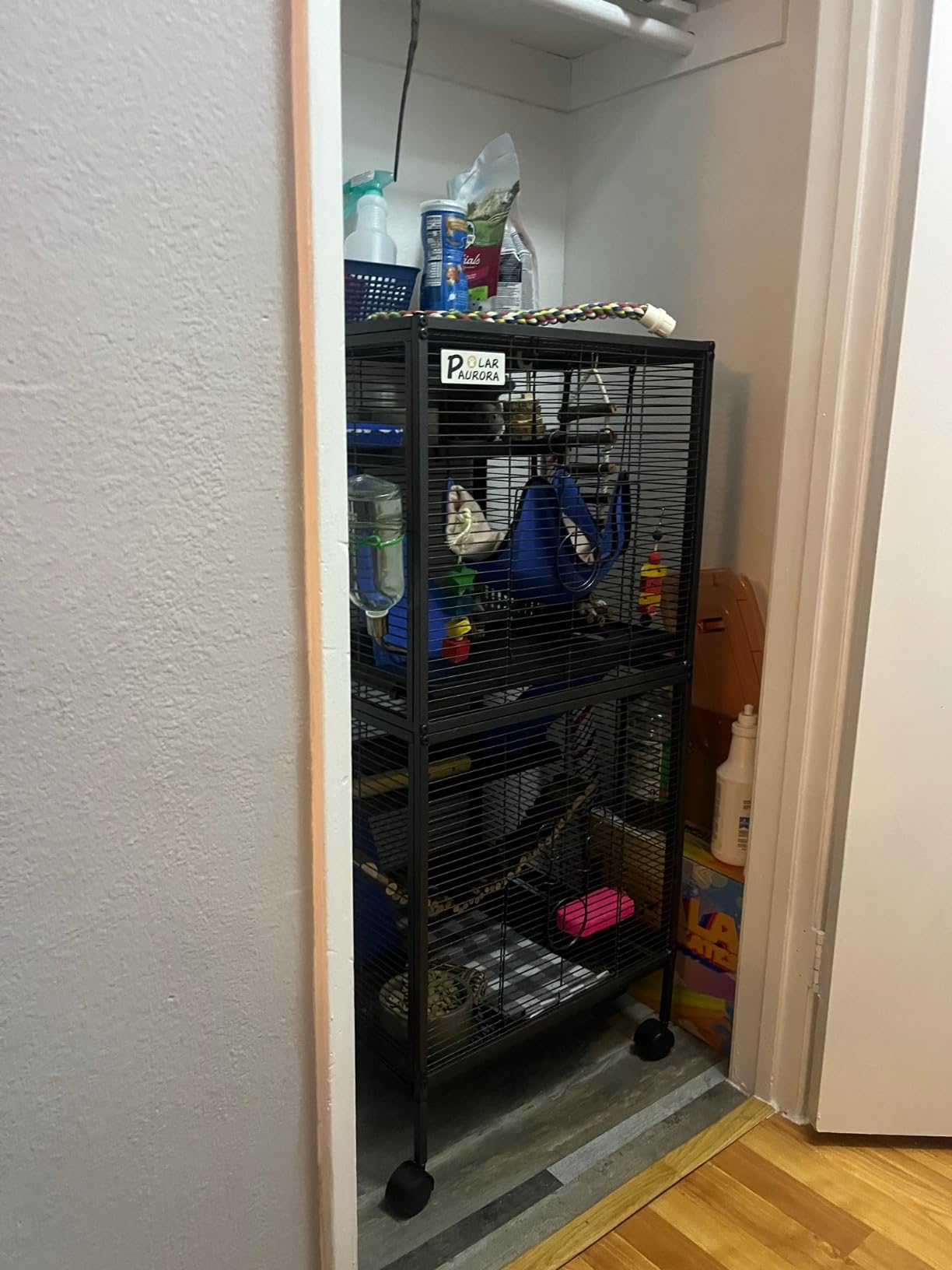
Enrichment is the reason to pick this cage. Six tiers carrying five platforms at different heights, a hanging hammock at the top and flannel-lined ramps between them is more usable climbing structure than most cages in this roundup, and the review summary on the listing picks out the level count and the hammock as the top strengths.
At 31.4 x 20.4 x 58.6 inches the footprint is one of the better ones here, and 58.6 inches of height gives a chinchilla room to climb without turning the cage into a tower. The 13mm square pipe frame has a 0.8mm wall thickness and a hammer-pattern painted finish, both of which show up in reviews as holding up well over time.
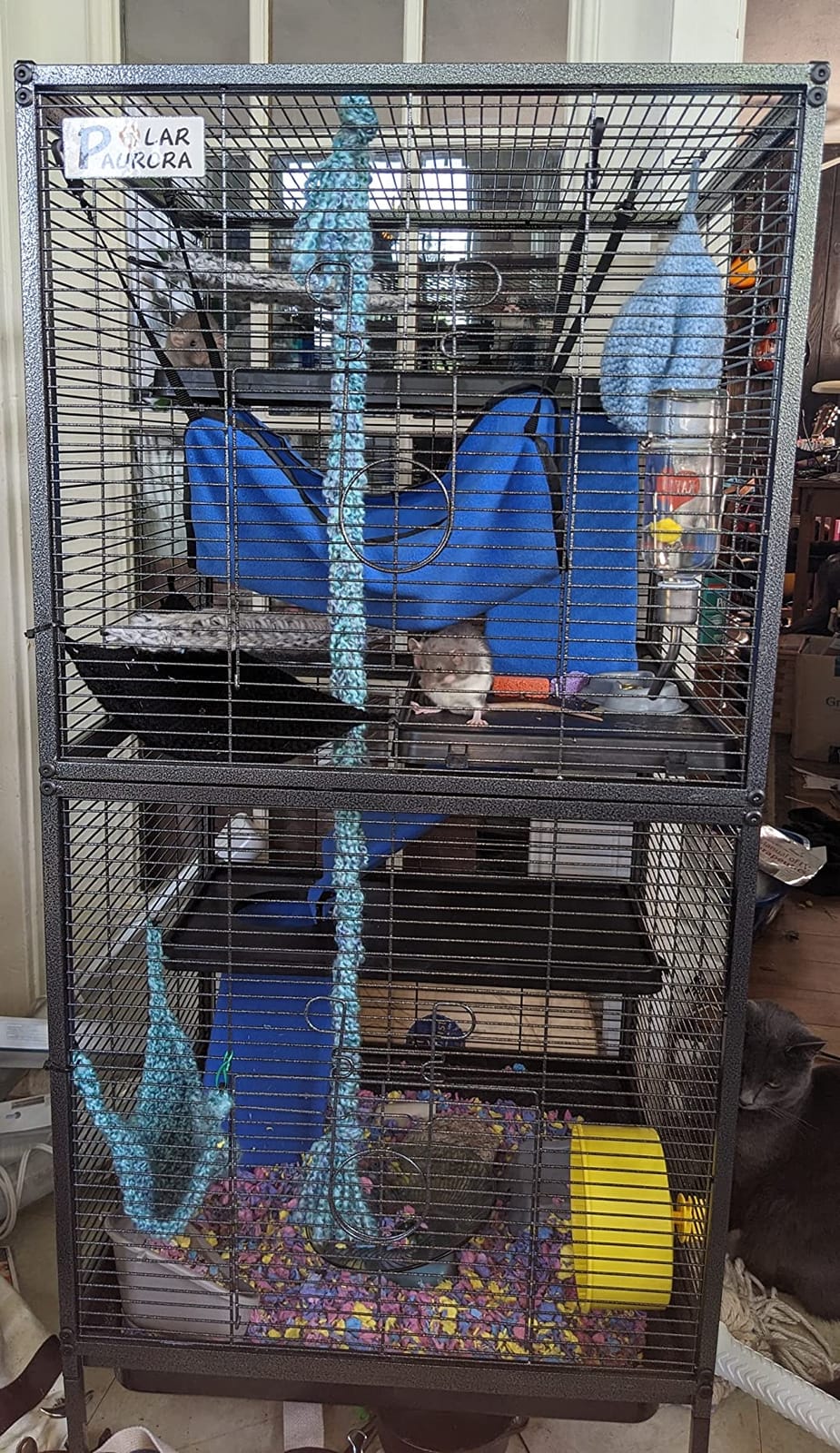
The detachable deep waste tray pulls out from the base for cleaning, and the depth means a chinchilla can go a week between full tray changes in a cool room. Multiple front doors mean you can feed without opening the whole front, which is useful during the first few weeks while your animal is still nervous.
Four universal wheels with two brakes keep the cage steady. This is a tall structure with a deep base, and an unlocked cage with an active animal in it is not a cage any more, it is a rocking chair.
How Should the Platforms Be Arranged?
Stagger them so there is no straight vertical drop from one level to the next, and put the hammock somewhere in the middle rather than at the very top. A chinchilla that falls onto a bare ramp or an empty gap lands wrong, and staggering turns most falls into short hops.
Keep level spacing under 18 inches even here, where the frame invites wider gaps. Add a wooden hide or a bridge between the two levels your animal uses most, and rotate a fleece cover between them so there is always a grippy surface.
Is the Bar Spacing a Problem?
It is the reason this cage sits in the middle of the ranking rather than the top. Vertical wire spacing is listed at 0.98 inch, which sits right under the safety ceiling for an adult chinchilla and over it for anything smaller, and the horizontal spacing is much wider again.
So this is an adult-only cage. It also carries the standing caveat that the wire geometry rules out hamsters and mice entirely, which is fine if you are certain about the species in the room. I would not use it for a chinchilla under six months.
6. HABUTWAY 50-Inch Rolling Cage – Best Mid-Height Setup
HABUTWAY 50”H Metal Small Animal Cages, Rolling Chinchilla Cage with Removable Ramps, Lagre Cage for Chinchillas/Guinea Pigs/Rabbit, Ferret Cages with Hammock & 5 Tiers, Black
31.5 x 20.5 x 50.4 inches
35.7 pounds
5 platforms, hammock
0.9 inch wire spacing
Pros
- Five platforms plus a top hammock at a reachable height
- Flannel-lined ramps give solid grip
- Waterproof pull-out tray wipes clean in seconds
- Front and side doors for full access
Cons
- Thin bottom tray flexes under weight
- Wheel legs use plastic inserts that can crack
- Assembly instructions are confusing and largely absent
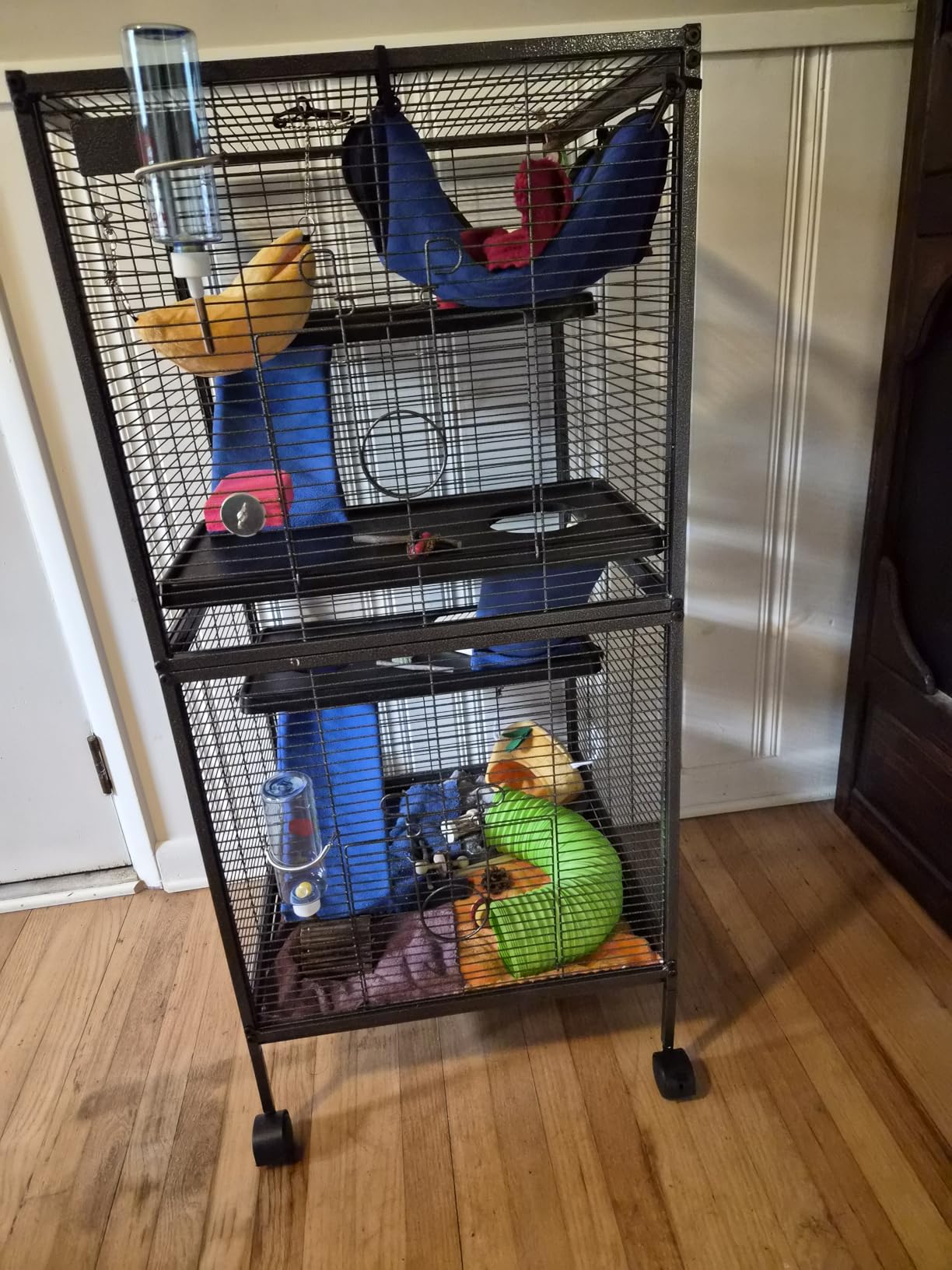
Fifty inches is a deliberate middle ground, and it is the height I would pick for a ceiling that will not take 60-plus inches. At 31.5 x 20.5 x 50.4 inches the footprint is wider than most in this roundup while staying in mid-range on height, which is the combination a moderate ceiling actually needs.
Five platforms at varying heights, a top hanging hammock and flannel-lined ramps give a chinchilla plenty to do without a six-tier vertical climb every day. The 0.9 inch wire spacing is under the safety ceiling, and the review summary on this listing praises the platform layout and the cleaning access most consistently.
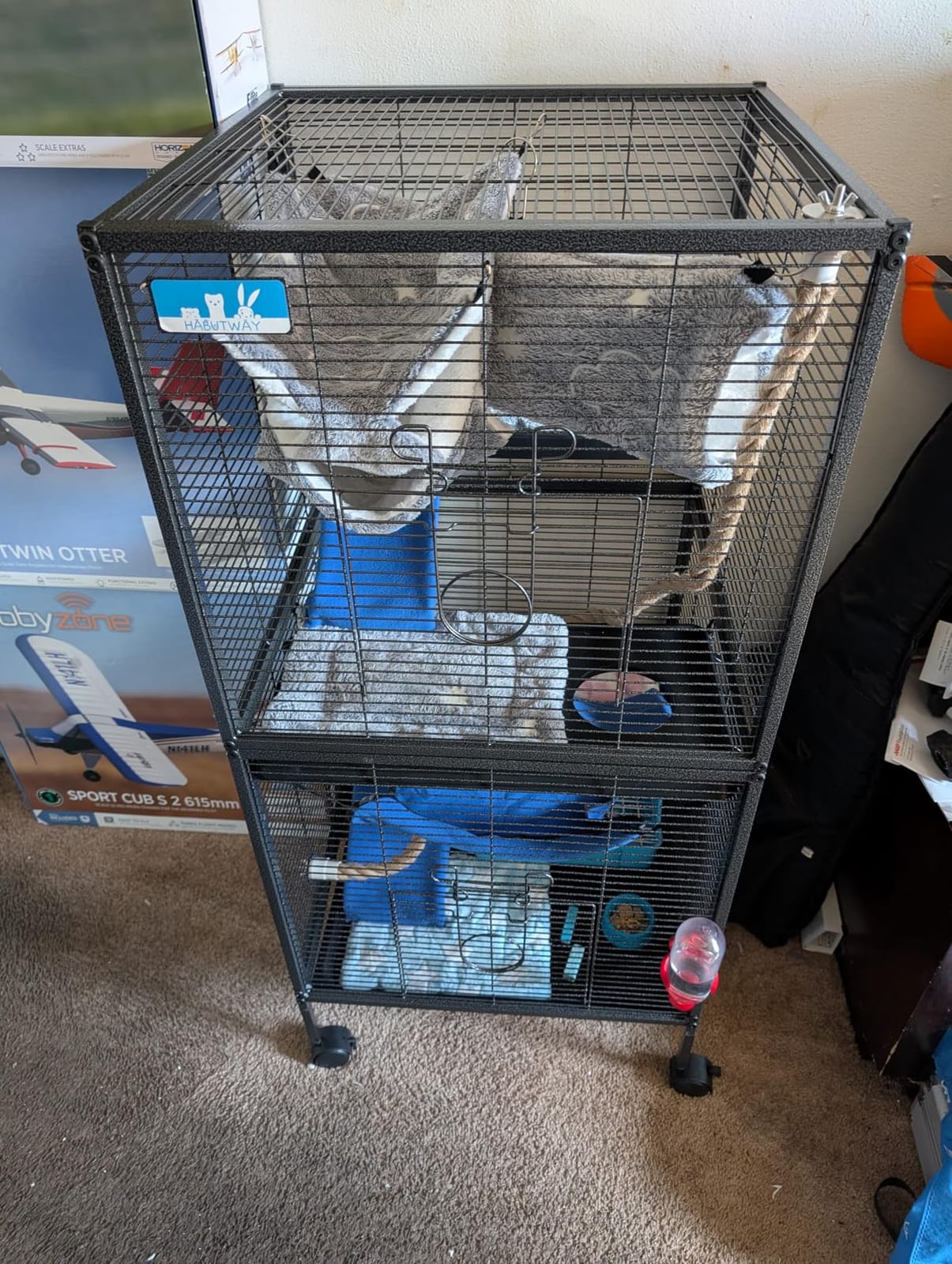
The waterproof pull-out bottom tray is the feature I would highlight. Wipe it, do not scrub it, and it is done in under a minute, which is the difference between a ten-minute daily routine and a chore you start avoiding. Front and side doors mean you can arrange the whole interior without contorting around the frame.
That cleaning advantage is real, but it is undermined by build quality at a few points. The bottom tray is thin and flexes when you slide it, and the wheel legs use plastic inserts that crack under load if you move the cage with an animal inside. Move it empty, always.
Is This the Right Height for a Low Room?
If your ceiling is under eight feet, 50 inches is the number that works without making a dent in the room. You still get five usable levels, which is what a chinchilla actually uses, and the 31.5 inch width gives the floor space that tall-narrow cages lack.
Do not underestimate the assembly. The instructions are described as confusing and largely absent, and this is a 35.7-pound frame that needs two people and a clear floor. Read the manual on your phone before the box is open, not after the panels are on the floor.
What Would I Change Before Buying?
The tray and the wheel legs, and neither is fixable without tools. If you can reinforce the tray with a thin liner and keep an eye on the plastic wheel inserts, this is a capable cage. If you are not going to do both, choose a different cage on this list.
Also note the 0.9 inch spacing is at the wide end of what I would accept, and the wire mesh size makes clip-on accessories awkward. Plan to add wooden ledges and shelves as separate purchases rather than assuming cage clips will hold.
7. PawHut 4-Tier 44.75-Inch Cage – Best for Small Apartments
PawHut Metal Small Animal Cage, 4-Tiers Rolling Big Ferret Cage, Gray
20.5 x 20.5 x 44.75 inches
26.4 pounds
4 tiers with hammock
Pull-out bottom tray
Pros
- Compact square footprint suits a small room
- Four tiers plus a hammock give vertical enrichment
- Light enough for one person to reposition
- Wheels let you move the cage with the sun
Cons
- Bar spacing is not specified by the manufacturer
- Only two doors means reaching across to clean
- Lightweight frame shifts when a pet pushes on it
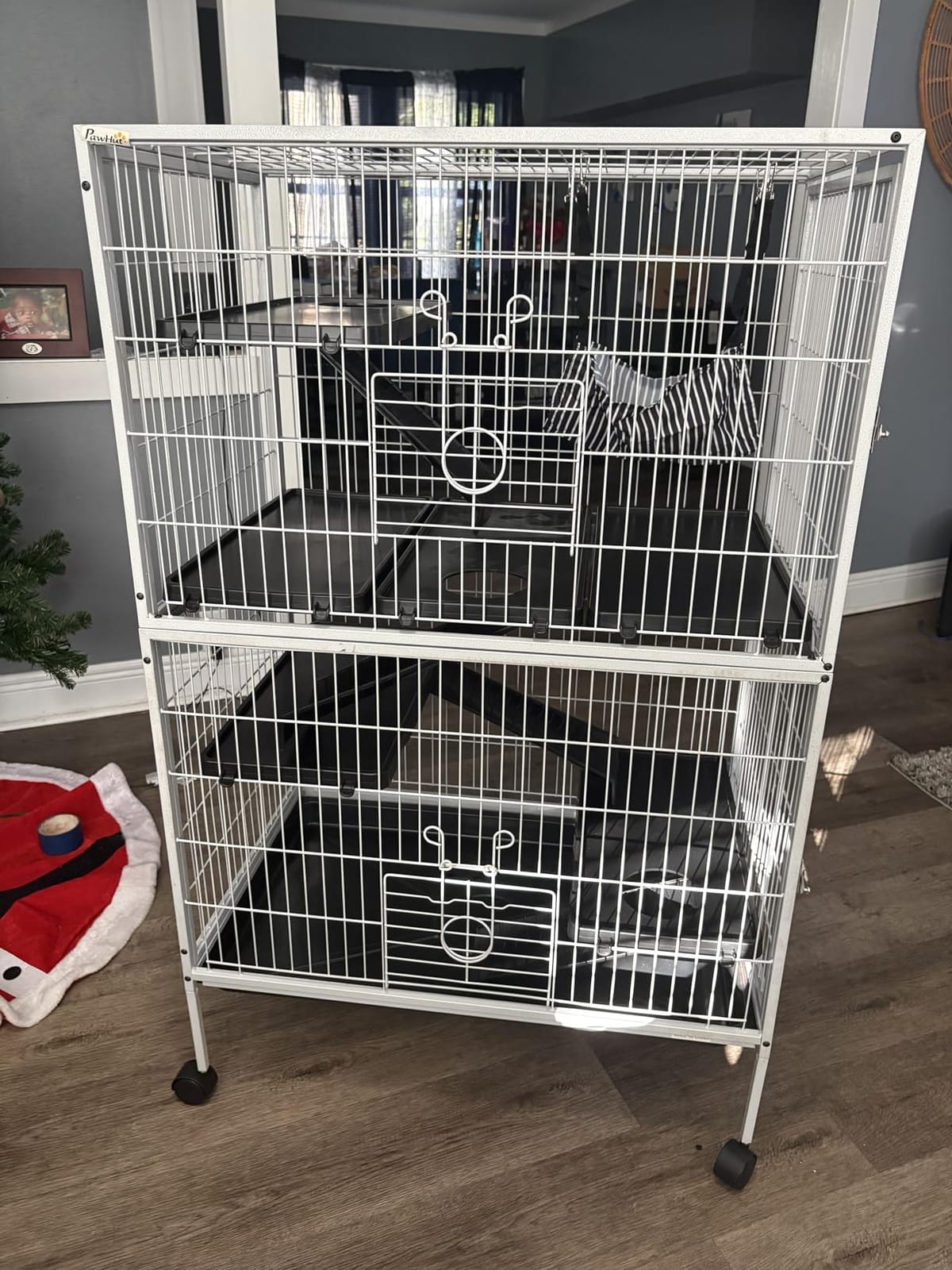
Twenty inches square is the tightest footprint here and that is exactly why it is on this list. In a one-bedroom flat where a 32-inch-wide cage means moving furniture, a 20.5 x 20.5 x 44.75 inch footprint buys back an entire wall, and 44.75 inches is still enough height for four usable tiers.
The review summary on this listing names the small footprint, the tiered layout and easy mobility as the consistent strengths, and the criticism centres on cleaning access and unlisted bar spacing. That is an accurate read. Two doors on a four-tier cage means you reach across the interior to clean the back levels.
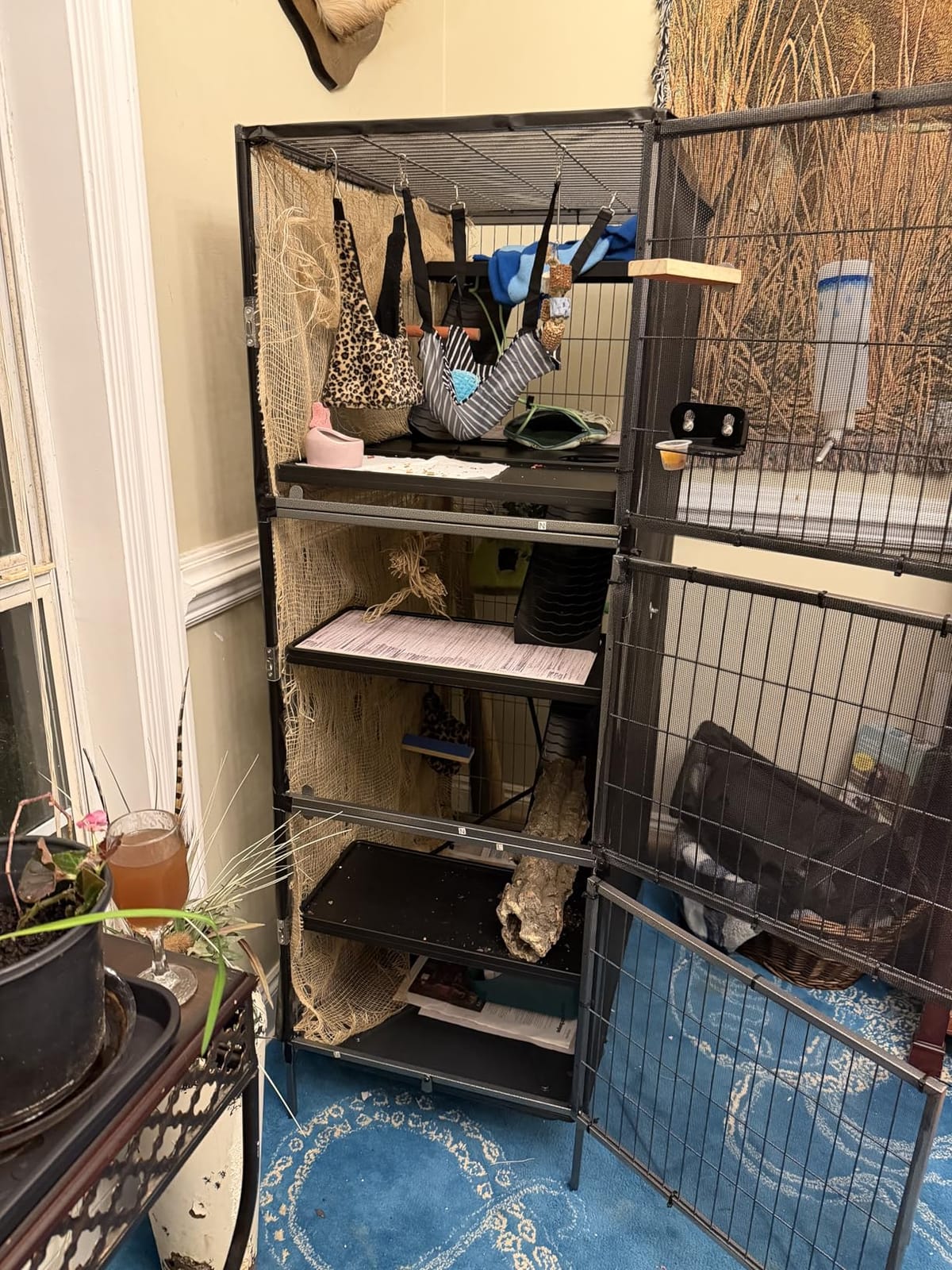
Four smooth-rolling wheels and a 26.4-pound weight mean one person can move this without help. That is not trivial, because most tall cages in this roundup weigh 35 pounds or more, and a cage you can shift to follow a draft is a cage you will actually maintain properly.
The top hammock gives a chinchilla a soft, enclosed-feeling spot to sleep, which matters for an animal that spends daylight hours hiding. The pull-out tray is simple, and the see-through wire makes it easy to check on the animal without opening a door and starting a sprint.
Can a 20-Inch Square Cage Work for One Chinchilla?
For a single adult, yes, provided you accept a floor under the 3 by 2 foot guideline and make up for it with platforms. A 20.5 inch square floor is genuinely small, so this cage needs two or three solid wooden ledges installed at staggered heights to be a fair setup rather than a token one.
I would not use it for a bonded pair. Two chins in this footprint is a stress setup, and the light frame means more noise and more movement when they jostle for a ledge.
Why Does the Unlisted Bar Spacing Matter?
Because you cannot check it. When a manufacturer does not publish bar spacing, you have to assume it is wider than 1 inch, which is the ceiling for an adult chinchilla. Owners on this listing flag exactly that, and the cage is not appropriate for hamsters or rats as a result.
The lightweight frame is the second issue. If a chinchilla leans on the door while you are away, the whole cage shifts. A basic door lock solves this, and if the listing you buy does not show one, add a clip.
8. SUPER DEAL 37.2-Inch 4-Tier Cage – Best Budget Pick
SUPER DEAL 37.2 Inches Metal Ferret Cage Chinchilla 4 Tiers Small Animal Cage with 3 Ladders/ 2 Front Doors/Food Bowl/Water Bottle/Slide Out Trays/Swivel Casters,Black
25.6 x 17.3 x 36.2 inches
24.5 pounds
4 tiers, 3 ladders
Folds flat for storage
Pros
- Folds flat
- which solves the travel and second-home problem
- Food bowl and water bottle included
- Two front doors with a two-finger lock
- Removable grille and slide-out tray
Cons
- Bar spacing of about 1.1 inches is over the safe ceiling
- Wire ramps and platforms give poor grip
- Footprint is small for a chinchilla
This is the one cage in the roundup that folds flat, and that single feature answers the most common question on the first page of results, which is about collapsible enclosures for travel, vet visits and a second home. At 24.5 pounds and 25.6 x 17.3 x 36.2 inches it is a genuinely portable metal cage rather than a fabric playpen.
It also includes a food bowl, a water bottle, three ladders and a storage shelf, which saves a first-time owner a first round of accessory shopping. Two large front doors with a two-finger locking mechanism give a real level of security for a cage this light.
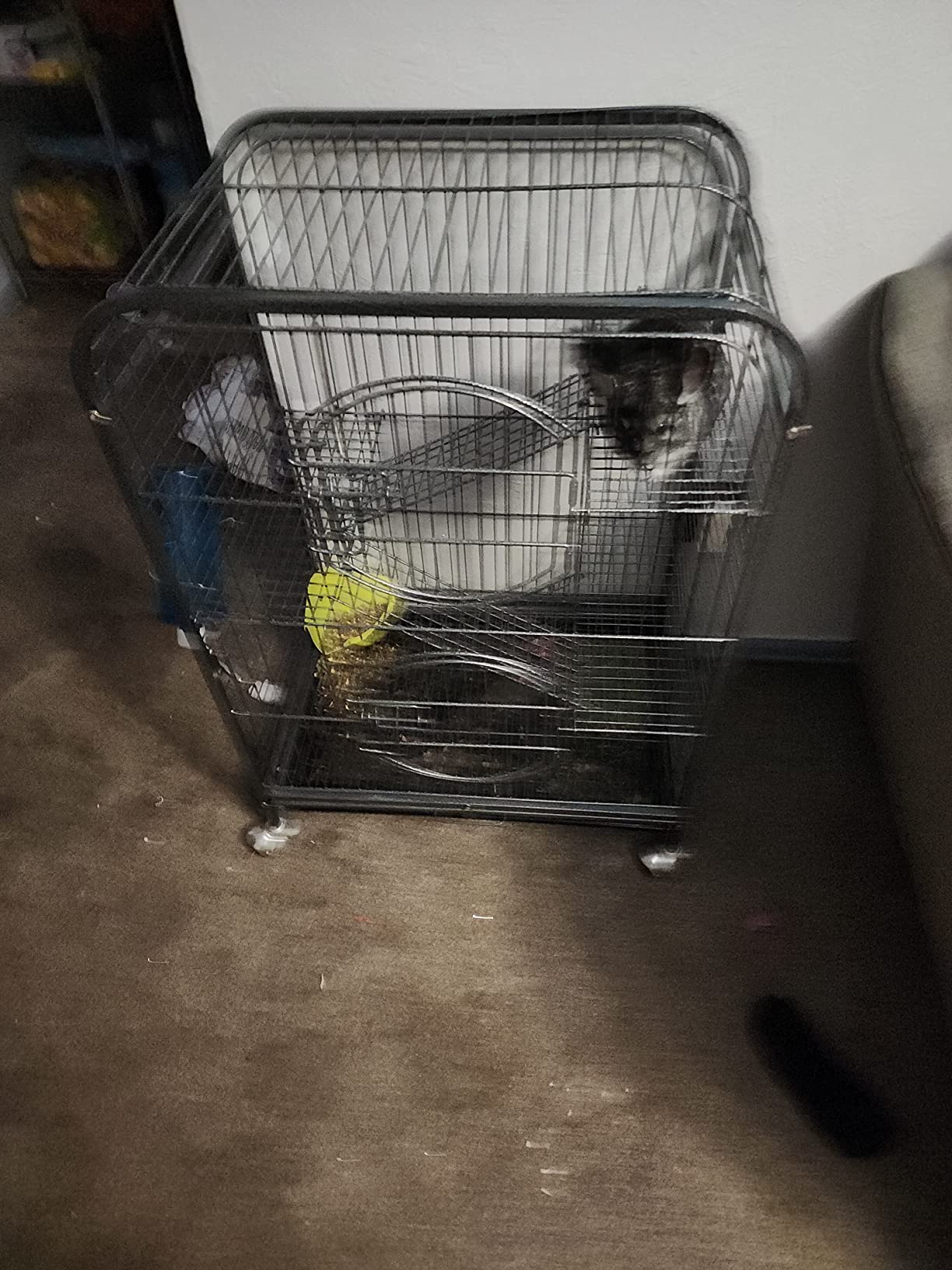
The removable grille and slide-out tray make cleaning straightforward, and the swivel casters let you lock the cage in place once it is positioned. Four tiers at 36 inches is on the short side, and the review summary on this listing is candid that it suits medium small animals rather than tiny rodents.
So the honest framing is this: a good travel and secondary-home cage, and a marginal primary cage. If you can only afford one enclosure, choose one of the tall metal cages above and use this one for the times you are away from home.
Is This Safe as a Main Cage?
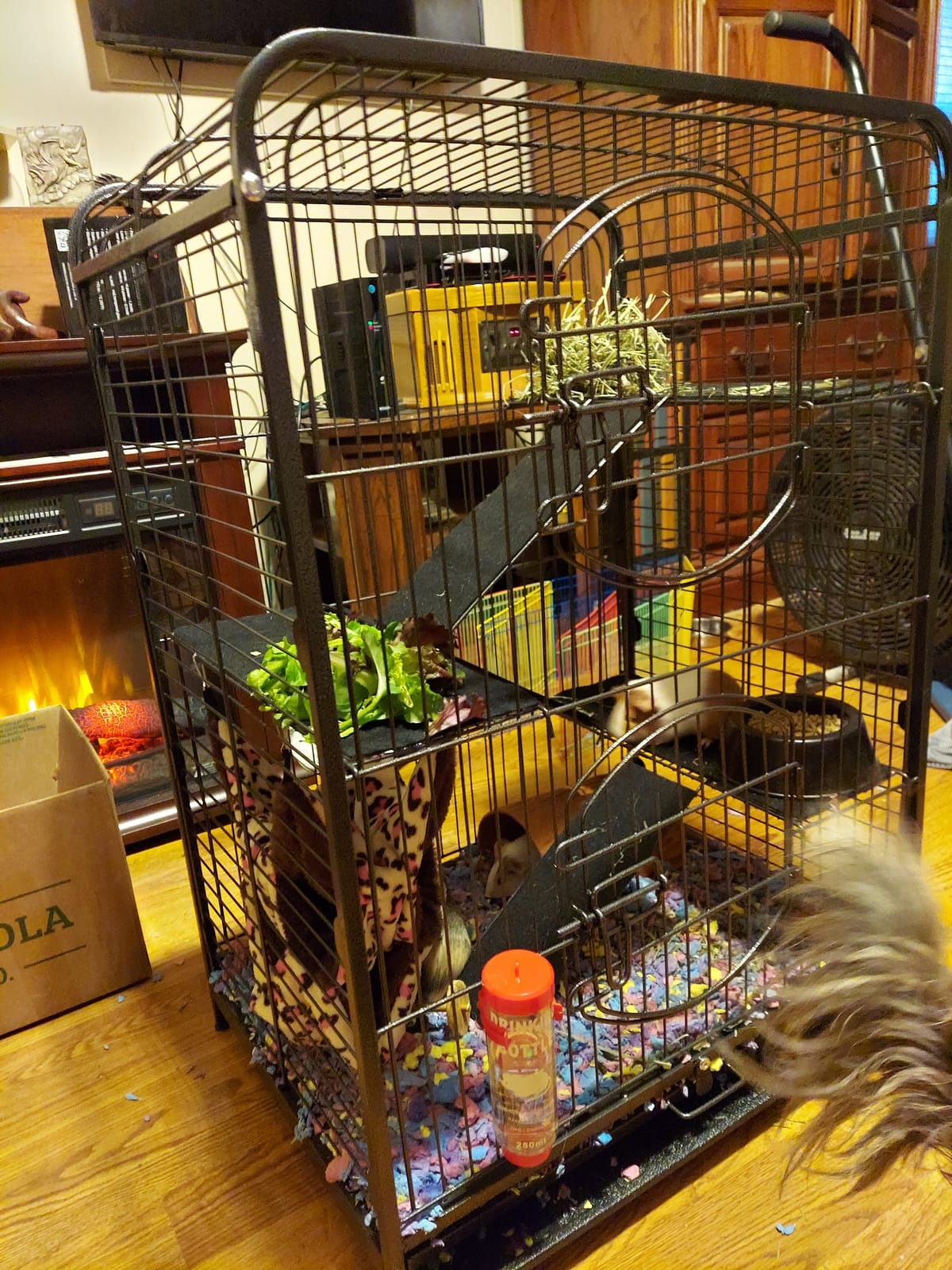
The 1.1 inch bar spacing is the problem, and it is over the 1 inch ceiling that most chinchilla guidance sets. It is not an emergency, but it is a gap a determined chinchilla can work at, and a baby could get a head into it. If you buy this, plan to add clips or a panel along the lower level until the gaps are closed.
Wire ramps and platforms are the other issue. They need fleece or wood covers for a chinchilla, and they need it from day one, not once you see sore hocks. Assume you are buying at least four covers with the cage.
When Is a Folding Cage the Right Answer?
Travel, vet visits, boarding, and a second home where you do not want a permanent 60-inch metal structure. Owners on r/chinchilla ask for collapsible enclosures more than any other enclosure question, and this is the most credible metal answer in the roundup.
Avoid it as the only cage a chinchilla lives in, and avoid it for any animal under six months. For everything else, the fold-flat design and included accessories make it a strong budget pick.
9. Mcage 5-Tier Deluxe Kitten Hutch – Best for Indoor or Outdoor Use
Large 5-Tiers Deluxe in/Outdoor Chinchilla Ferret Squirrel Hedgehog Kitten Rabbit Bunny Hutch House Critter Habitat Mesh Floor Easy Clean 2-Inch Deep Pull Out Tray with Rolling Casters
27 x 18 x 53 inches
5 tiers
2 inch deep pull-out tray
Tool-free assembly
Pros
- Tool-free assembly with pop-in wheels
- 2 inch deep tray with removable urine guard
- Lockable top and front doors
- Rated for indoor or outdoor placement
Cons
- Plastic platforms and ramps are chewy targets
- 0.9 inch wire spacing suits only larger small pets
- Lightweight frame for its 53 inch height
The 2-inch deep pull-out tray is the standout spec here, and at 2 inches it is the deepest tray depth stated anywhere in this roundup. Deep trays mean bedding stays inside the cage, urine stays away from your floor, and a busy week does not turn into a scrubbing job. The removable urine guard lifts out for cleaning rather than being a fixed ridge you work around.
Tool-free assembly with clipped-on connectors means no screwdriver, no lost hardware, and a build time measured in minutes. The review summary on this listing names the easy setup and the deep tray as the wins, with chewy plastic parts and wide bar spacing as the recurring complaints.
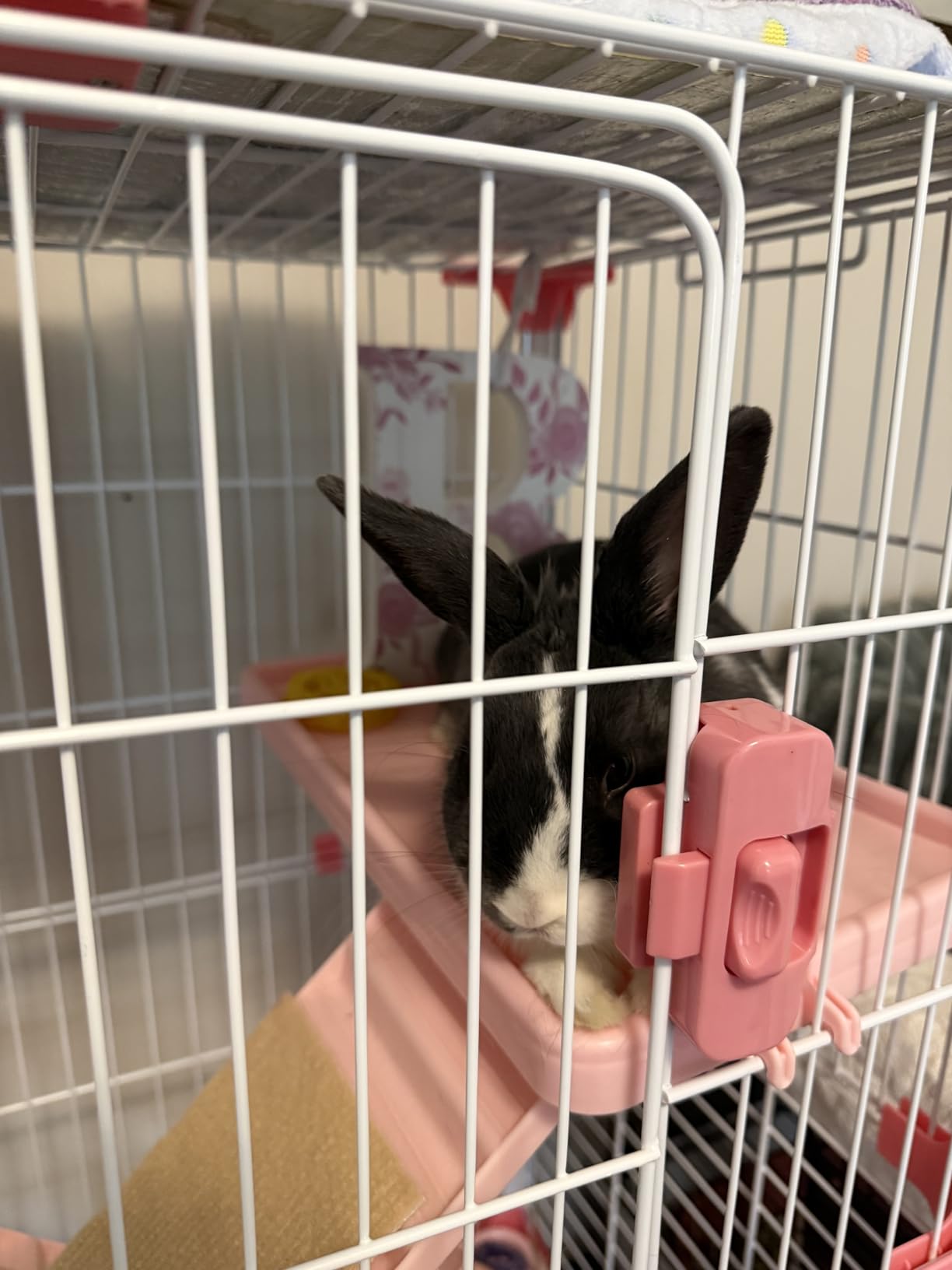
Lockable top and front doors plus corner safety protectors are thoughtful details at this level. The top lock matters because a chinchilla is a climber, and a cage with a latch on the front only is a cage with a plan for escape. Four universal wheels with brakes keep a 53-inch structure planted.
At 27 x 18 x 53 inches the footprint is 27 inches wide, which is under the 3 foot minimum but close enough that a single chinchilla will be comfortable. Add ledges to extend the floor area and the problem largely disappears.
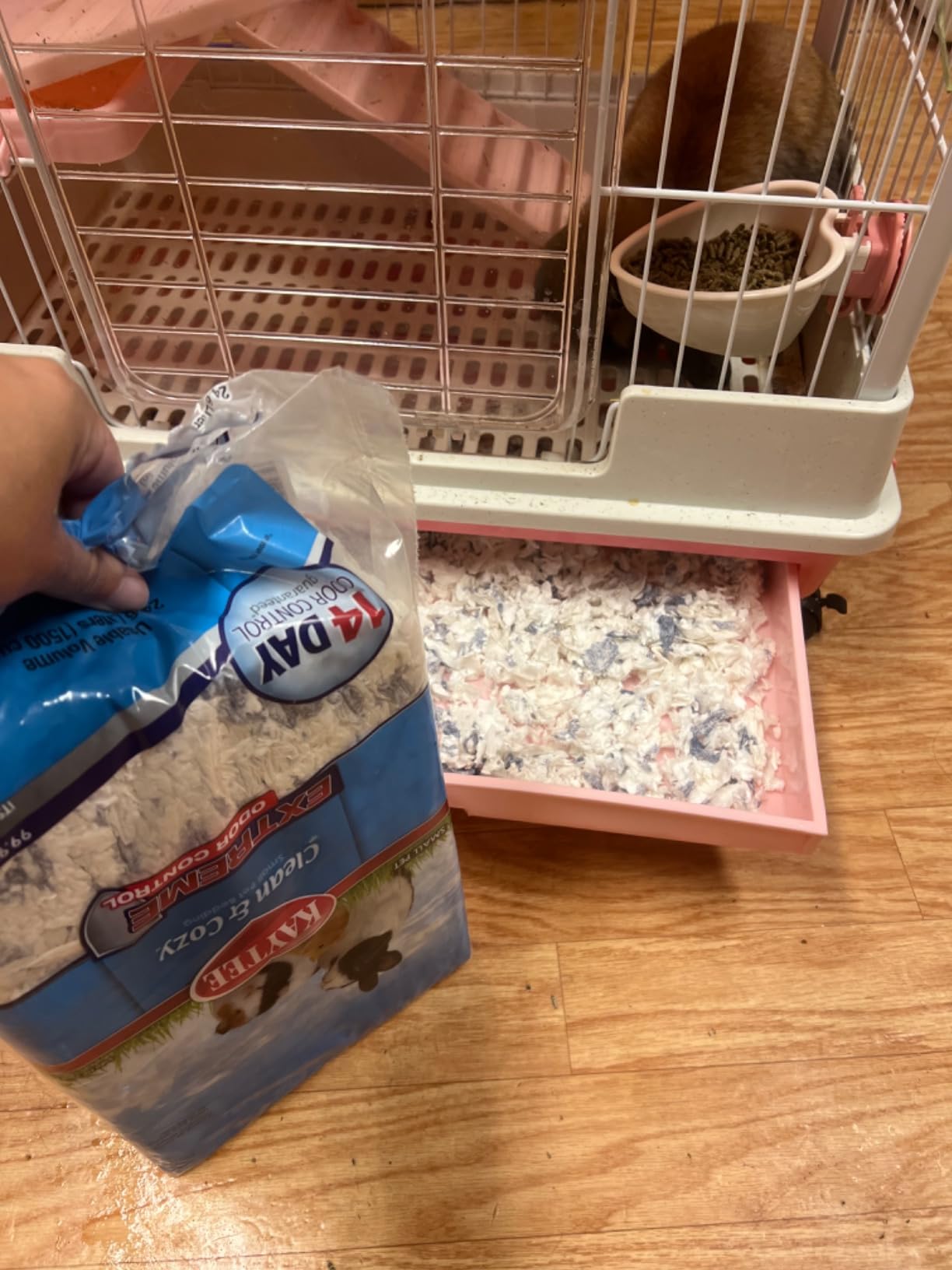
Can This Cage Live Outside?
It is listed as indoor and outdoor rated, and I would treat that as shade-only use. A chinchilla is not an outdoor animal, and direct sun is the fastest route to heat stroke. If you put it on a covered patio, it needs constant shade, water and a thermometer, and you need to bring it in the moment the temperature moves.
The indoor use is the strong suit. For a cool room, a cage that can be hosed off outside and wheeled back is genuinely convenient, and the mesh floor rinses clean in seconds.
What About the Plastic Parts?
That is the real objection. Plastic platforms and ramps will be chewed, and chinchilla teeth grow continuously, so chewed edges become sharp. Replace them with wooden ledges in the first month and treat the plastic as a temporary convenience rather than the finished cage.
The 0.9 inch spacing also makes this an adult-only recommendation, and the frame is light for its height, so check the stand connection whenever you roll it past a threshold.
10. PawHut 59.5-Inch 6-Level Cage – Easiest Cage to Clean
PawHut 59.5″ Small Animal Cage with Wheels, 6-Level Portable Bunny Cage, Chinchilla Ferret Cage with Removable Tray, Platform and Ramp
31.5 x 20.75 x 59.5 inches
40.7 pounds
0.5 inch bar spacing
Deep litter base with sliding trays
Pros
- Tight 0.5 inch bar spacing in a tall frame
- Solid bottom door that opens down with no gaps
- Pull-out tray is the easiest to strip on this list
- Large openings for reaching any level
Cons
- Shelves sit unevenly and can shift
- Metal wire and plastic clips feel thin above the base
- Some units arrive with a warped door
The gap-free bottom door is the design detail I would point a first-time owner to. Most cages have a gap where a base panel meets the frame, and a hind foot caught in that gap is a fracture. This one opens downward and closes flush, which owners reviewing this cage single out as the reason it works well for chinchillas specifically.
At 0.5 inch bar spacing this is the second-tightest grid here after the 3/8 inch wrought iron model, and it is in a 59.5-inch frame with a 31.5 by 20.75 inch footprint. That combination is close to ideal, and the 4.4 rating with 445 reviews reflects owners who have had it long enough to be specific about it.
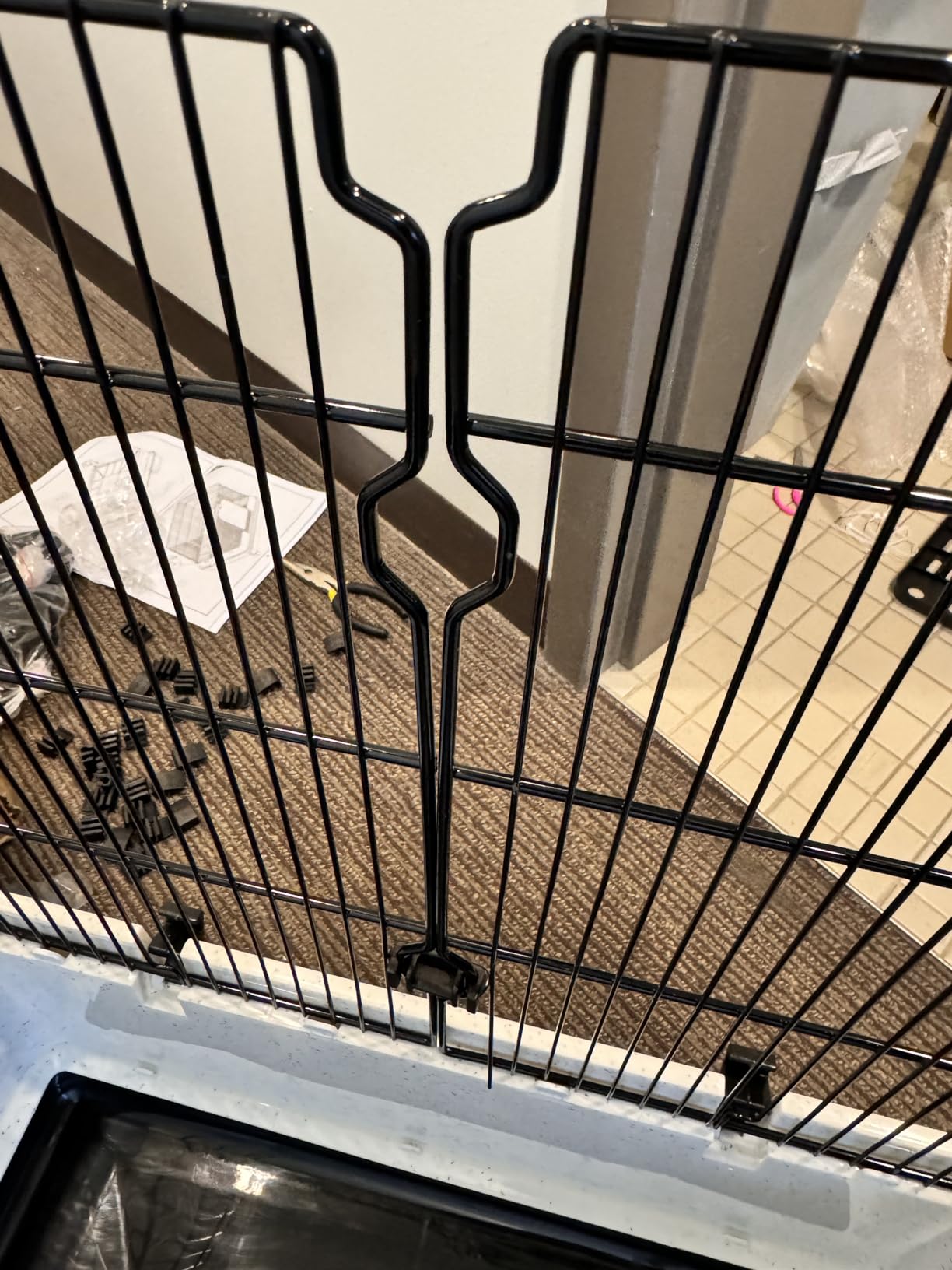
The deep litter base with sliding-out trays is the cleaning story. You pull the tray out, wipe it, slide it back, and you are done. The removable bottom grate lifts out completely for a full strip, and four universal wheels with two brakes let you move the cage to work on it.
Six levels come with a platform and ramp included, so the vertical space is usable out of the box. As with the rest of this list, fleece covers on the ramps and shelves are the first accessory purchase, because bare wire and thin plastic do not hold up to a chinchilla that wants to use them.

Why Do the Shelves Shift?
Because the rests are wire ledges seated on clips rather than a fixed frame, and a 40.7-pound cage flexes slightly as an animal moves across it. Owners report shelves sitting slightly out of level, which is a real problem for a chinchilla because they will not use a sloping surface.
Level them yourself on day one and check monthly. If a shelf keeps drifting, glue a thin wooden ledge to it rather than relying on the original rest, and you have solved it permanently.
Is the Build Quality Good Enough?
It is good enough for one adult chinchilla and marginal for two heavy adults. Reviews describe the wire and plastic clips above the base as thin and sometimes needing reinforcement, and a warped door is a recurring arrival complaint. Inspect everything on arrival, because most arrival problems on this cage are fixable with a zip tie or a wooden ledge.
For a bonded pair, I would run two of these connected. The bar spacing and footprint handle two animals well, and a deep litter base in each unit makes a two-animal cleaning routine manageable.
11. Homey Pet 38-Inch 3-Tier Rat Cage – Best for a Young Chinchilla
Homey Pet Rat Cage, Small Animal Cage for Ferret, Chinchilla, Guinea Pig
25 x 17 x 38 inches
20 pounds
3 tiers, 0.65 inch wire spacing
1 inch removable tray
Pros
- 0.65 inch bar spacing is tight enough for a young chinchilla
- Lockable 360 degree casters
- Detachable floor grates lift out for deep cleaning
- Escape-proof two-finger door lock
Cons
- Debris collects between tray and urine guard
- Thin bottom plastic is not built for heavy chewers
- Not large enough for ferrets despite the marketing
For a chinchilla under six months, the cage does not need to be big, it needs to have no gaps and no hard edges. At 0.65 inch wire spacing, two-finger door locks and detachable plastic floor grates, this is the safest of the smaller enclosures here, and that is a different job from being the best overall cage.
Most baby chinchilla guidance also says to keep a juvenile in a restricted space, without a wheel and without out-of-cage playtime, so the compact 25 x 17 x 38 inch size is not a compromise here. It is the correct choice until the animal is old enough to use height safely.
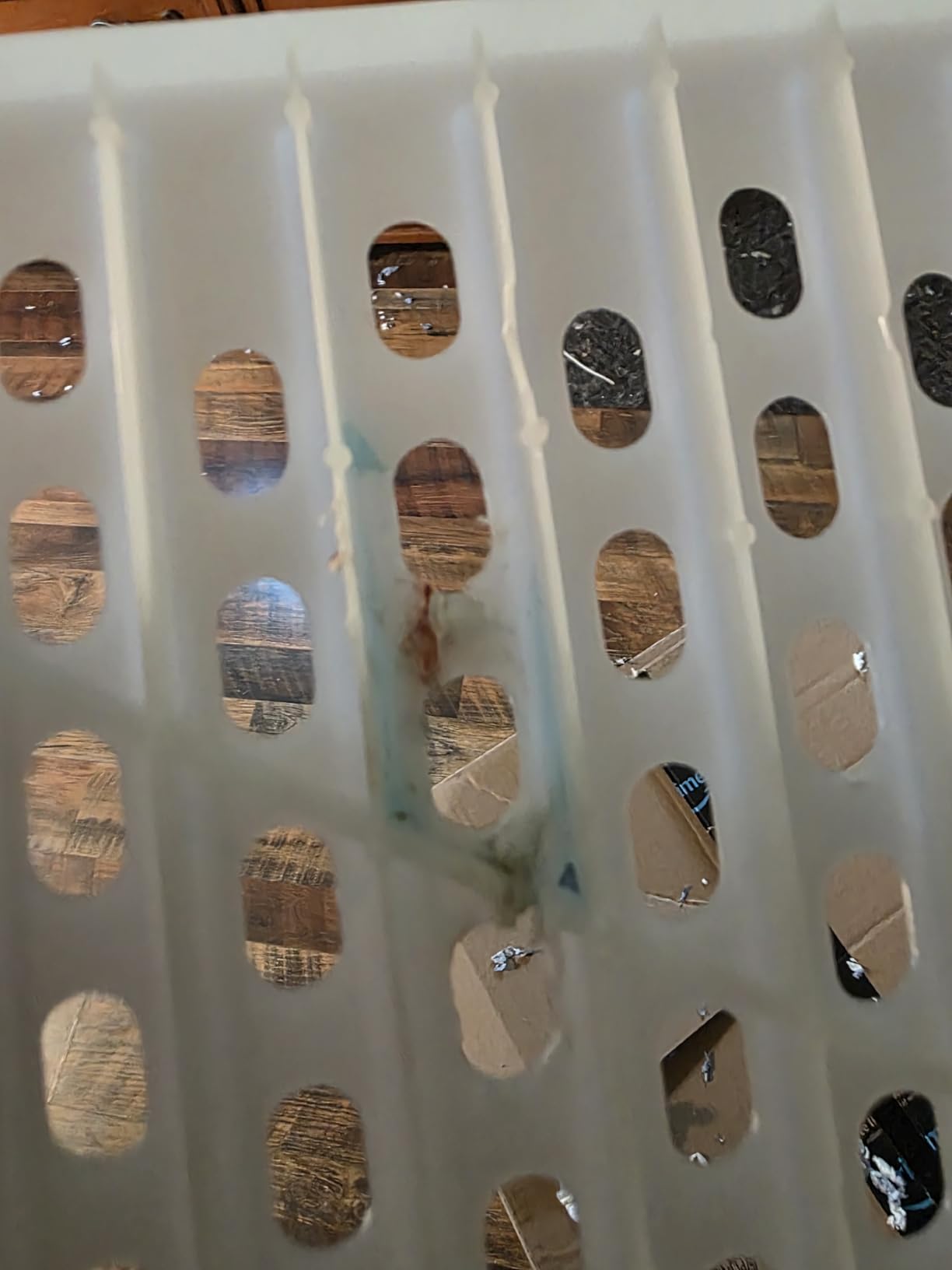
Four 360-degree lockable wheels and a detachable ramp and platform make it easy to move the cage for cleaning. The wheels lock, which matters when a small animal can push against a door, and the cage is light enough at 20 pounds for one person to reposition.
The 1-inch removable tray with an anti-spill splash guard keeps bedding on the tray rather than your floor. Owners like the wheels and the guards most, and complain most about the tray edge, which is the one part of this cage that takes real effort to clean properly.
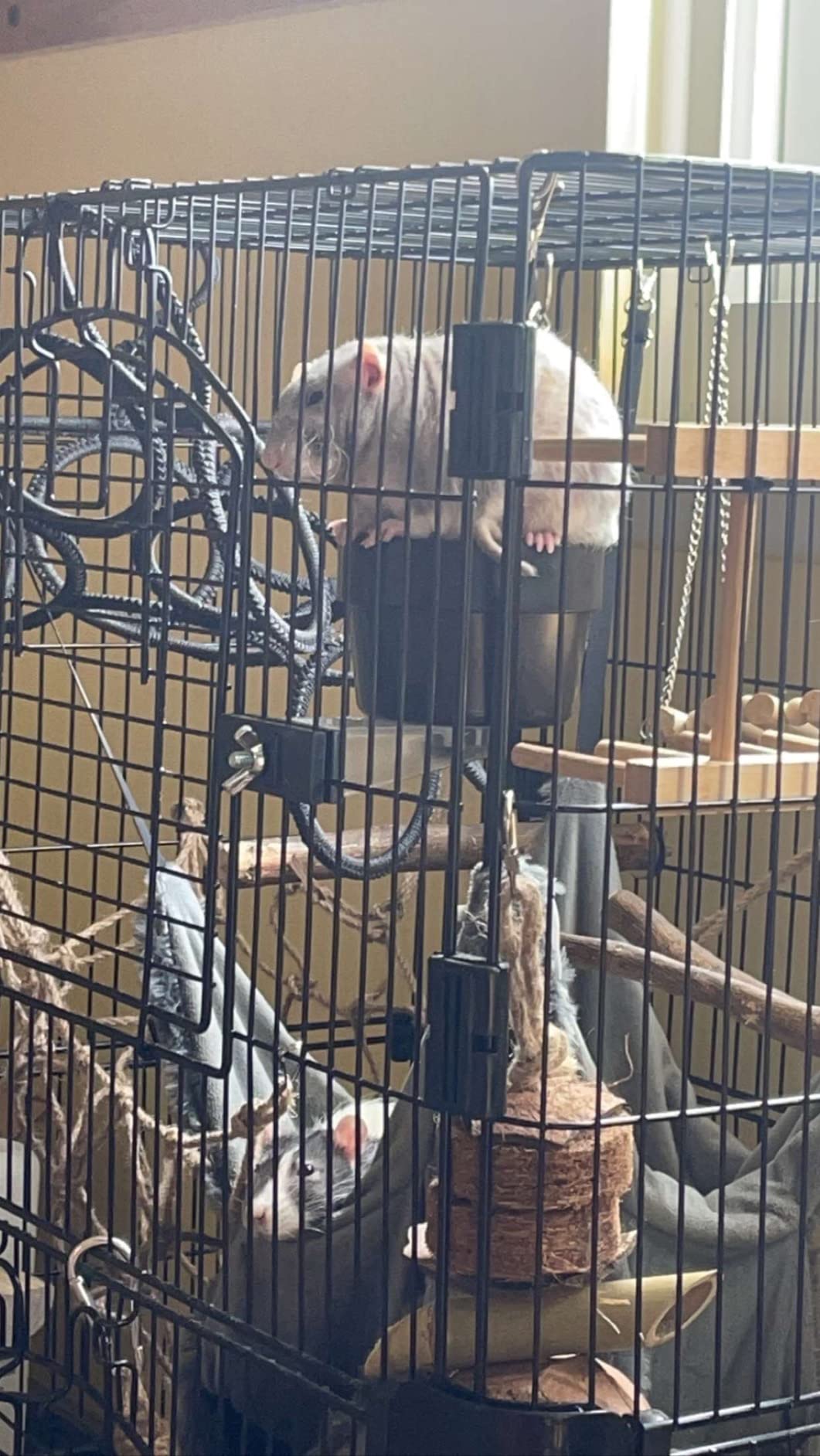
Is It Big Enough Long Term?
No, and I want to be clear about that. Thirty-eight inches is short by the time a chinchilla is a full adult, and a bonded pair would need something substantially wider. Plan this as the first cage, then move up to one of the 50-plus inch models when your animal is around a year old.
The upside is that a smaller first cage is cheaper, and the detachable parts mean you can clean it quickly during the messy juvenile months. Owners who bought it as a starter report the transition to a bigger cage was painless.
What Cleaning Problem Should I Expect?
Debris collects between the tray and the urine guard, and cleaning it means partly taking the cage apart. That is the single most common complaint in the reviews and it is a real, daily, unglamorous annoyance. Budget five minutes more than you expect and keep a small brush for the seam.
Also watch the bottom plastic, which is thinner than you would want against a heavy chewer. If your chinchilla is already gnawing on plastic at the tray lip, add a wooden or metal replacement lip rather than waiting for it to fail.
12. Prevue 485 Feisty Ferret Home – Best Two-Animal Value
Prevue Pet Products 485 Feisty Ferret Home with Stand, Black Hammertone Small
31 x 20 x 54 inches on stand
23.6 pounds
7/8 inch wire spacing
Two hinged escape-proof doors
Pros
- 7199 reviews at a 4.5 rating give unusual confidence
- Two large doors can split the cage into two rooms
- Removable platforms
- grille and tray
- Caster stand with a storage shelf
Cons
- Less vertical space than modern multi-tier cages
- Stand adds cost compared with the cage alone
- 7/8 inch spacing excludes smaller rodents
The 7199-review base is the story here. This cage has been sold since 2007, and a design that survives nineteen years of owners does not need a marketing team to prove itself. The review summary on this listing describes it as consistently durable, well built and easy to access, with the main complaint being lower vertical space than newer designs.
At 31 x 20 x 54 inches the footprint is wide enough for two animals side by side, and the cage itself is 41.5 inches on a 54-inch stand. The two large hinged escape-proof doors are the feature owners praise most, because they open wide enough to reach every corner and can be closed to divide the cage into two separate rooms.
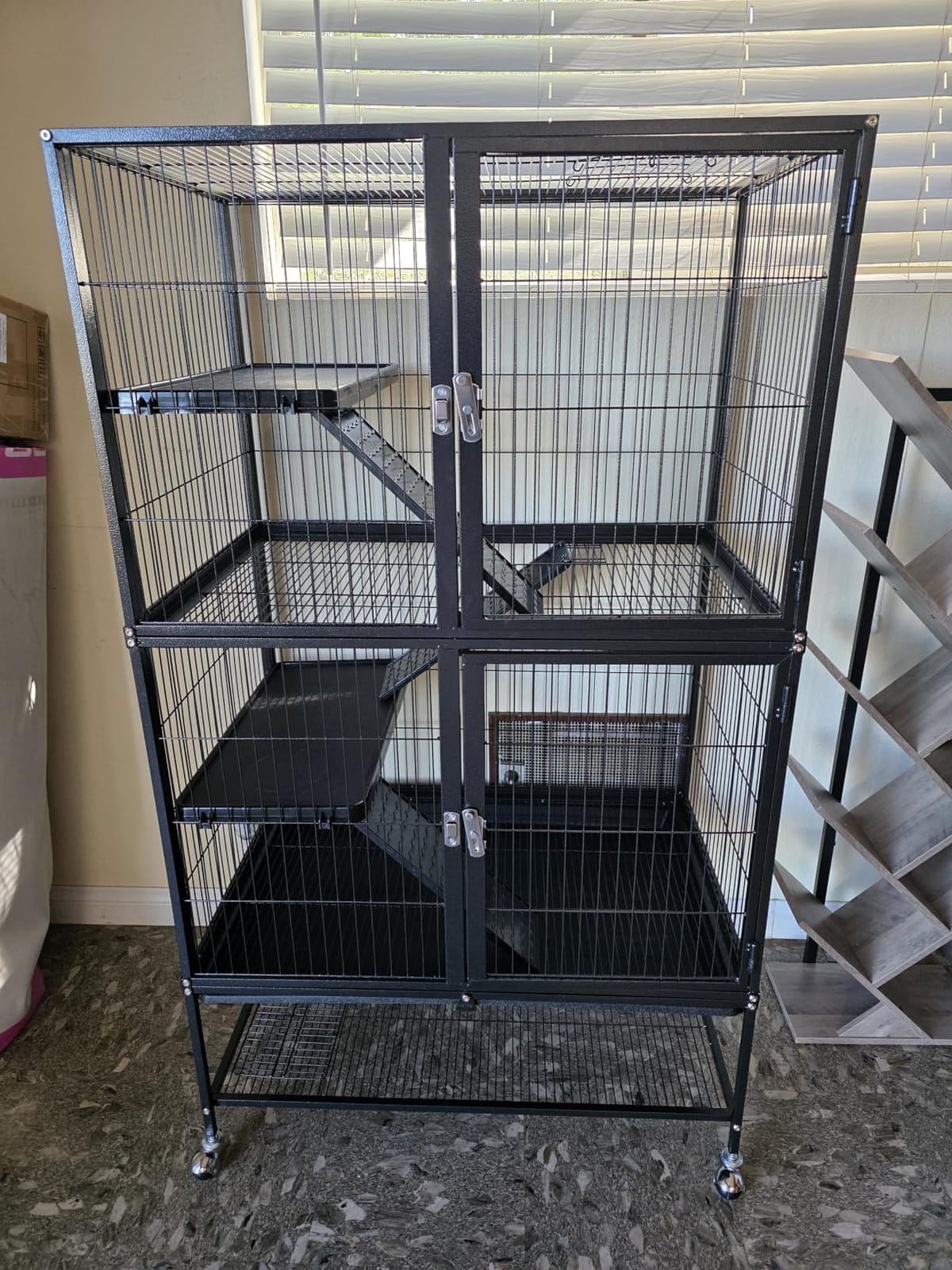
That split function is why this is my pick for two chinchillas on a budget. A dividing panel and a second set of water and feed fittings turns one cage into two side-by-side enclosures, which is a straightforward way to house a bonded pair you are not yet ready to fully trust with a shared space.
Ramps, shelves and a hammock are all included, and the removable platforms, grille and bottom tray make cleaning straightforward. The caster wheels and space-saver storage shelf stand keep the footprint manageable and give you somewhere to keep bedding and dust bath tubs.
Critter Nation vs Ferret Nation and This: Which Bars?
The cage the community asks about most is the Ferret Nation, and the Ferret Nation and this Prevue both use vertical bars rather than horizontal ones. Owners who prefer vertical bars argue chinchillas are natural climbers, and vertical bars are where they can grip. Welfare-minded sources argue chinchillas are runners and jumpers, and horizontal bars are safer for a head and a foot.
Both camps have evidence. The practical compromise most owners land on is a cage with vertical bars and a floor and platforms that are solid, so the animal can climb without landing on wire. That is what the removable grille and platforms here give you, and it is why this cage closes the list rather than opening it.
Is the Stand Worth It?
It adds cost compared with the cage on its own, but it also lifts the animal to a comfortable working height and gives you the storage shelf. At 54 inches tall on the stand you are not crouching to reach the top platform, which is daily ergonomics you will notice in year one.
The trade-off is vertical space. This cage is 41.5 inches tall on its own, and owners consistently note it has less climbing height than modern six-tier designs. If your chinchilla is a jumper and you want real height, the tall metal cages further up this list serve you better. If you want two animals, wide access and a proven build, this is the value pick.
How to Choose the Best Chinchilla Cage for Home
How Big Should a Chinchilla Cage Be?
VCA Animal Hospitals gives a minimum of 3 by 2 by 3 feet for a single chinchilla and 3 by 2 by 5 feet for a bonded pair, and those figures are floors rather than targets. The community often repeats a looser figure of about 25 inches deep by 25 inches tall by 36 inches wide as an entry-level configuration. Both can be true, because height does work that floor area does not.
When you compare the twelve cages here against those numbers, only the Critter Nation double unit reaches a full 36 by 24 inches of floor. Several others land in the high twenties or low thirties wide with a 20 inch depth, which works for a single chinchilla once you add ledges. The rest trade floor width for height, which is a reasonable trade in a narrow room and a poor one if you have the space.
What Bar Spacing Do Chinchillas Need?
One inch or narrower, and that number is the ceiling, not the target. Bar spacing decides whether a chinchilla can wedge its head, catch a hind foot or squeeze out entirely, and it is the first spec I check on any cage. The tightest options here are the Yaheetech 69-inch at 3/8 inch, the Critter Nation and the PawHut 59.5-inch at 1/2 inch, and the Homey Pet at 0.65 inch.
Anything above 1 inch is a problem, and the SUPER DEAL at about 1.1 inch is the one cage here I would not use as a primary enclosure. Bar orientation is a separate question. Horizontal bars are argued to be safer for a chinchilla head and foot, vertical bars give better climbing grip, and the honest answer is that either is workable if the floors and platforms are solid.
Tall vs Wide: Which Shape Wins?
This is the genuine disagreement in the chinchilla world, and pretending otherwise would be dishonest. One camp points to the animal’s climbing instinct and argues a tall cage with more levels is the correct environment. The other points to the fact that chinchillas are primarily runners and jumpers with fragile bones, and argues tall cages create fall risk and stress.
Both arguments have support, and the two authoritative pages on this topic sit on opposite sides. What both agree on is level spacing under 18 inches, solid surfaces, and a minimum footprint. So rather than pick a side, break the height up. Stagger platforms, add a hide or bridge between levels, and cover every wire surface. A tall cage with solid landings at staggered heights is safer than a short cage with a bare wire floor.
Cages to Avoid
Hamster and mouse cages: bar spacing far too wide, tiny footprint, plastic everything. Dangerous for a chinchilla.
Cages with bare wire floors: the main cause of sore hocks in pet chinchillas, and a leg-injury risk in young animals.
Cages with plastic pans and plastic platforms: a chinchilla will chew them, and chewed plastic becomes a sharp edge or a swallowed fragment.
Galvanized or plastic-coated bars: zinc exposure once the coating is chewed through. Powder-coated steel or wrought iron is the safe choice.
Cages with only one small door: a stress problem every day, because the animal cannot retreat from a reaching hand.
Cages sold with a heat lamp inside: the single most dangerous accessory in this list. See below.
How to Set Up a New Chinchilla Cage
Cover every wire shelf, ramp and platform with washable fleece or replace them with wooden ledges before the animal goes in.
Keep a solid resting surface on each level, spaced under 18 inches apart, and stagger them so there is no straight vertical drop.
Add a hide on the middle level, a hammock higher up, and a dust bath tub that is heavy enough not to tip.
Hang a metal hay rack at mid height and mount a glass water bottle on the outside of the cage, never inside where it can be chewed.
Fit a solid-surface wheel of about 15 inches diameter if your chinchilla uses one, and secure it flat against a level rather than a slope.
Line the tray with a washable fleece or paper bedding, add kiln-dried pine or aspen, and never cedar or fresh aromatic pine.
Lock the casters, check every door latch twice, and give the cage a full day before you leave the animal in it unsupervised.
Heat Safety: Why the Room Comes Before the Cage
Overheating is the number one cause of death in pet chinchillas, and no cage design fixes a hot room. Keep the cage out of direct sun and away from windows, and treat 80 degrees Fahrenheit as the ceiling rather than a target. The practical rule that circulates among owners is to add the humidity reading to the temperature reading: if the total passes 150, the room is too warm.
A tall metal cage also traps heat, which is another argument for choosing a wide-but-shorter cage in a warm room rather than a 69-inch tower. Roller casters help here more than any spec, because moving the cage to the coolest part of the room twice a day is a real strategy. A ceramic tile laid in the tray gives a cool surface to sit on when the air is warm.
Never put a heat lamp inside or above the cage. A chinchilla is not a reptile, and owners who have tried it report the fastest route to heat stroke. If your room cannot be kept cool, that is a veterinary conversation, not a cage-shopping one.
A Cleaning Rhythm That Takes Ten Minutes
Daily, spot-clean droppings, sweep bedding out of the tray and replace it, and check the water bottle. Weekly, strip the tray completely, wash it, wipe the shelves, and rotate fleece covers so they get a wash in rotation. Monthly, wash every removable part including platforms and grates, and check the bar spacing, the door latches and the caster locks.
Cage choice makes this easier or harder than it needs to be. A deep slide-out tray with a urine guard, wide doors and removable shelves turns a ten-minute job. A cage with a shallow tray, a urine guard you cannot lift and a single small door turns it into an argument with your chinchilla every evening. Buy the cage you will actually clean.
Frequently Asked Questions
What type of cage is best for a chinchilla?
A tall, metal, multi-level enclosure with solid shelves, bar spacing of 1 inch or narrower, a deep removable urine tray and lockable casters. Give a chinchilla vertical levels and solid resting surfaces before you give it floor space, and keep level spacing under 18 inches.
What are the space requirements for a chinchilla?
VCA Animal Hospitals sets a minimum of 3 by 2 by 3 feet for one chinchilla and 3 by 2 by 5 feet for a bonded pair. Those are floors, not targets. Height matters too, so a tall narrow cage can work in a small room if the footprint is close to 3 by 2 feet and every level has a solid surface.
What is the difference between Ferret Nation and Critter Nation?
They share a footprint and differ mainly in bar orientation. The Ferret Nation uses vertical bars at wider spacing, which suits climbing grip. The Critter Nation uses horizontal bars at 1/2 inch spacing, which owners argue is safer for a chinchilla head and foot. Both are workable if the floors and platforms are solid.
Can chinchillas live in a wire bottom cage?
Not as a permanent setup. Wire floors are the main cause of sore hocks in pet chinchillas and can injure the legs of young animals. Cover every wire shelf and platform with washable fleece, or replace them with wooden ledges, and keep a solid surface on every level the animal uses.
Are tall cages bad for chinchillas?
It depends on how the height is used. Chinchillas climb, so height is valuable, but a bare vertical drop between levels risks injury to a fragile-boned animal. Keep level spacing under 18 inches, stagger the platforms, add hides and bridges between levels, and make sure every wire surface is covered.
Our Final Picks for Chinchilla Cages in 2026
The MidWest Critter Nation double unit is the best chinchilla cage for home in 2026 because it combines the two specs that matter most, 1/2 inch horizontal bar spacing and 36 x 24 x 63 inches of two-level space, in a build that has survived nineteen years of ownership. The Yaheetech 52-inch six-level cage is the value pick if you want more vertical levels for less, and the Prevue 485 is the best option for two animals because its two hinged doors can divide it into two rooms.
Beyond those three, match the cage to the animal rather than to the trend. A bonded pair wants a wide floor, so look at the PawHut 6-level or two connected units. A high ceiling can take the Yaheetech 69-inch with its 3/8 inch bars, though you will need to cover the wire ladders. A small flat can take the compact PawHut 4-tier, and a young chinchilla under six months belongs in the Homey Pet 3-tier with its 0.65 inch spacing.
Whatever you choose, cover the wire, keep level spacing under 18 inches, and pick the cage you will enjoy cleaning every evening. Then check the room temperature before you worry about anything else on the list. Our other home roundups follow the same rule: the right product is the one that fits your actual space, not the one with the longest spec sheet.