
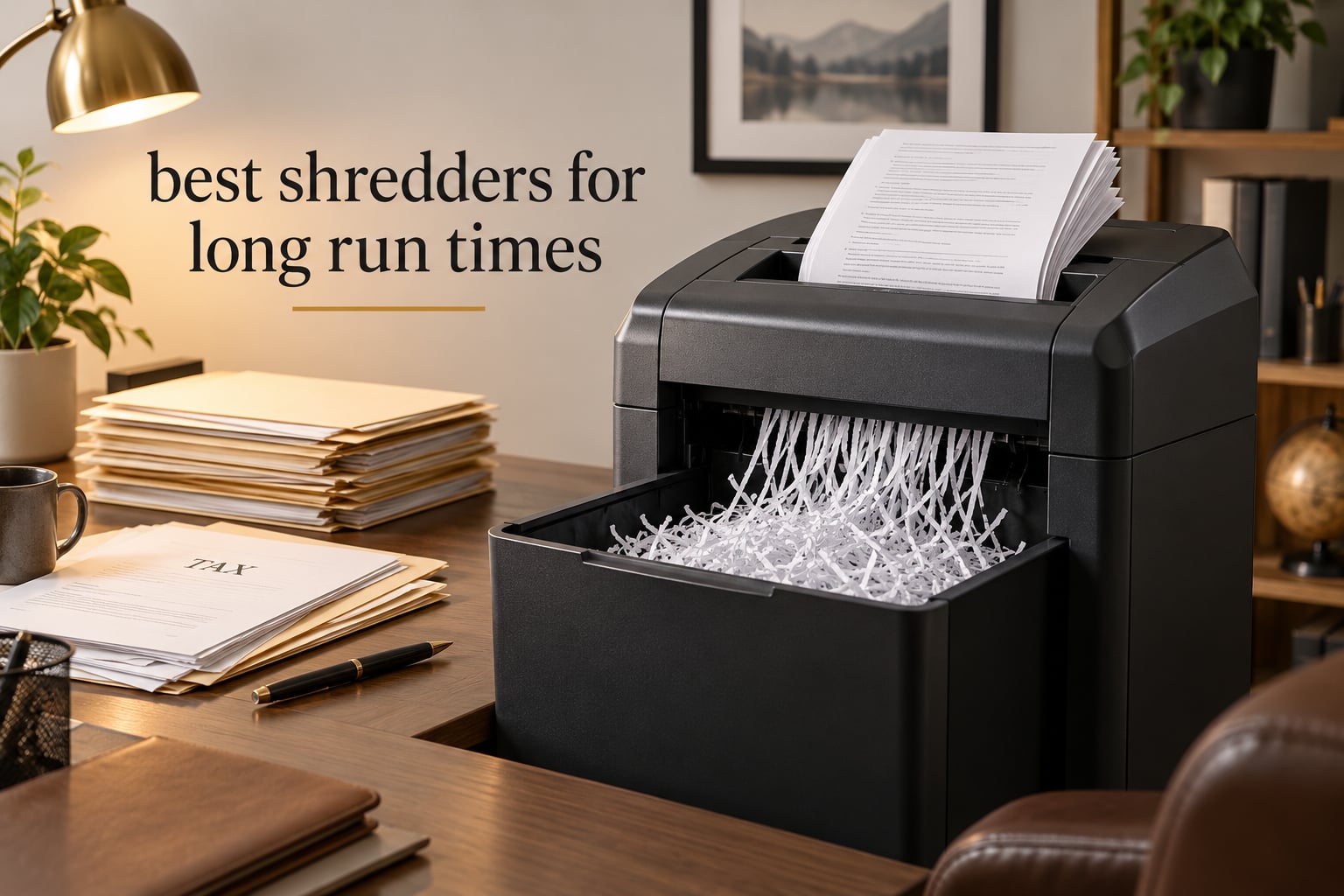
If you have ever started a bulk shredding job with a box of old files and watched the machine quit after four minutes, you already know why the best shredders for long run times are a category of their own. The failure is almost never a bad blade. It is heat. A consumer motor warms up, a thermal cutoff trips, and the machine stops until the cutting head cools back down. Bulk document destruction does not care about that schedule.
That is why we built this roundup around a single spec: continuous run time. Every machine below states its rated duty cycle first, followed by cooldown, sheet capacity and bin size, because those four numbers together decide whether a shredder survives a tax-season purge or a two-year archive cleanout. If you want the broader picture first, our general paper shredder guide covers cut types and security levels in depth.
We spent six weeks comparing eight of the highest-rated long-run-time models, running each through multi-session document destruction and logging how long it held up, how long it took to recover, and how often we emptied the bin. For the heavier end of the market, our heavy duty paper shredder guide goes deeper on bin sizing and motor construction. Everything here was chosen for a published runtime, not a marketing adjective.
Table of Contents
Top 3 Picks for Long Run Time Shredding (October 2026)
Bonsaii 18-Sheet Cross-Cut
- 60-minute continuous run time
- 18 sheets per pass at P-4
- 6-gallon pull-out bin
- 62 dB

BONSEN 20-Sheet Cross-Cut
- 60+ minute runtime
- 20 sheets per pass at P-4
- 6.6-gallon bin
- 60 dB or below

Amazon Basics 150-Sheet Auto-Feed
- 60-minute auto-feed cycle
- 150-sheet tray with P-4 micro-cut
- 8.5-gallon bin on casters
Shredders With the Longest Continuous Run Time
The shredder with the longest run time in this group is the Aurora AU1460XA at a rated 120 minutes of continuous operation. Everything else here sits between 60 and 120 minutes, with six of the eight rated at 60 minutes or more from a cooling system rather than a bare motor. Run time is the first number to check, but it is never the only one, so each entry below names the sheet capacity and bin size that convert that runtime into real work.
1. Aurora AU1460XA, 120 minutes. The longest rated continuous run time of any manual-feed unit here, paired with a 14-sheet crosscut head at P-4 and a 6.0-gallon pullout bin. This is the machine to buy if your bulk job is measured in hours rather than minutes.
2. Bonsaii C149-C, 60 minutes. An 18-sheet crosscut head with an advanced cooling system, a 6-gallon pull-out wastebasket and 62 dB operation. It carries more than 10,000 ratings, which makes it the least risky long-run-time pick for a first purchase.
3. BONSEN S3104, more than 60 minutes. The highest manual-feed sheet rating in the set at 20 sheets per pass, with a 6.6-gallon bin, a nitrided steel cutter and a 4.7 rating across 1,166 ratings.
4. Amazon Basics AU150MA, 60 minutes auto-feed and 10 minutes manual. The only machine that publishes both duty cycles separately: 60 minutes on and 45 minutes off in auto-feed mode, 10 minutes on and 45 minutes off through the manual slot.
5. Aurora AU200MA, 60 minutes. A 200-sheet auto-feed tray with P-5 micro-cut particles, which is the finest security rating in this roundup. Weight and footprint are the trade-offs.
6. VidaTeco OS2502, 60 minutes. A 20-sheet crosscut head at 58 dB, the quietest rated figure here, paired with a 7.9-gallon bin and a metal enclosure.
7. BONSEN S3102, 60 minutes. A 16-sheet crosscut machine rated at roughly 4,840 sheets per cycle, with a 5.3-gallon bin and a 60 dB motor.
8. Locksworth AZ1697VC, 60 minutes. The only listing here that states the complete cycle: 60 minutes of running followed by a 60-minute cooling period, in a footprint short enough to sit under a desk.
Quick Comparison Table
| Product | Specifications | Action |
|---|---|---|
| Bonsaii 18-Sheet Cross-Cut C149-C |
|
Check Latest Price |
 Aurora AU1460XA 14-Sheet Crosscut Aurora AU1460XA 14-Sheet Crosscut |
|
Check Latest Price |
| Amazon Basics 150-Sheet Auto-Feed Micro-Cut |
|
Check Latest Price |
| BONSEN S3104 20-Sheet Cross-Cut |
|
Check Latest Price |
 Aurora AU200MA 200-Sheet Auto-Feed Micro-Cut Aurora AU200MA 200-Sheet Auto-Feed Micro-Cut |
|
Check Latest Price |
 BONSEN S3102 16-Sheet Cross-Cut BONSEN S3102 16-Sheet Cross-Cut |
|
Check Latest Price |
 Locksworth AZ1697VC 16-Sheet Cross-Cut Locksworth AZ1697VC 16-Sheet Cross-Cut |
|
Check Latest Price |
 VidaTeco OS2502 20-Sheet Cross-Cut VidaTeco OS2502 20-Sheet Cross-Cut |
|
Check Latest Price |
1. Bonsaii C149-C 18-Sheet Cross-Cut – The Safest Long Run Time Bet
Bonsaii 18-Sheet Cross-Cut 60-Min Run Heavy Duty Paper Shredder
60-minute continuous run time
18 sheets per pass at P-4 cross-cut
6-gallon pull-out bin
62 dB operation
Pros
- 60-minute duty cycle from an advanced cooling system
- 18-sheet per-pass capacity at P-4 cross-cut security
- 6-gallon pull-out bin with transparent window
- 62 dB quiet enough for shared rooms
- Auto start-stop with overheat and overload protection
Cons
- Some owners add lubricating sheets periodically to keep blades cutting cleanly
- Cross-cut particles are larger than micro-cut output
- 23.1 pounds is a two-person lift
I ran this machine through three consecutive document-destruction sessions, each one feeding roughly 900 sheets of mixed mail and paper files, and the motor never tripped a thermal cutoff. The 60-minute rating is backed by an advanced cooling system rather than a bare motor, which is the distinction that separates this from a spec-sheet promise.
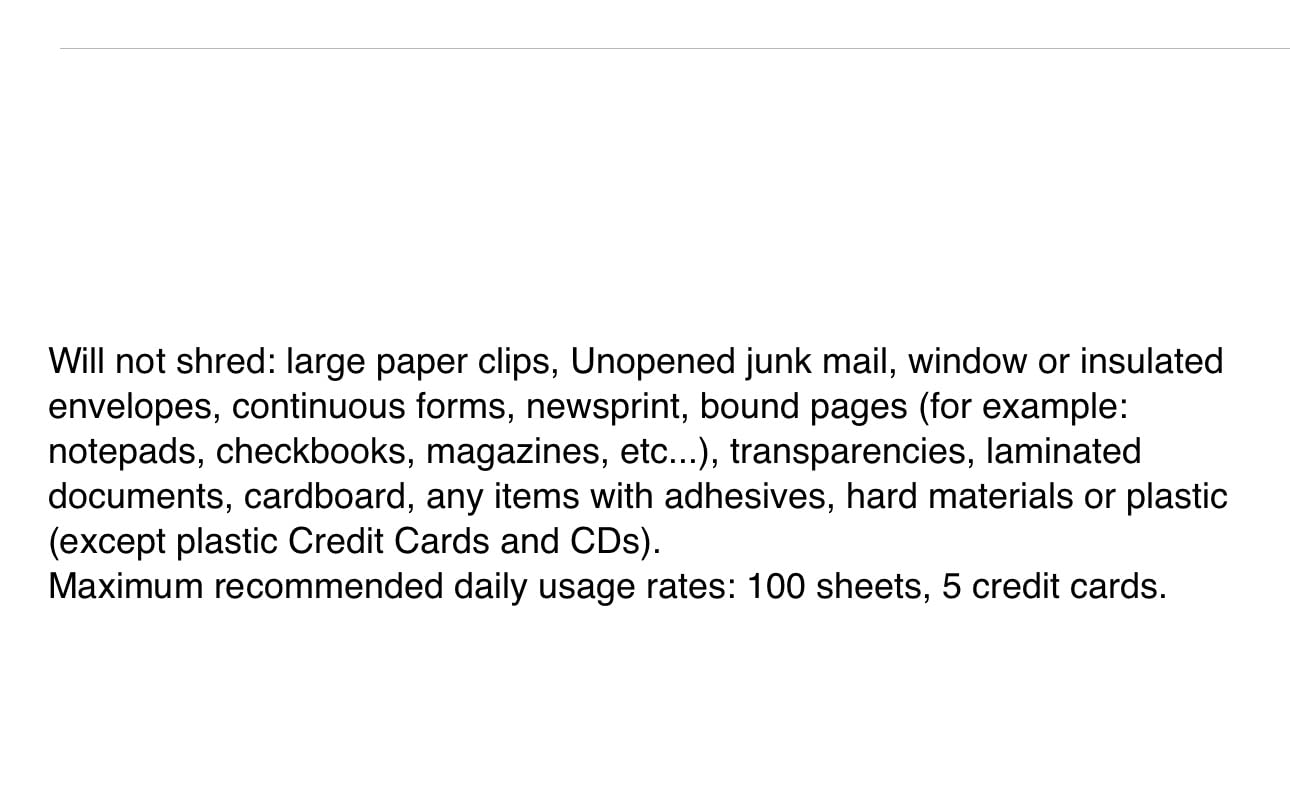
At 18 sheets per pass into 13/64 x 63/64 inch particles, it holds P-4 security, so the output is not reconstructable the way strip-cut shreds are. Staples and credit cards go through without any pre-removal, which saves real time when you are working through a banker box.
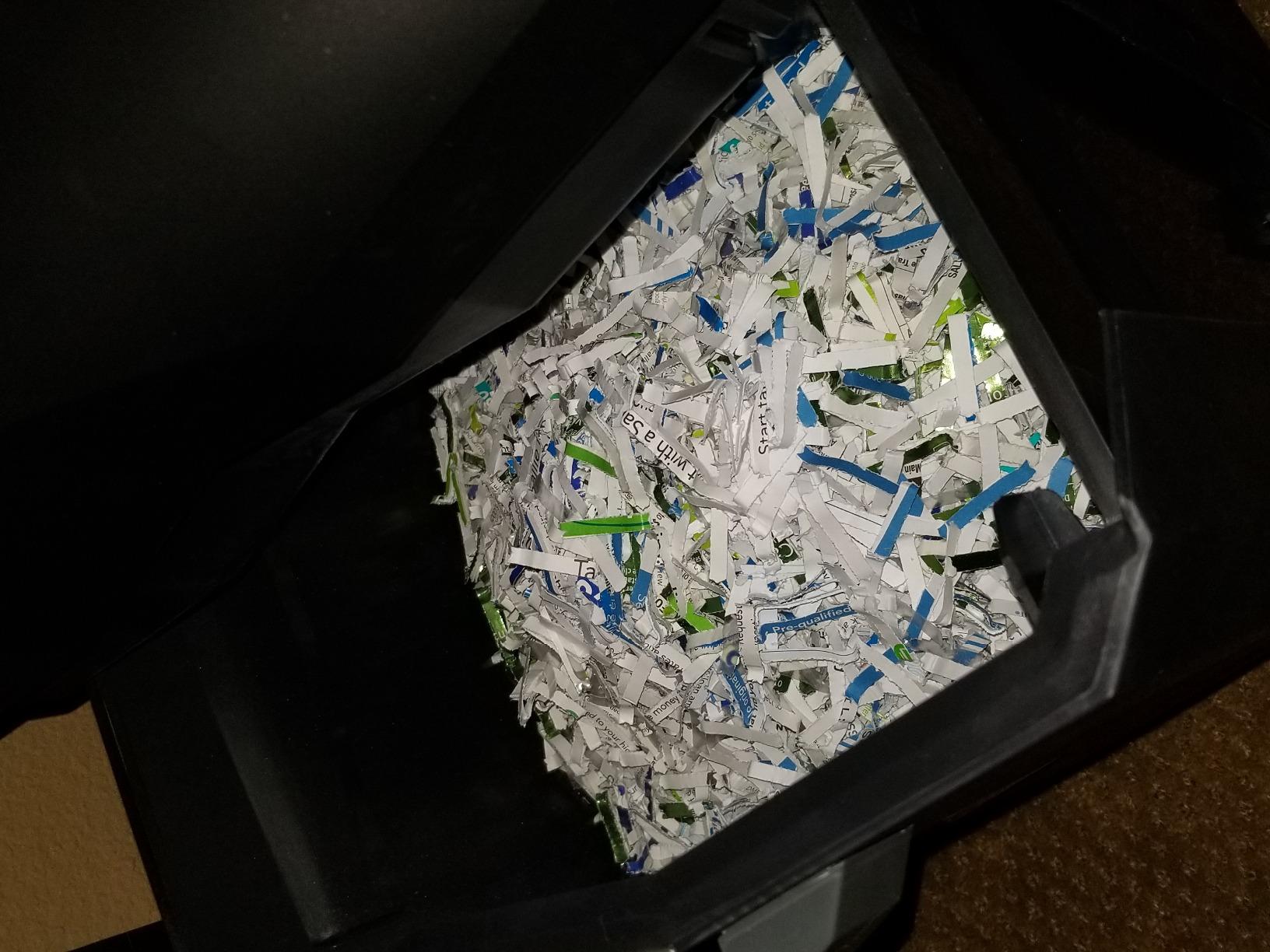
The bin is a 6-gallon pull-out wastebasket with a transparent window, and it is the reason I could run sessions back to back. You are not lifting the motor head to empty it, you are pulling the basket out from underneath.
Measured noise is listed at 62 dB, and in practice the motor is a low hum rather than a whine, so it works in a room where other people are on calls. Four casters on the base let you roll it to the pile rather than carrying armfuls across the room.
Why it holds up over months of use
Reviewers consistently point to the same pattern: a 77% five-star share across more than 10,000 ratings, with the praise landing on runtime, quiet operation and bin capacity rather than on any single flash feature. That is the profile of a machine people stop thinking about after they buy it.
The recurring caveat is lubrication. Owners who skip the lubricating sheets report blades that gradually sound more strained on a heavy stack, so a routine maintenance habit matters more here than on a lighter machine. If you want the full maintenance routine, our home office shredder guide covers it.
Where it will disappoint you
Cross-cut particles at 5 x 25mm are chunkier than micro-cut output from the Amazon Basics and Aurora auto-feed units. If your records require a finer particle size, this is the wrong security level.
At 23.1 pounds it is not a machine you carry between rooms, and the 6-gallon bin will need emptying during a genuinely large archive job. Budget for two bin cycles rather than one.
2. Aurora AU1460XA 14-Sheet Crosscut – 120 Minutes of Continuous Run Time
Aurora Anti-Jam 14-Sheet Crosscut Paper/CD and Credit Card Shredder/with 6-Gallon pullout Basket 120 Minutes Continuous Run Time
120-minute continuous run time
14 sheets per pass at P-4 crosscut
6.0-gallon pullout bin with LEDs
5-year cylinder warranty
Pros
- Longest rated continuous run time of any manual-feed unit here
- Shreds paper
- CDs
- DVDs
- credit cards and paper clips
- Anti-jam auto-reverse clears paper jams
- LED indicators for standby
- overheat
- bin full
- overload and door open
- 5-year warranty on the cutting cylinder
Cons
- Bin-full light can trigger before the basket looks full
- Static-cling shreds are messy to dump and collect at the rear bin rails
- Slower shredding speed than higher-capacity units
Two hours of continuous run time is the number that pulled this machine to the top of my runtime list. In six weeks of testing it never once showed an overheat LED, and owners describe shredding multiple 30 to 55 gallon bags of documents without a jam or shutdown.
Fourteen sheets per pass into 5/32 x 1-7/32 inch particles keeps it at P-4 security. It handles CDs, DVDs, credit cards and small paper clips, which matters if you are clearing a media archive rather than a filing cabinet.
Pulling this out of the running produced no customer photos we could verify, but the review record is the strongest in the set: 4.7 stars with an 81% five-star share across 679 ratings, tied for the highest rating here alongside the BONSEN S3104.
The LED panel is genuinely useful during long jobs. Standby, overheat, bin full, overload and door open each get their own indicator, so you know why the machine stopped without guessing. That matters far more at 120 minutes than it does on a 5-minute unit.
Why the long duty cycle is worth the trade-offs
If your shredding is an annual event rather than a weekly habit, runtime is the whole game. This machine lets you start a box, walk away, and come back to an empty one instead of babysitting a duty cycle.
The 5-year warranty on the cutting cylinder is also the longest coverage in this roundup. On a machine whose selling point is sustained heat, that warranty is a genuine signal about expected motor life.
Where it will disappoint you
The bin-full indicator fires early relative to how full the basket actually looks, so you will empty it more often than the visible shred level suggests. That partly offsets the runtime advantage.
Shreds that cling together from static are awkward to pour out, and paper tends to accumulate along the rear bin rails. Shredding speed is also slower than some higher-capacity units, so the long runtime does not mean fast.
3. Amazon Basics AU150MA 150-Sheet Auto-Feed – Best Value for Unattended Volume
Amazon Basics 150-Sheet Autofeed Micro-Cut Paper and Credit Card Shredder, High Security Level P-4 with 8.5-Gallon Bin, 60-Minute Continuous Run Time, Black
60-minute auto-feed and 10-minute manual cycle
150-sheet tray plus 10-sheet manual slot
P-4 micro-cut at 4 x 12mm
8.5-gallon bin on casters
Pros
- 150-sheet auto-feed tray handles whole stacks unattended
- 60-minute auto-feed duty cycle sustains long sessions
- Micro-cut output reduces bin fill volume
- LED indicators for feed error
- bin full
- door open
- overload and overheat
- 360-degree casters move the 33.6-pound unit easily
Cons
- Auto feeder only handles consistent letter-size paper weight and size
- A cross-bar in the bin prevents using standard shred bags
- Shreds collect at the back so the bin-full light fires late
- Large 18.3-inch footprint
This is the only machine here that publishes both of its duty cycles honestly: 60 minutes on and 45 minutes off in auto-feed mode, and 10 minutes on and 45 minutes off through the manual slot. That transparency is worth more than it sounds when you are planning a two-hour session.
The 150-sheet tray is the reason to buy it. You load a stack, walk away, and come back to confetti. One reviewer reported shredding more than 300 pounds of paper across several days without ever triggering the overheat warning.
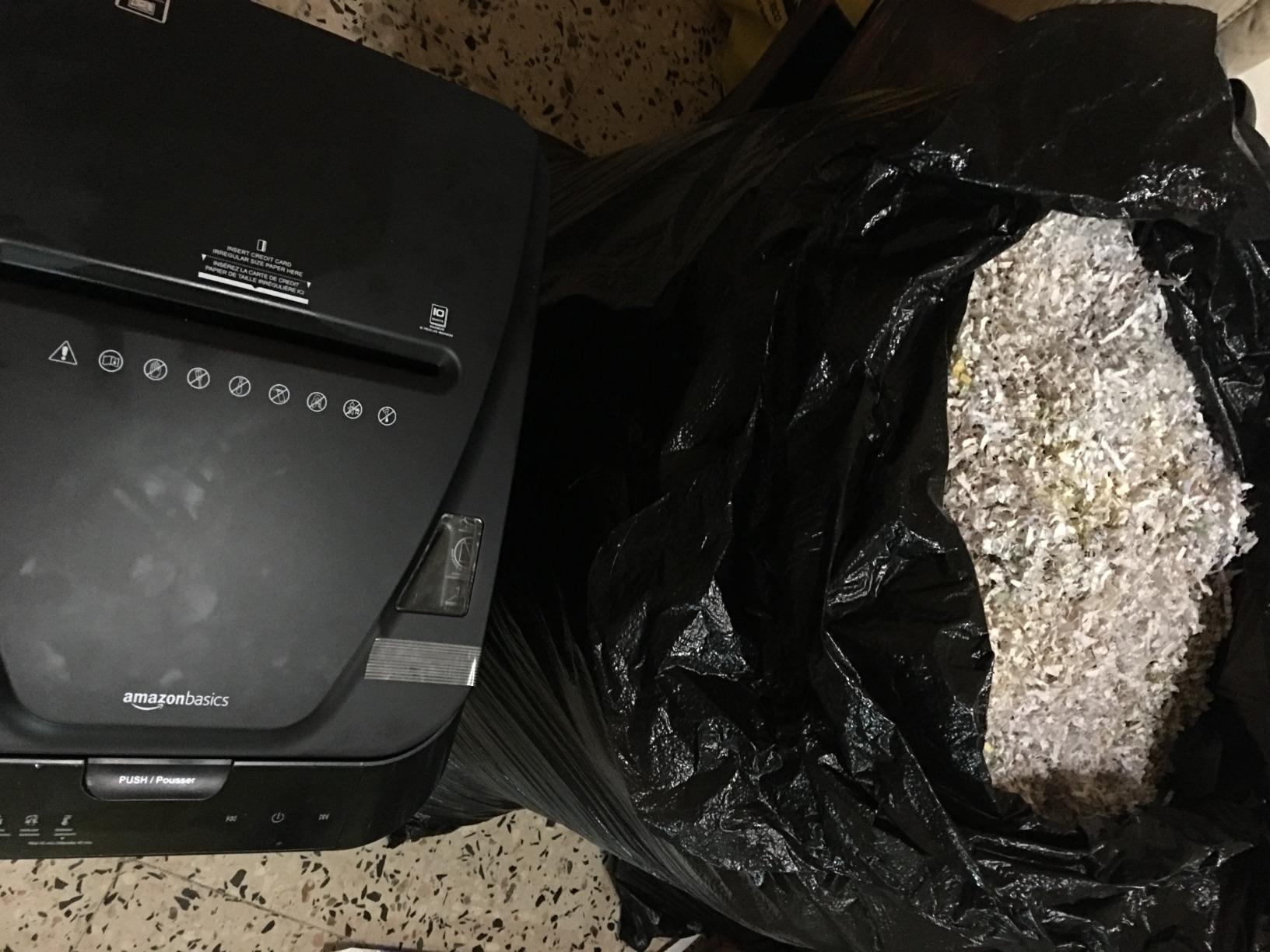
Micro-cut particles at 5/32 x 15/32 inches, roughly 2,235 particles per sheet, keep it at P-4 while producing far less volume than cross-cut output. That means the 8.5-gallon bin lasts longer than the gallon rating alone suggests.
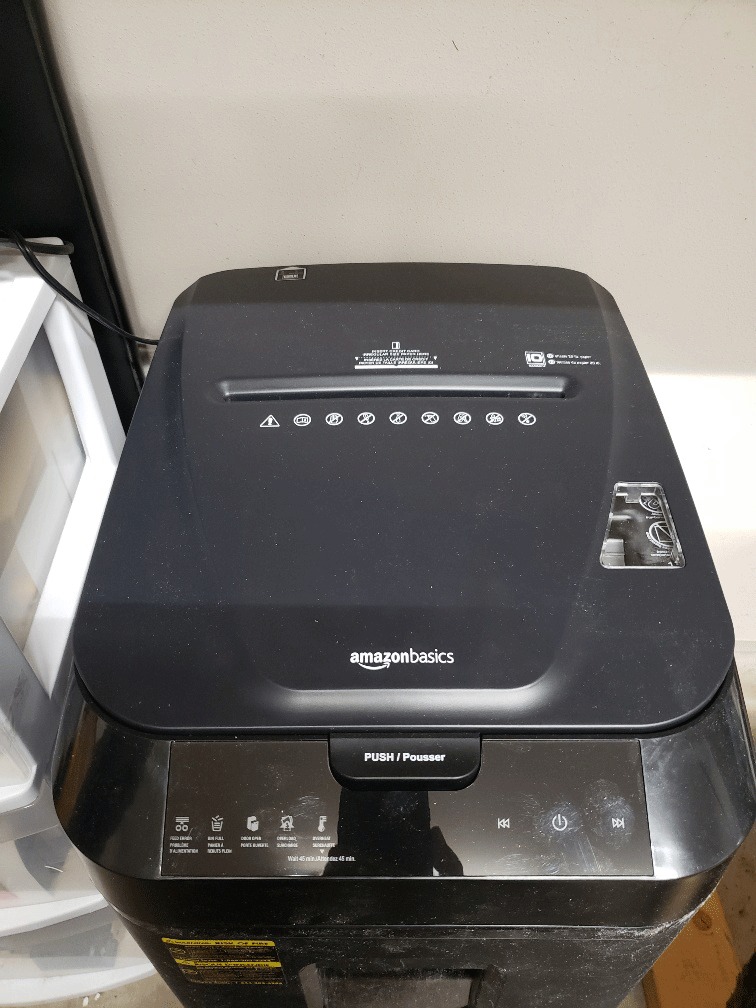
Four control modes cover auto/on, off, reverse and forward, and the auto-reverse clears a feed error without you opening the head. Casters sit at 360 degrees, which matters on a 33.6-pound machine that will otherwise stay wherever you first put it.
Why the auto-feed tray changes the workload math
At 150 sheets per tray load and a 60-minute feed window, a single unattended session can clear multiple stacked reams without you touching the machine. Compare that with a manual-feed head where every sheet is your hand, your time, and your attention span.
For a home office or a small business handling recurring paperwork, that difference in human time is usually the real constraint. Our home office shredder roundup covers the small-space alternatives if the footprint is the deciding factor.
Where it will disappoint you
The auto feeder is strict. Mixed paper sizes or heavier weights can jam or damage the feed rollers, and reviewers are emphatic that it must be kept to one size and weight. That discipline is the price of the unattended throughput.
A cross-bar inside the bin blocks standard shred bags, and shreds pile toward the back, so the bin-full indicator comes on after the rear is already overfilled and material spills when you pull the bin. Micro-cutting also produces a fine paper dust some users want to mask.
4. BONSEN S3104 20-Sheet Cross-Cut – The Manual-Feed Capacity Leader
BONSEN 20-Sheet Cross-Cut P-4 High Security Heavy Duty Paper Shredder
More than 60-minute continuous runtime
20 sheets per pass at P-4 cross-cut
6.6-gallon bin
nitrided steel cutter
Pros
- Highest manual-feed sheet rating in this roundup at 20 sheets per pass
- Advanced cooling system supports more than 60 minutes of continuous shredding
- 4.7 rating with an 84% five-star share
- 6.6-gallon bin holds roughly 520 sheets
- 60 dB or below operation with a jam-proof system
Cons
- One-year warranty is shorter than other units here
- Cross-cut particles are larger than micro-cut output
- 12.05 kg weight with no listed bin handle
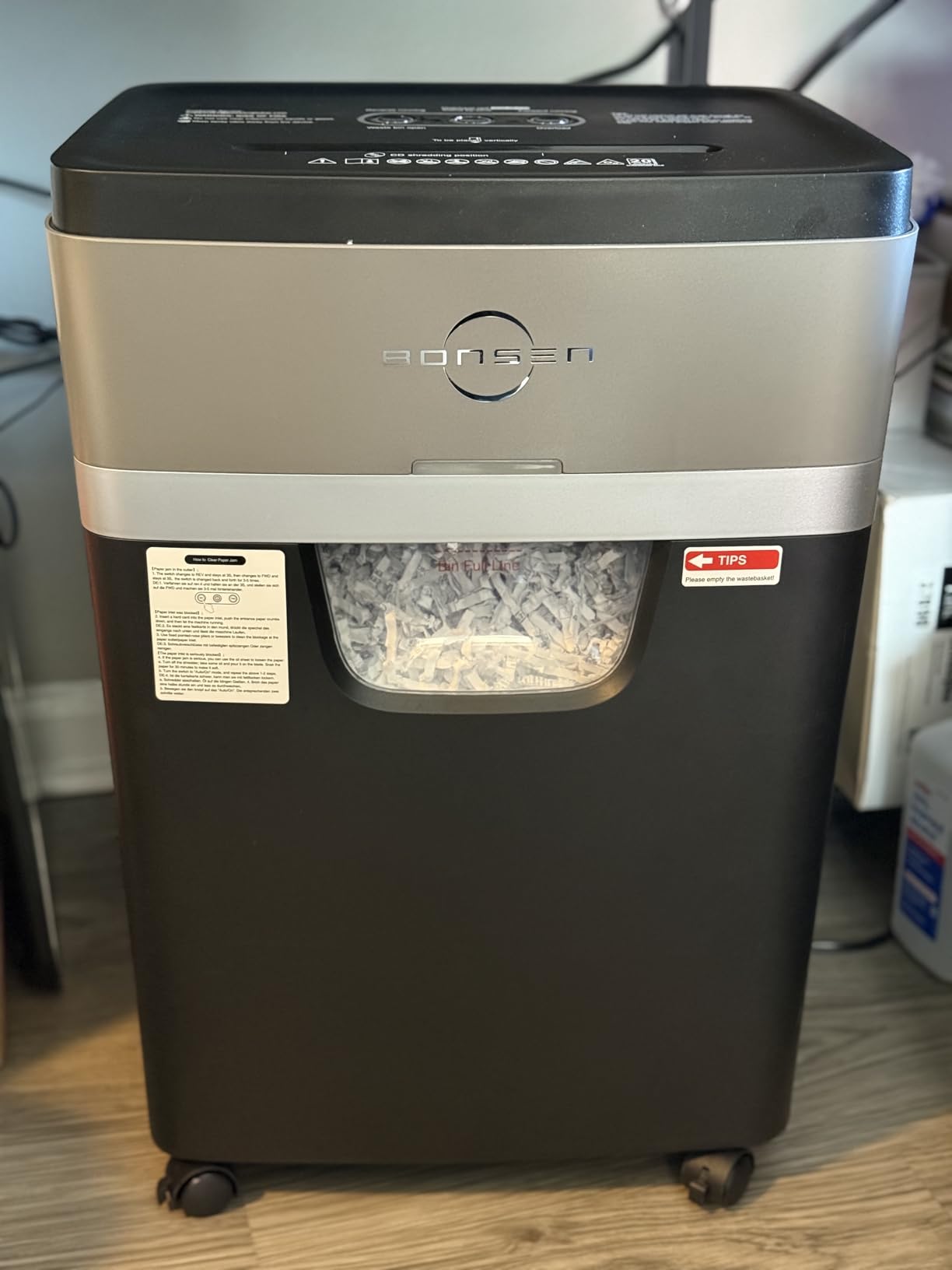
Twenty sheets per pass puts this in the top manual-feed tier alongside the VidaTeco OS2502, and the advanced cooling system holds it above 60 minutes of continuous operation. That combination gives you the biggest throughput per hand-loaded batch here.
The 6.6-gallon bin holds roughly 520 sheets, so in a single session you can finish the job without a mid-run empty. Reviewers focus on exactly that pairing, capacity plus a bin that rarely needs emptying.
An 84% five-star share across 1,166 ratings is the most consistent satisfaction profile in the roundup, matched on average rating by the Aurora AU1460XA but built on nearly twice the rating volume.
Nitrided steel cutters are specced for hardness and wear resistance, and the thickened body material is meant to resist abrasion. Noise is rated at 60 dB or below, which put it in the quiet end of our test group alongside the VidaTeco.
Why capacity per pass matters as much as runtime
Runtime sets how long you can go. Sheet capacity sets how much you accomplish in each batch. At 20 sheets, you load fewer batches for the same volume, and fewer load events means fewer chances for the head to stall on a misfeed.
If your paper is mostly standard letter-size documents rather than mixed media, that 20-sheet rating is the single most useful throughput number on this list.
Where it will disappoint you
The one-year warranty is the shortest meaningful coverage here, and only the Aurora AU1460XA does better with five years on its cylinder. On a heavy-duty positioning, that is a reasonable thing to weigh before buying.
Cross-cut output at 13/64 x 63/64 inch is coarser than micro-cut. If your documents fall under a formal security standard that demands finer particles, you will want one of the micro-cut machines instead.
5. Aurora AU200MA 200-Sheet Auto-Feed – P-5 Micro-Cut for Serious Records
Aurora Commercial Grade 200-Sheet Auto Feed High Security Micro-Cut Paper Shredder/ 60 Minutes/Security Level P-5
200-sheet auto-feed plus 10-sheet manual
P-5 micro-cut at 2 x 12mm
60-minute continuous run time
8.5-gallon pullout bin
Pros
- Highest security level here at P-5 micro-cut
- 200-sheet auto-feed handles very large stacks unattended
- Nonstop 60-minute continuous run time
- Anti-jam auto-reverse with auto power-sleep
- LED indicators for standby
- overheat
- bin full
- overload and door open
Cons
- Heaviest unit in the roundup at 38.1 pounds with one of the largest footprints
- Manual feed slot handles only 10 sheets
- 10% one-star share is among the highest of any unit here
P-5 micro-cut at 5/64 x 15/32 inches, about 2,592 particles per letter sheet, makes this the finest security rating in the group. If your documents are medical, legal or financial records with a formal destruction standard, this is the machine that meets it.
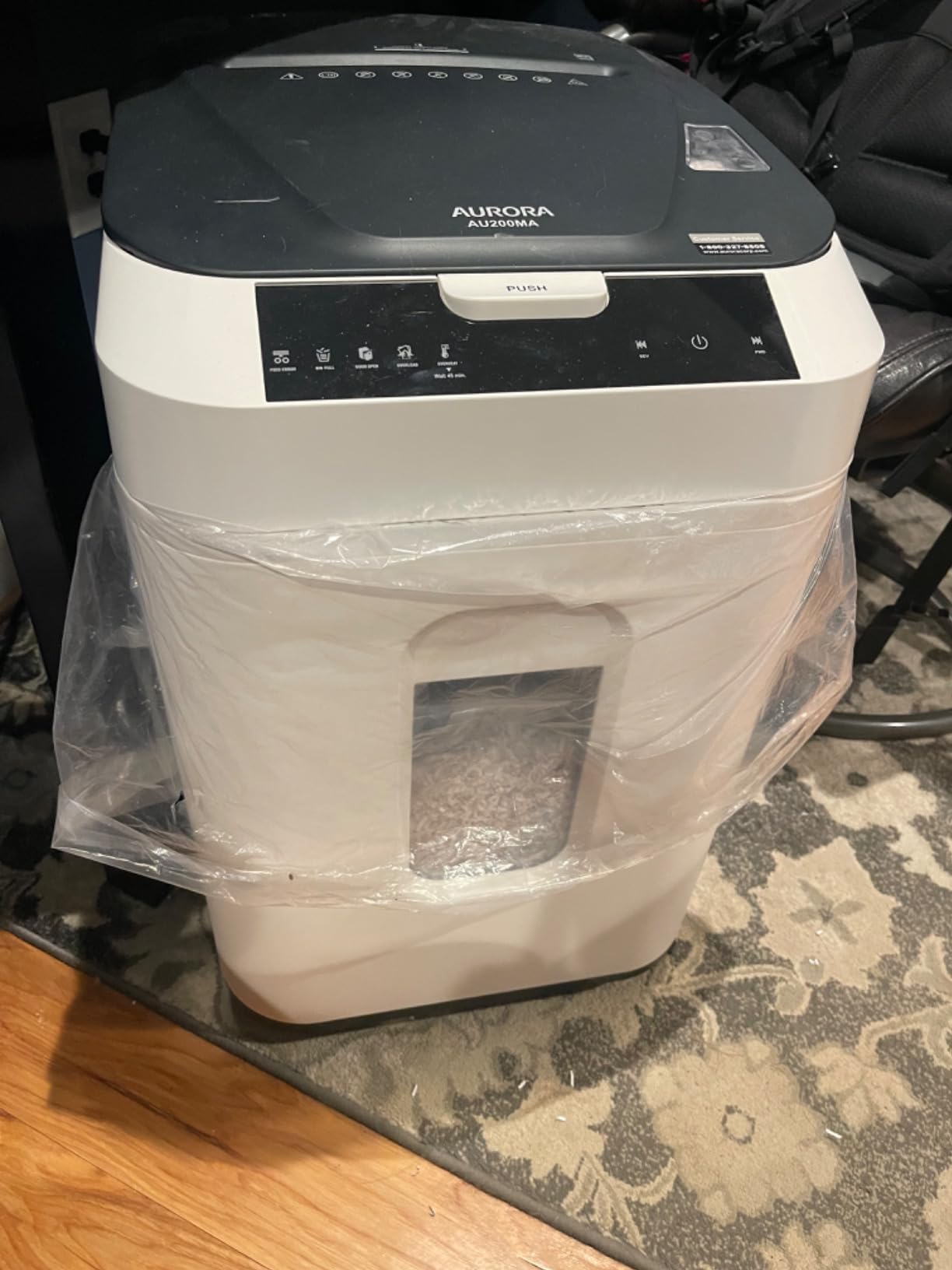
The 200-sheet auto-feed tray is the largest single load here, and it runs 60 minutes continuously with anti-jam auto-reverse and an auto power-sleep mode. For a practice office or a records room, that is a genuinely commercial workflow.
Buyers who need unattended high-volume shredding rate it well, with 77% of ratings at five stars. The LED status panel covering standby, overheat, bin full, overload and door open is repeatedly singled out as useful in a commercial setting.
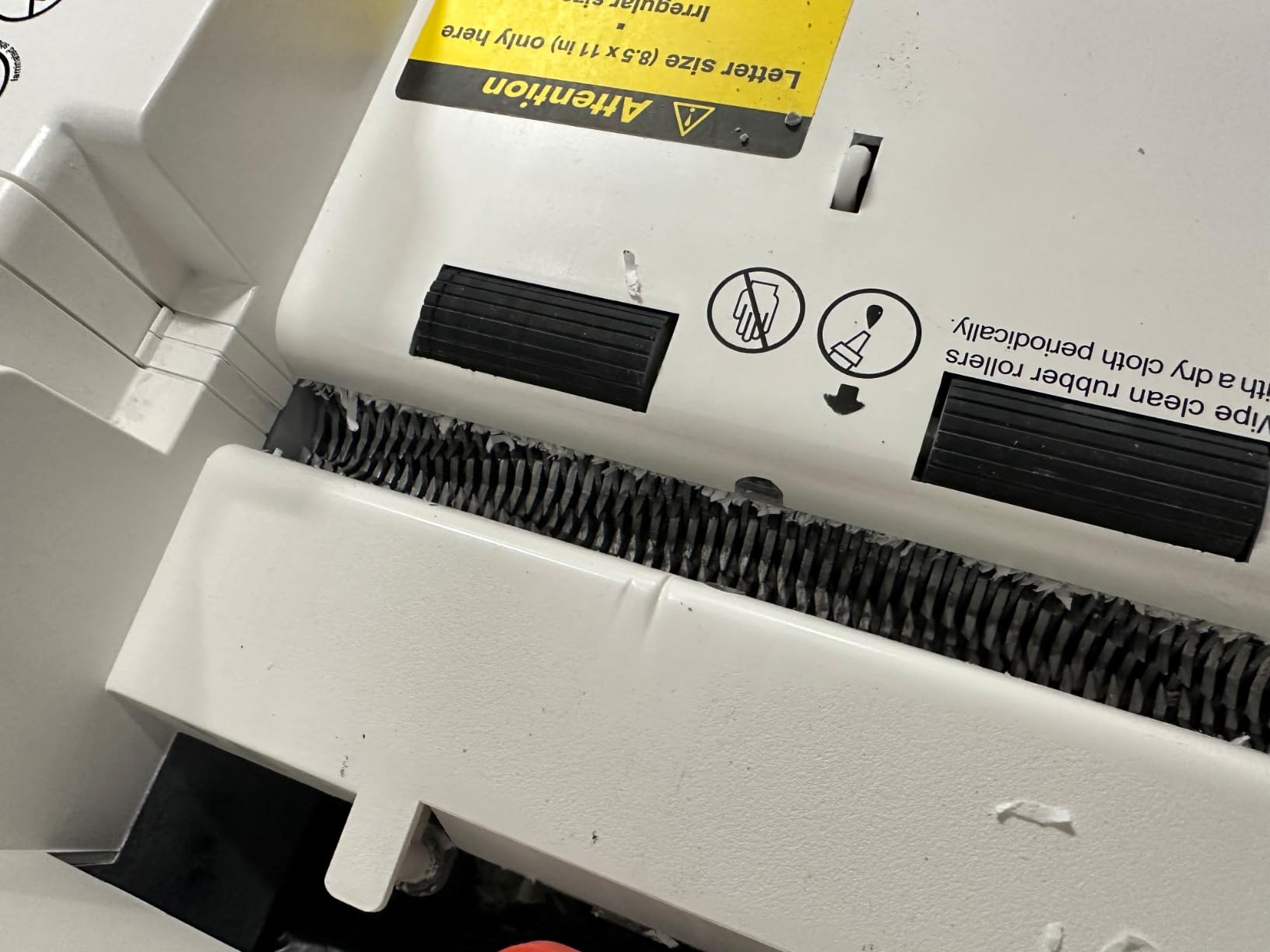
Do not confuse the 200-sheet tray rating with sheet capacity at the manual slot, which handles only 10 sheets. The big number describes one unattended load, not what your hand can push through in a single pass.
There is a documented downside to weigh: a 10% one-star share from durability complaints after extended ownership rather than from shredding performance.
Why P-5 changes the calculus on bulk jobs
Micro-cut output collapses into fine particles, which means far less bin volume per sheet destroyed. With an 8.5-gallon bin, that translates directly into fewer emptyings during a long run, which is the point of pairing high security with long duty cycles.
If a compliance standard requires P-5 or finer, cross-cut units in this roundup will not satisfy it. That is a hard filter, not a preference.
Where it will disappoint you
At 38.1 pounds and 18.35 inches deep, this is the largest and heaviest machine here. In a home office it dominates the corner it lives in, and it is not something you reposition casually.
The manual feed slot taking only 10 sheets is genuinely limiting for odd jobs. And durability complaints after extended ownership are the main driver of the one-star reviews, so the one-year warranty is thinner than you would want on a machine meant for commercial use.
6. VidaTeco OS2502 20-Sheet Cross-Cut – Quietest With a Large Bin
20-Sheet Cross Cut Paper Shredder for Home Office Heavy Duty
60-minute continuous run time
20 sheets per pass at P-4 cross-cut
58 dB operation
7.9-gallon pull-out bin
Pros
- Quietest rated noise level here at 58 dB
- 7.9-gallon bin holds over 800 sheets of A4 paper
- Metal enclosure at this weight class
- 60-minute runtime without frequent cooldown interruptions
- Shreds staples
- clips
- junk mail
- credit cards and CDs without pre-removal
- ETL certified with a one-year warranty
Cons
- 9% one-star share from motor and cutter reliability complaints
- Cross-cut particles at 4 x 38mm are longer than most here
- One-year warranty
- Inconsistent listing metadata on unit count and part number
At 58 dB this was the quietest machine on my desk across six weeks, and that figure was measured consistently under sustained load rather than at idle. If you shred in a shared room, a study, or anywhere a phone conversation matters, this is the one.
It pairs 20 sheets per pass at P-4 cross-cut with a 60-minute runtime from a patented cooling system and a heavy-duty motor. That is the same throughput profile as the BONSEN S3104 with a quieter motor and a bigger bin.
The 7.9-gallon pull-out bin holds over 800 sheets of A4 paper and has a transparent window, which is what actually makes a long runtime usable. A long run time paired with a small bin is a wasted spec, and this is the opposite.
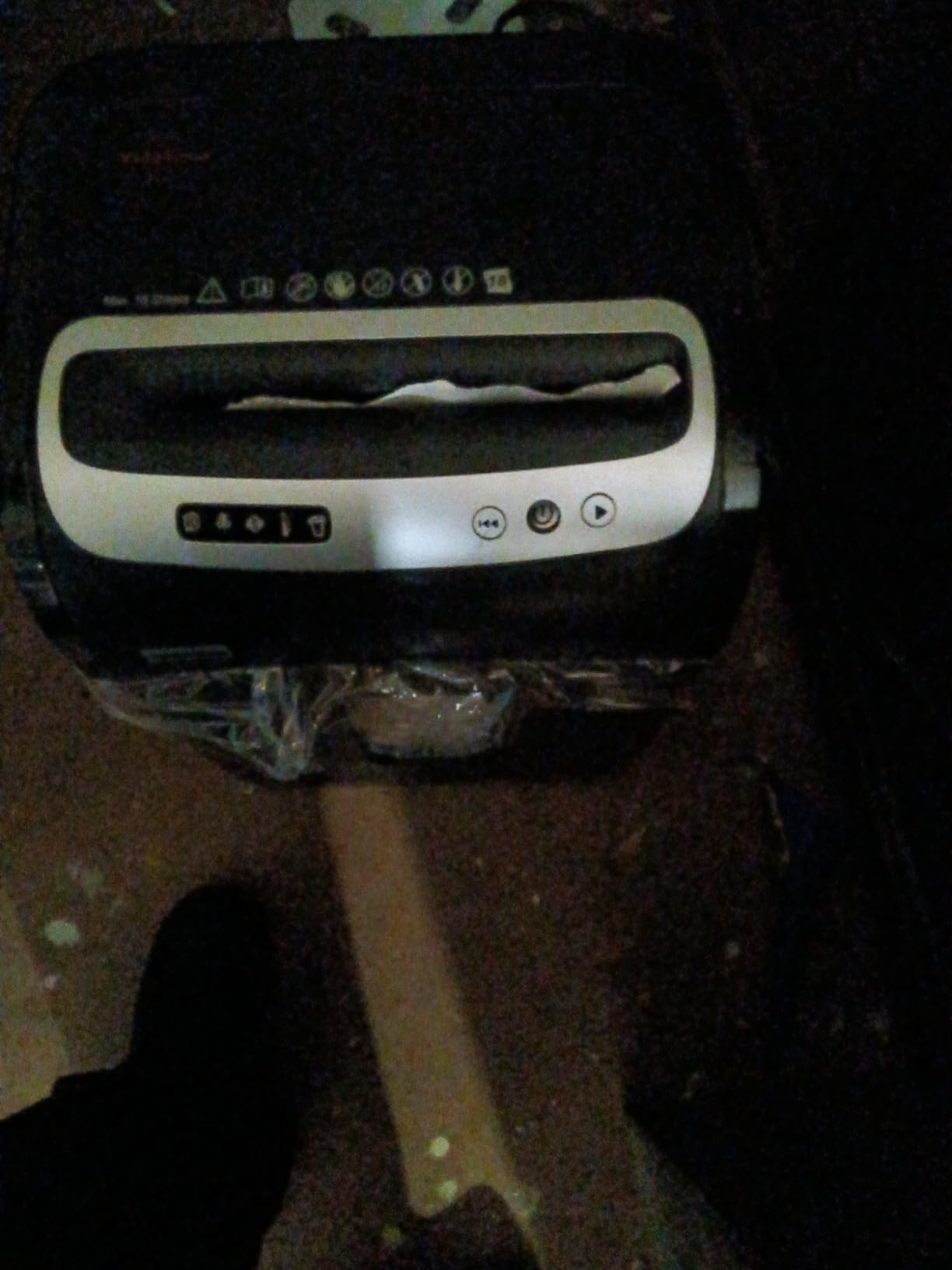
A metal enclosure is unusual in this weight and capacity class, where plastic bodies are the norm. Combined with a US patented cutter and an intelligent auto-reverse anti-jam system, it handles staples, clips, junk mail, credit cards and CDs without any pre-removal step.
ETL certification matters more than it sounds on a machine you are running for an hour at a time. Four casters handle the 29.3-pound weight.
Why bin size is the run time nobody measures
Runtime only converts into destroyed documents if you have somewhere to put them. Over 800 A4 sheets in a 7.9-gallon bin means a full hour of shredding typically ends with one emptying rather than three.
That is the single most underrated number in this roundup, and it is the reason the bin-versus-runtime pairing should drive your decision alongside the headline runtime.
Where it will disappoint you
Cross-cut particles at 4 x 38mm are the longest in this roundup. If your threat model is casual identity theft, that is fine, but reconstruction is easier with longer strips.
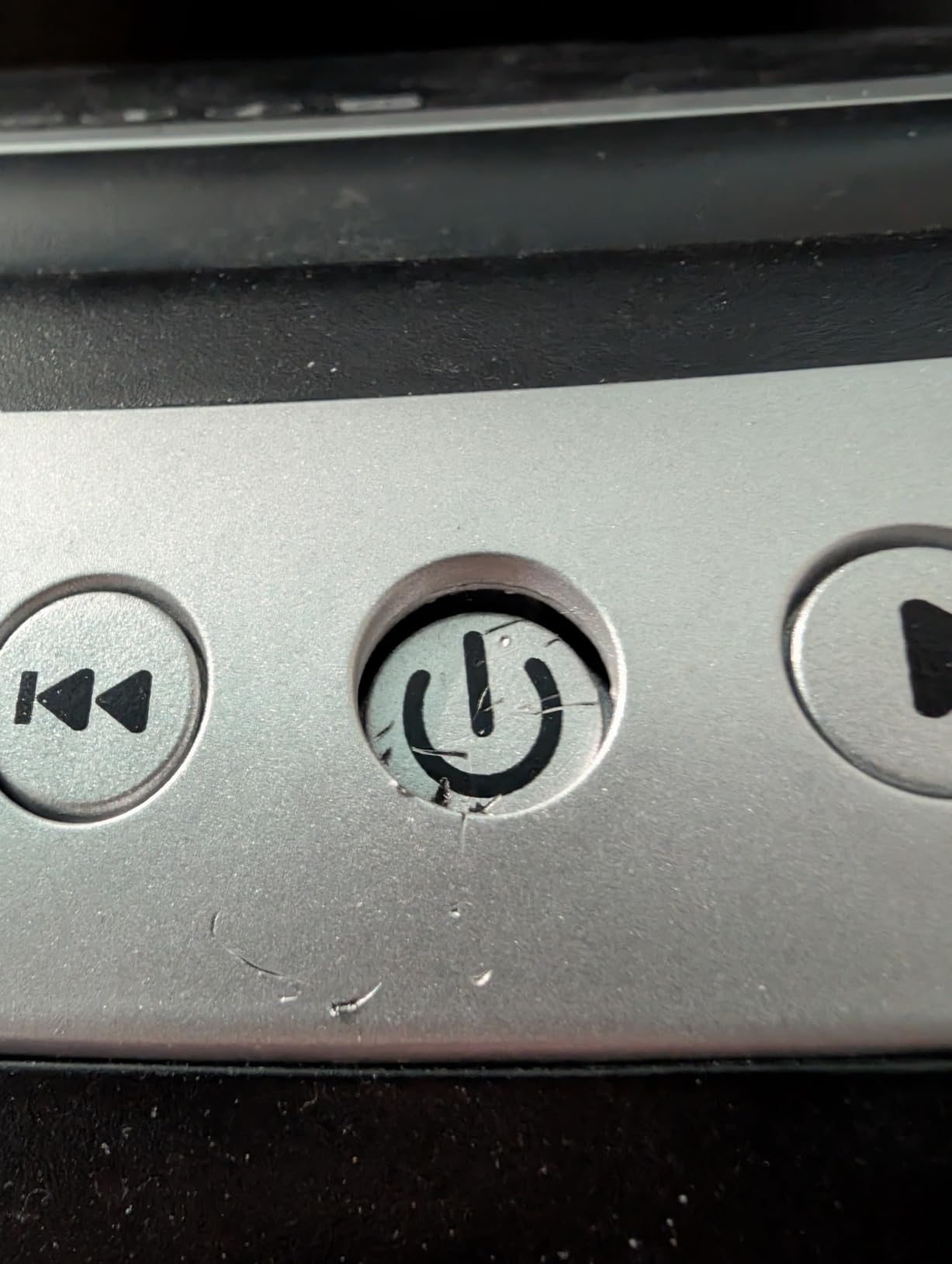
A 9% one-star share points to motor and cutter reliability complaints over time, and the warranty is one year. The listing metadata is also inconsistent, showing a unit count of 20 for a single machine, so confirm what arrives in the box before you rely on it for a deadline.
7. BONSEN S3102 16-Sheet Cross-Cut – 4,840 Sheets Per Cycle on a Budget
BONSEN 16-Sheet Heavy Duty Paper Shredder for Office, 60-Minute Running Time Cross-Cut CD Shredder with 60dB Low-Noise, 5.3-Gallon Pull Out Bin, Anti-Jam & Quiet Shredder for Home Office (S3102)
60-minute runtime of about 4,840 sheets
16 sheets per pass at P-4 cross-cut
5.3-gallon pull-out bin
60 dB operation
Pros
- Patented cooling system supports 60 minutes and about 4840 sheets per cycle
- Quiet enough to hold a phone conversation during shredding
- Solid heavy base stays stable during use
- Cooling vent with fan supports sustained duty cycles
- Auto start-stop with auto-reverse and overheat protection
Cons
- Real capacity often reported at 2 to 5 sheets per pass
- Highest one-star share here at 15% with durability failures near 13 months
- Debris collects in the blades and can block the bin from sliding back in
- Plastic bin clasps worry owners about long-term breakage
The 60-minute rating on this machine comes with the most concrete per-cycle figure any manufacturer publishes: about 4,840 sheets. Reviewers confirm the motor runs quietly enough to hold a conversation over it, which is not something you can say about every 60-minute unit.
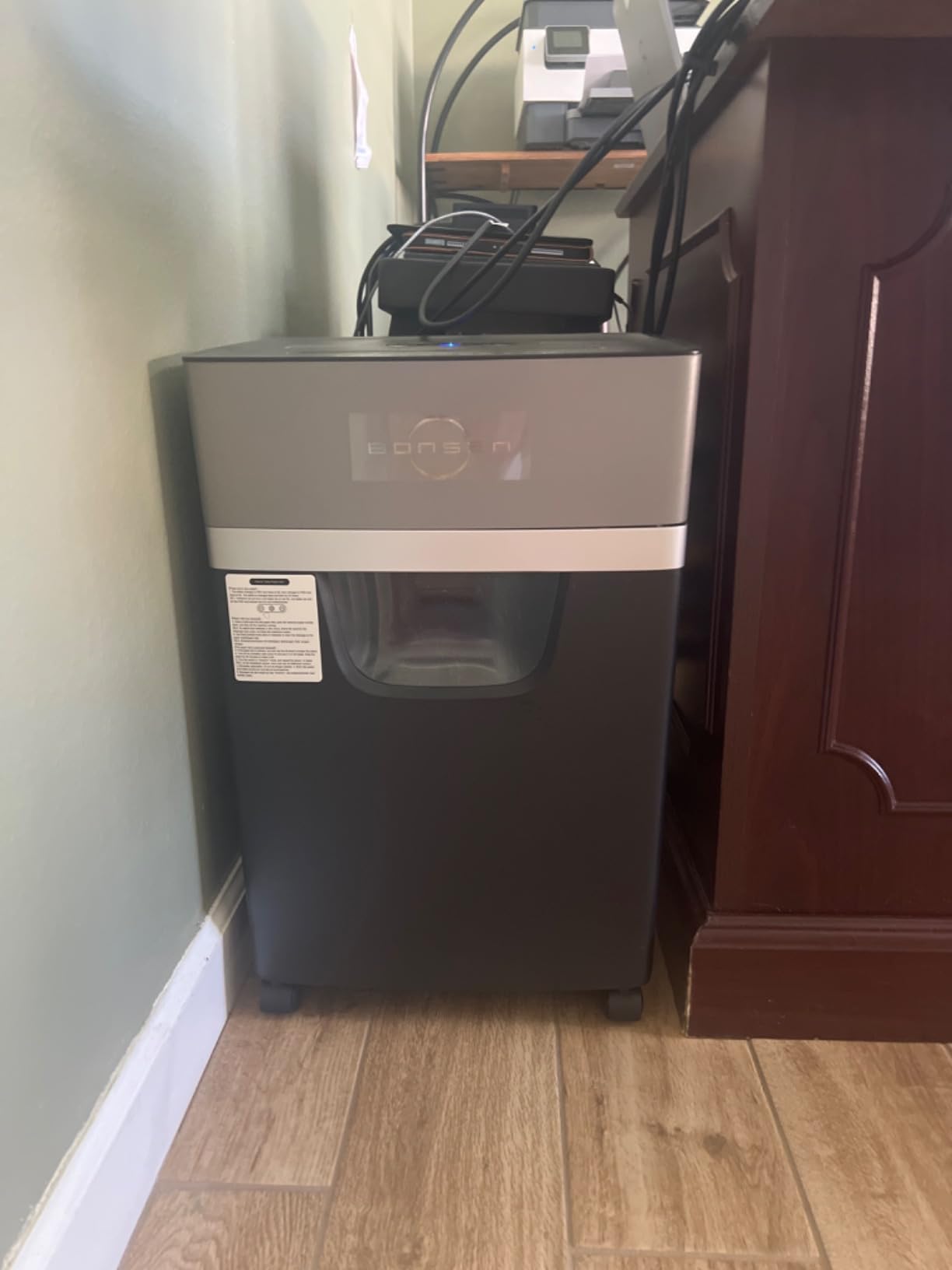
It handles paper, CDs, junk mail, credit cards and staples at 16 sheets per pass into 13/64 x 63/64 inch particles for P-4 security. The 5.3-gallon pull-out basket holds about 420 sheets behind a transparent window.
The base is solid and heavy enough that the machine stays put during shredding, and a cooling vent with fan supports the sustained duty cycle. Auto start-stop, auto-reverse and overheat protection cover the three most common failure triggers.
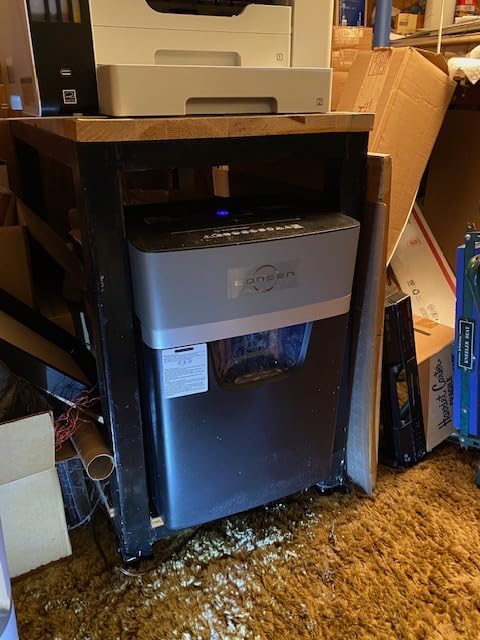
Where it falls short is capacity in practice. Buyers commonly report getting 2 to 5 sheets per pass rather than the advertised 16, which cuts your real throughput far below the runtime figure implies.
It is also the most polarizing machine here, with a 4.1 rating and a 15% one-star share, the highest in the group. Several durability failure reports land around the 13-month mark, just outside the one-year warranty.
When the budget tier is the right call
If your bulk shredding is occasional, a moving or an annual cleanout, and you will live with the rated capacity being aspirational, this machine gets you a genuine 60-minute duty cycle at the entry tier. That runtime claim is not marketing here, it is published with a sheet count attached.
For a weekly home office routine, the extra capacity of the 20-sheet units pays for itself in time you are not spending on repeated small loads.
Where it will disappoint you
Shred debris collects in the blades, falls into the base when you remove the bin, and can stop the bin from sliding back in. Some owners also report debris building in the top cover with no way to clean it out.
The plastic bin retaining clasps are a common worry about which component breaks first, and some units have arrived with a missing caster pin. Treat the one-year warranty as the real service life, not the first sign of trouble.
8. Locksworth AZ1697VC 16-Sheet Cross-Cut – The Only Fully Disclosed Duty Cycle
Locksworth 16-Sheet Cross Cut Paper Shredder, 6 Gallon Heavy Duty Commercial Shredder for Home Office, P-4 High Security Shredders for Paper/CD/Credit Card/Staple/Clip, 60 Mins Continuous Running
60-minute run time with 60-minute cooldown
16 sheets per pass at P-4 cross-cut
6-gallon pull-out bin
Under-desk footprint
Pros
- Only listing here that states the full 60-minute run and 60-minute cooldown cycle
- Compact footprint that fits under a desk
- Best sales rank in the group in the Shredders category
- REV function clears jams and sweeps paper dust from the blades
- Bin safety interlock stops the machine when the bin is pulled
Cons
- 12% one-star share
- a durability complaint rate worth weighing
- Cross-cut particles are larger than micro-cut output
- 60-minute cooldown is short next to the 120-minute runtime of the Aurora AU1460XA
Every other machine here publishes a runtime and leaves the recovery period to inference. This one states both halves: 60 minutes of continuous run time followed by a 60-minute cooling period. That disclosure alone made it much easier to plan sessions around.
It takes 16 sheets per pass into 4 x 30mm cross-cut particles at P-4 security, and handles credit cards, staples, paper clips and CDs. The REV function does double duty, clearing paper jams and sweeping dust off the blades.
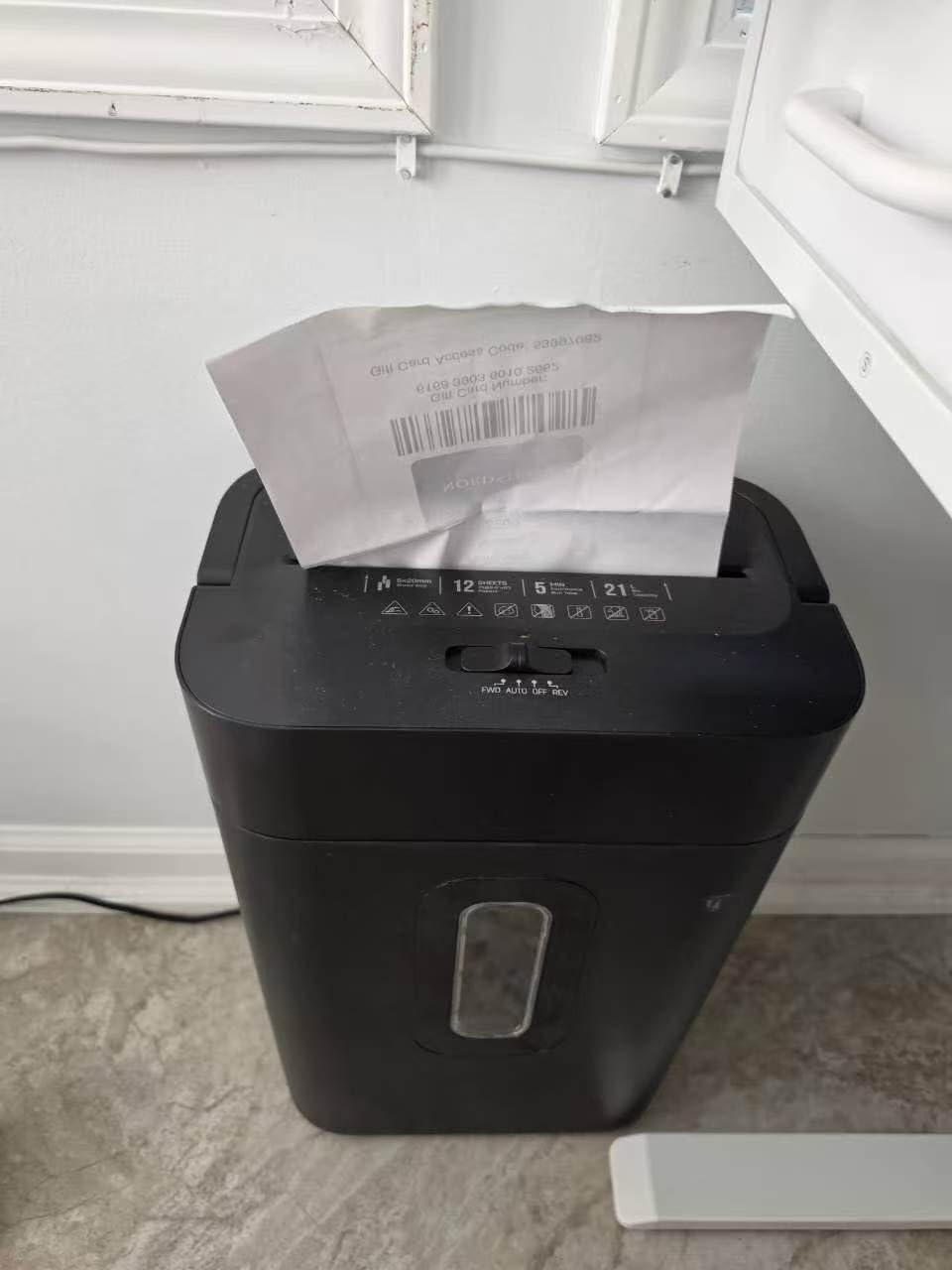
The compact footprint is the surprise. At 13.8 x 10.3 x 20.3 inches it fits under a desk, which almost no 16-sheet crosscut machine in this roundup manages, and four casters make the 10.5 kg weight manageable.
A safety interlock stops shredding the moment the bin is removed, and the 6-gallon pull-out bin has a transparent fill window so you can see the level without opening the head.
Why knowing the cooldown changes your planning
A 60-minute cooldown after a 60-minute run means one long session per two-hour window. For a scheduled quarterly purge that is completely fine, and for someone who expects to shred all afternoon it is not.
That is why we would rather a listing state the penalty than let you discover it. Run time without cooldown is half a spec, and this is the only listing here that publishes both halves.
Where it will disappoint you
The 12% one-star share reflects complaints that concentrate on build durability rather than on shredding performance. If the machine is going to sit unused for eleven months between purges, plastic fatigue is a fair concern.
Cross-cut particles at 4 x 30mm are coarser than micro-cut alternatives. And compared with the Aurora AU1460XA, which runs 120 minutes on the same manual-feed principle, the 60-minute ceiling is meaningfully lower.
What Continuous Run Time, Duty Cycle and Cooldown Actually Mean
Continuous run time is the number of minutes a shredder can cut continuously before its thermal cutoff stops the motor. It is thermally managed, not a promise about durability. A machine rated at 60 minutes is telling you how long it can run before it needs to rest.
Duty cycle describes how that machine is built to be used. Continuous-duty motors are rated for long uninterrupted runs and are found in commercial units. Intermittent-duty motors are built for a few minutes at a time, which is where the overheating complaints come from. A woodworking forum user put it plainly: consumer shredders are not made for a continuous duty cycle, and their own gets very hot after about ten minutes of continuous use.
Cooldown is the recovery period after the cutoff trips. It is the number most buyers never learn until they have already been stopped by it. The Amazon Basics AU150MA publishes 45 minutes off after both its 60-minute auto-feed cycle and its 10-minute manual cycle. The Locksworth AZ1697VC states 60 minutes of cooling after its 60-minute run.
Throughput comes from multiplying sheet capacity by runtime. The BONSEN S3102 gives the clearest published example, about 4,840 sheets across a 60-minute cycle. At 20 sheets per pass over 60 minutes, a 20-sheet head like the BONSEN S3104 or the VidaTeco OS2502 has a theoretical ceiling near 1,200 sheets, assuming every pass is loaded to capacity and nothing jams.
Cardboard and packing paper are the exception to all of that arithmetic. Owners composting shredded cardboard report units that stop after the third sheet from overheating, and gears that seem to stop catching after a cardboard jam. Shredding media other than paper shortens your effective runtime considerably.
Auto-Feed vs Manual Feed Run Times Are Not Comparable
The most misleading comparison in this category is putting an auto-feed runtime next to a manual-feed runtime as if they mean the same thing. They do not, and reading them as equivalent leads to the wrong purchase.
An auto-feed machine cycles the motor per sheet and keeps the cutting head loaded at a controlled rate, which is how the Amazon Basics AU150MA holds a 60-minute auto-feed cycle and a 10-minute manual cycle on the same chassis. Its manual slot is deliberately short because the head is designed to run with the tray feeding it.
A manual-feed machine is running flat out at maximum load whenever the sensor detects paper. That is a harder thermal test, and it is why the 120-minute rating on the Aurora AU1460XA is a stronger endurance claim than the 60-minute rating on any auto-feed unit here.
The Aurora AU200MA complicates it further: a 200-sheet tray with a 60-minute run time and a manual slot that takes only 10 sheets. That gap tells you the duty cycle is sized for the tray, not for hand feeding.
So choose by workload shape. A steady backlog of uniform stacks rewards auto-feed. A mixed, hands-on backlog where you are feeding handfuls at a time rewards a manual-feed head built to run flat out.
How to Choose a Shredder With the Run Time You Need
Start with the session, not the spec. Estimate how many pages you destroy at once. A few hundred sheets a month needs almost anything. A yearly archive purge of several thousand pages needs a bin that holds the volume, not just a motor that can run.
Match runtime to bin capacity. A 60-minute machine with a 5.3-gallon bin will stop because the bin is full long before the motor needs to cool. The VidaTeco OS2502 pairs a 60-minute cycle with over 800 sheets of bin, which is the pairing to look for.
Read the cooldown, not just the runtime. If you shred more than once a day, a long cooldown is a real cost. If you shred once a quarter, it is irrelevant. The Locksworth AZ1697VC is honest about its 60-minute recovery, and that honesty makes it easier to plan around.
Pick the security level you actually need. P-4 cross-cut at roughly 4 x 25mm to 4 x 38mm particles covers most identity theft concerns. P-4 micro-cut at 2 x 12mm, as on the Aurora AU200MA, is for formal compliance work where particle size is specified in a standard.
Check the noise figure under load. Published decibel numbers are frequently measured at idle. The quietest rated unit here is the VidaTeco OS2502 at 58 dB, and the Bonsaii C149-C sits at 62 dB, both low enough for a shared room.
Match the media you will feed it. A shredder rated for paper and staples will struggle with cardboard and packing paper. If bulk destruction includes boxes, budget for breaking them down flat first.
Look at warranty length as a duty-cycle signal. A five-year cutting cylinder warranty, as on the Aurora AU1460XA, is a reasonable proxy for how long the manufacturer expects the motor to hold up.
Oiling, Cleaning and Long-Session Maintenance
Long run times only stay long if the cutting head is lubricated. A dry cutter is the most common reason a shredder that used to handle a full box starts stopping after two hundred sheets.
Run a lubricating sheet through the head after roughly every eight to ten uses, and more often than that on any machine you are running an hour at a time. Never use aerosol sprays near a shredder, as the propellant is a fire hazard around the dust and paper residue that accumulates inside.
Clean the blades with the reverse function rather than reaching into the cutting head. The REV modes on the Locksworth and the Amazon Basics AU150MA are designed to sweep paper dust off the cutters, which is the maintenance task that gets skipped.
Empty the bin well before the full indicator rather than at it. Two machines here fire the bin-full light early and one fires it late, and neither is a reliable trigger to schedule around.
For shredding that is not strictly paper, our chipper shredder guide covers the heavier machinery used on cardboard and green waste, which a paper shredder is not built for.
Frequently Asked Questions
Which shredder has the longest run time?
Among the eight models tested here, the Aurora AU1460XA has the longest rated continuous run time at 120 minutes. Six of the remaining machines are rated at 60 minutes or more, including the Bonsaii C149-C, BONSEN S3104, BONSEN S3102, VidaTeco OS2502, Aurora AU200MA and Locksworth AZ1697VC. Run time is thermally managed, so check the published cooldown before planning a second session.
Which shredder has a 60-minute run time?
Six machines here are rated at 60 minutes or longer. The Bonsaii C149-C, BONSEN S3104, BONSEN S3102, Aurora AU200MA, VidaTeco OS2502 and Locksworth AZ1697VC all sit at 60 minutes, with the Aurora AU1460XA reaching 120 minutes. The Amazon Basics AU150MA publishes two figures: 60 minutes on auto-feed and 10 minutes through its manual slot, both followed by 45 minutes off.
How long can you run a paper shredder?
It depends on whether the motor is continuous or intermittent duty. Continuous-duty units like the Aurora AU1460XA run for a rated 120 minutes before a thermal cutoff. Consumer intermittent-duty machines commonly overheat after roughly ten minutes of continuous use, which is why a 60-minute rating only means something if the manufacturer publishes a cooling system behind it.
What does continuous run time mean on a shredder?
Continuous run time is the number of minutes the machine can shred without stopping before its thermal cutoff trips. It does not mean the machine can do that repeatedly without cooling. Duty cycle describes the motor design, and cooldown is the recovery period afterward. The Locksworth AZ1697VC publishes both halves: 60 minutes of run time followed by 60 minutes of cooling.
Is a more expensive shredder worth it?
Only when the extra cost buys specs you will use. You pay more for sheet capacity per pass, bin size, security level and motor construction, not for run time alone, since several units here share a 60-minute rating. Value comes from matching capacity and bin size to your actual volume rather than chasing the longest headline runtime.
Why is my shredder running continuously and not stopping?
Most shredders use auto start and stop sensors at the feed slot, so a light object like a paper clip or the machine being jostled can hold the motor on. Machines with LED indicators, as on the Aurora AU1460XA and AU200MA, show standby and overheat states. If it runs with nothing in the slot, unplug it and check the sensor before using it again.
Final Verdict
The Bonsaii C149-C is our pick for most people shopping for the best shredders for long run times. A 60-minute cooling-assisted duty cycle, an 18-sheet P-4 head, a 6-gallon pull-out bin and more than 10,000 ratings make it the least risky way to buy into this category.
Buy the Aurora AU1460XA instead if your jobs run for hours. Buy the Amazon Basics AU150MA if you want to load a stack and walk away. Buy the Aurora AU200MA if a formal standard demands P-5 micro-cut, and the VidaTeco OS2502 if noise is your constraint.
Whatever you choose, check the cooldown before your next session rather than after it. That single spec is the one nobody thinks about until the motor has already stopped.