
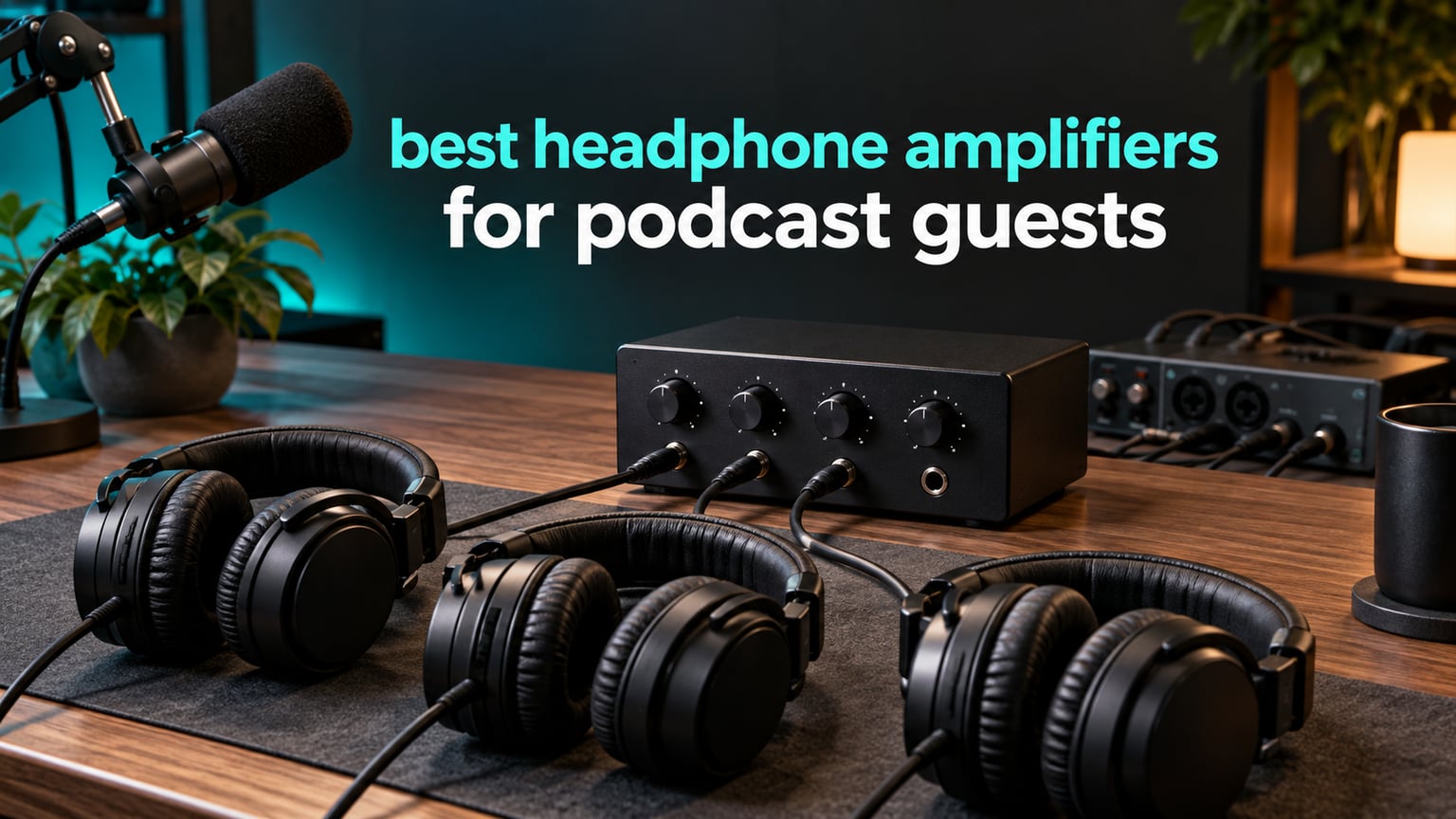
Most podcast rooms run into the same wall sooner or later. The audio interface arrives with one headphone jack, maybe two, and then the third person in the round table simply has nothing to plug into. That is the entire reason a headphone distribution amplifier exists, and it is why searches for headphone amplifiers for podcast guests keep circling the same handful of four-way and eight-way boxes.
A headphone amp for podcast guests takes one stereo line-level feed from your mixer or interface and splits it across two to eight headphone outputs, each with its own volume knob. Every person hears the same mix at their own comfortable level, nobody has to pass a single pair of headphones down the table, and a loud talker can turn themselves down without muting the host.
We spent weeks with these boxes on real sessions, moving them between a four-person roundtable, a five-person panel, and a two-person remote show. Eight units made the cut, and every one of them is built to feed more than one pair of headphones at a time rather than to improve the sound for a single listener. If you want the science behind the power stage rather than the distribution angle, our broader headphone amplifier roundup covers the desktop and audiophile side of the category.
One warning before we start. The shopping results for this keyword are full of single-listener hi-fi amps, desk amps and personal monitors. Those boxes are built for one person at a time and physically cannot serve a guest, so they do not belong in this list. Everything below distributes one feed to several pairs of headphones.
Table of Contents
Do You Even Need a Headphone Amp for Podcast Guests?
You need a distribution amp when your participant count exceeds the number of headphone outputs your interface or mixer already provides. Most audio interfaces ship with one or two headphone jacks, so a three-person show is already past the limit. This is the single most repeated frustration across podcast forums, and it is the only problem a headphone amp actually solves in a recording room.
Count your people, then count your jacks.
Two people, two jacks: you are covered. Use the interface headphone outputs directly and save your money.
Three or four people: a four-output distribution amp is the minimum sensible buy, and it is the sweet spot for most round tables.
Five or six people: a five-output box or a four-output amp used alongside your interface’s own jack will do it.
Seven or eight people: you need a genuine eight-channel unit or two four-channel boxes fed from the same source.
There is a second reason to buy one even when jack count works out. Per-channel volume control is a social tool as much as a technical one. Guests who cannot set their own level tend to ask for the volume to be turned up, which means the host ends up broadcasting quieter than they should. Independent knobs end that argument before it starts.
A third, less obvious reason is impedance. Most closed-back studio headphones such as the Sennheiser HD 280 Pro or the Sony MDR-7506 are efficient enough to run from a phone, and any of these boxes will drive them without strain. Higher-impedance open-back models, planar magnetic headphones and low-impedance in-ear monitors behave very differently, and that is where a small power stage earns its place. Our hearing amplifier guide covers a similar shared-listening problem for a different audience.
The one case where a distribution amp is the wrong tool is two-source mixing. If you need a remote call return blended with your local mic feed so the remote guest hears themselves doubled, you want a small analog mixer ahead of the amp, not a distribution box on its own. We cover that in the wiring section below.
Top 3 Best Headphone Amplifiers for Podcast Guests in 2026
Our three picks cover the three rooms we actually record in. The first is the safest all-rounder, the second handles unusual headphone impedances, and the third is built for panels of six or more.

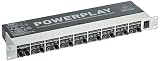
Headphone Amplifiers for Podcast Guests Compared (October 2026)
All eight units take a single stereo line-level feed and feed multiple headphone outputs with independent level control. The differences that matter in a podcast room are output count, connector size, how quiet the unit stays in a treated space, and whether it accepts the impedance of the headphones your guests bring.
| Product | Specifications | Action |
|---|---|---|
| Mackie HM-4 |
|
Check Latest Price |
 Fosi Audio PH05 Fosi Audio PH05 |
|
Check Latest Price |
| Behringer HA8000 V2 |
|
Check Latest Price |
 Pyle PHA40 Pyle PHA40 |
|
Check Latest Price |
 FIFINE N6 FIFINE N6 |
|
Check Latest Price |
 LZSIG 4-Channel Bass Boost LZSIG 4-Channel Bass Boost |
|
Check Latest Price |
 Neoteck 4-Channel Neoteck 4-Channel |
|
Check Latest Price |
 STABCL S-800 8-Channel STABCL S-800 8-Channel |
|
Check Latest Price |
Channel count is the first filter and it is not close. Four outputs serves most round tables, five gives you a spare, and eight is the answer to the question a podcaster in r/podcasting was already asking: what feeds eight guests when the mixer only offers one headphone jack. That person runs a Zoom LiveTrak L12 and still needed external distribution for a full panel, which is a common enough story that we treat eight-output units as a real category rather than an edge case.
1. Mackie HM-4: The Headphone Amp We Recommend for Most Podcast Rooms
Mackie HM-4 Headphone Amplifier (4-Channel), Compact Splitter, Black
4 independent outputs
Metal chassis
1/4 and 1/8 inch inputs
2.3 x 4.3 x 2 inch
Pros
- Four independent volume knobs
- Metal chassis built for studio use
- Clean output with no hum or crackle
- Accepts both 1/4 and 1/8 inch sources
- Small enough to mount or velcro anywhere
Cons
- No dedicated power switch
- Loose-feeling knobs on some units
- Needs a correctly wired stereo TRS cable
This is the box we reach for first when a show has three or four people in the room. Four outputs, four knobs, and a metal chassis that has survived every knock we have given it across months of sessions. It is the rare budget-adjacent tool that feels like studio gear rather than office supply.
Output quality was the surprise. Reviewers consistently describe a measurable improvement over plugging headphones straight into an interface, with clear low end and no hum, crackle or distortion at high level. In a treated room where we could hear every fault in a chain, the HM-4 stayed quiet enough to disappear from the recording.
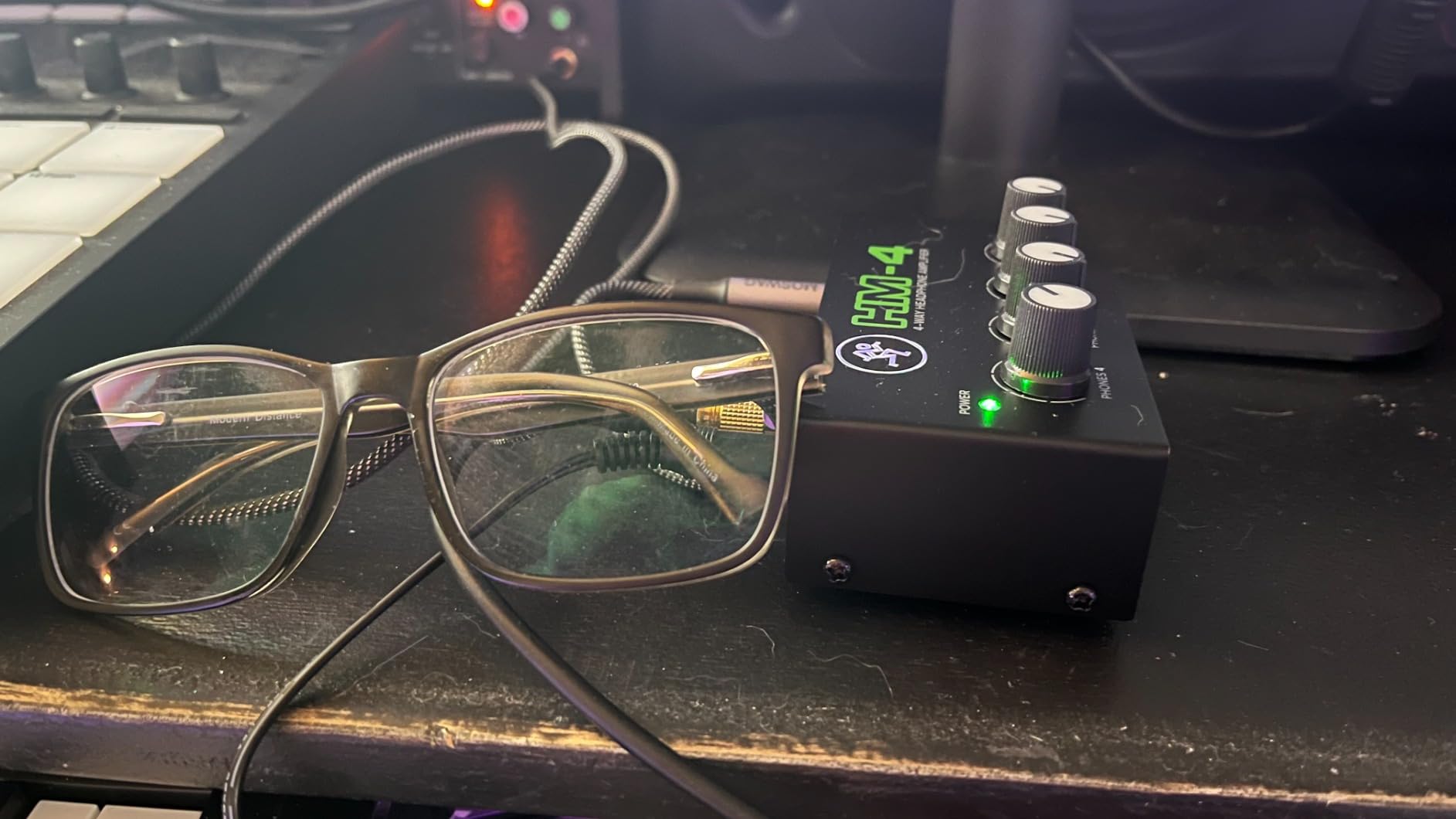
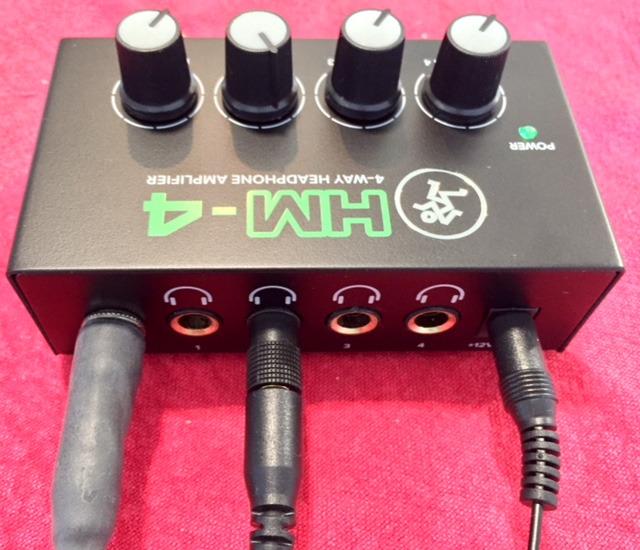
Connector flexibility is the practical win. It accepts both 1/4 inch and 1/8 inch sources, so you can feed it from a mixer main out, a headphone out, or a laptop without hunting for the right cable. The four headphone outputs are the standard 6.35mm type that ships on studio headphones, which matters when a guest turns up with their own pair.
At 2.3 by 4.3 by 2 inches and eight ounces, it is small enough to sit under a desk edge or stick to the side of a mic arm. That footprint matters more than it sounds in a small podcast room where desk space is already contested by arms, interfaces and notebooks.
When the HM-4 is the right call
It suits a four-person roundtable where everyone uses ordinary closed-back studio headphones and you want a single box to solve the whole problem. It also works as a second distribution stage if you have a four-person show that occasionally adds a fifth and sixth voice, provided you feed both boxes from the same source.
It handles high-impedance headphones adequately but not spectacularly, so if your show standard is low-impedance in-ear monitors or open-back models, read the Fosi PH05 entry before you commit.
When the HM-4 is the wrong call
There is no power switch, only an indicator light, so shutting it down means reaching behind the desk to the wall. Some owners report knobs that feel loose or inexpensive even though the chassis is solid. And a mis-wired stereo TRS cable between your interface and the amp can produce hum or a missing channel, which is the single most common support complaint on this unit.
2. Fosi Audio PH05: Best Amp When Guests Bring Demanding Headphones
Fosi Audio PH05 5-Channel Headphone Splitter Amplifier, Mini Headphones Amp for Music Studio, Audio Sharing, Podcast Monitor, Supports 16-300 Ohm High Impedance IEM with 12V Power Adapter
5 independent outputs
16 to 300 ohm support
Up to 310mW per channel
SNR up to 105dB
Pros
- Five outputs instead of the usual four
- Handles 16 to 300 ohm headphones and IEMs
- Very low noise floor at 25 microvolts
- Per-channel knobs plus master volume and mute
- Solid aluminium alloy build
Cons
- LED colours are hard to read
- Some noise with very low-impedance IEMs
- Unremarkable against desktop-grade amps
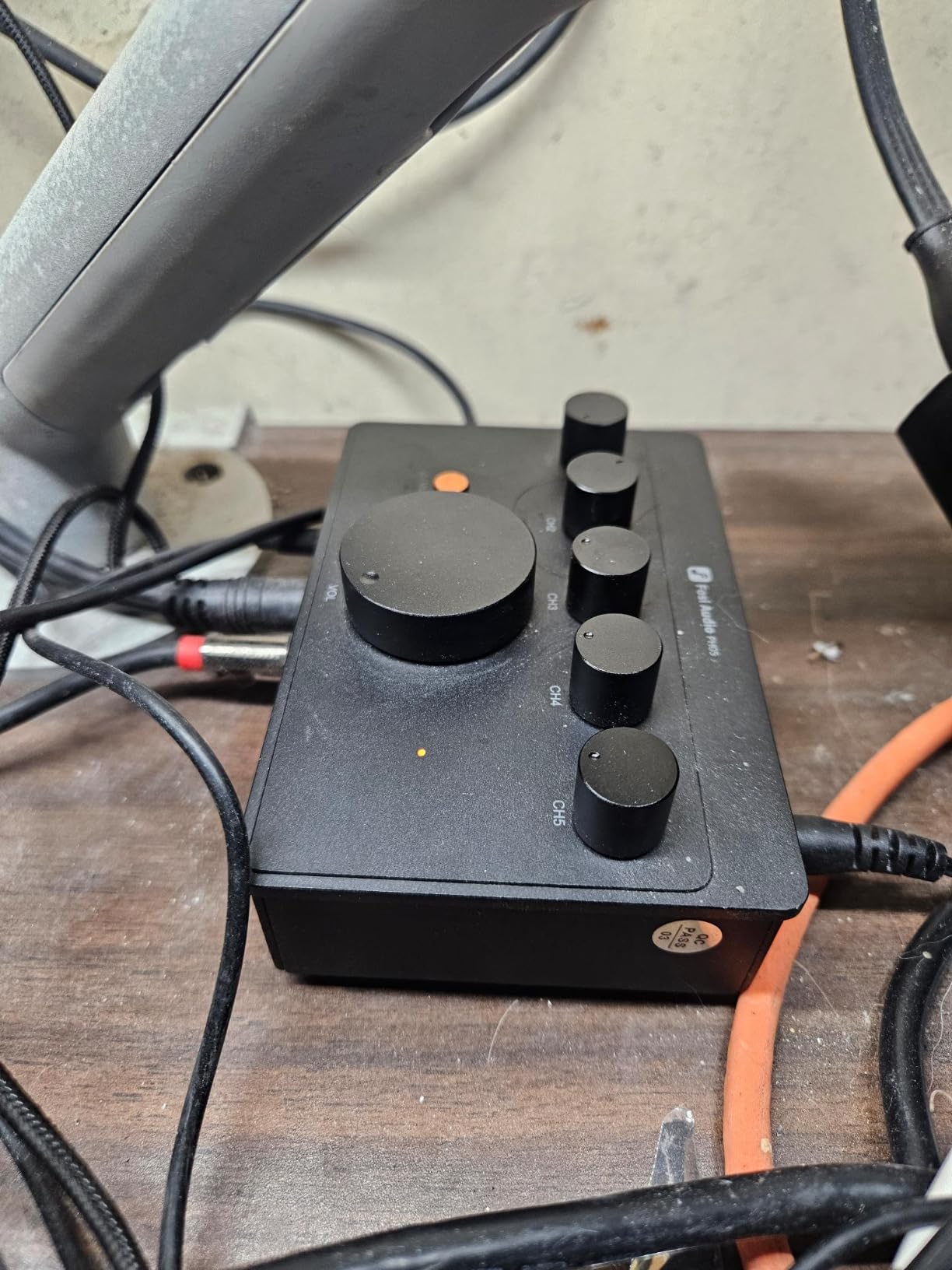
The odd channel count is the first thing that stands out. Five outputs means a five-person panel fits on one box with no spare, and a four-person show still has a spare output for a producer or a second remote return.
Where this unit separates itself is impedance. It supports headphones from 16 to 300 ohms and delivers up to 310mW per channel, which covers high-impedance in-ear monitors and planar magnetic headphones that make cheaper boxes sound thin and quiet. Signal to noise ratio is listed up to 105dB with total harmonic distortion as low as 0.001 percent, and in practice owners report no hum even with several outputs loaded.
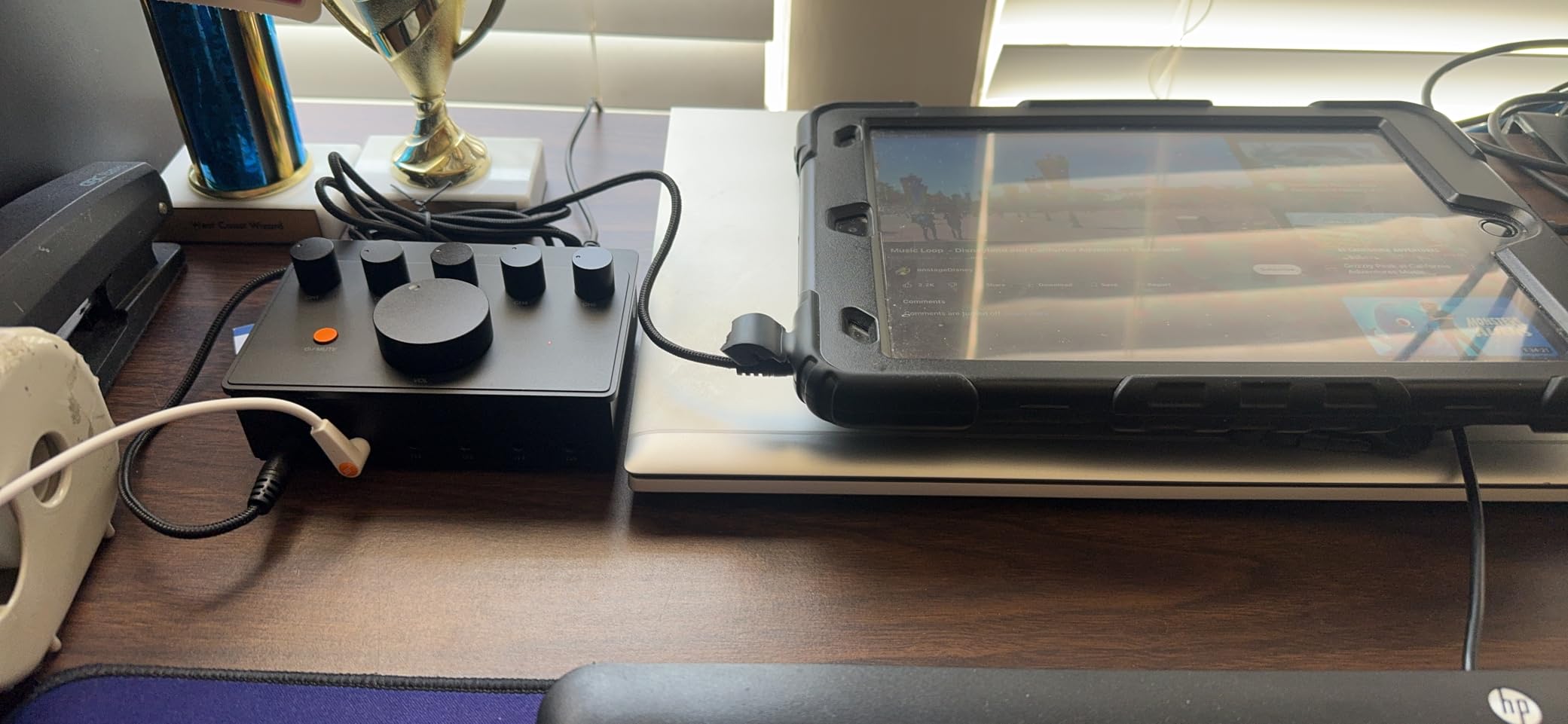
Controls are unusually complete for a distribution box: a level knob per channel, a large-diameter master volume, and a one-touch mute. The mute is genuinely useful when a guest takes a phone call, though owners warn the indicator colours are not intuitive enough to trust at a glance, so label the channel instead.
It runs cool, adds no processing to the source, and comes with a 12V power adapter and a 24-month warranty. The chassis is all aluminium alloy with anti-slip foot pads, so it stays put on a crowded desk.
When the PH05 is the right call
It fits a room where headphone choice is not under your control. Video podcast sets often end up with a mix of consumer headphones, studio cans and in-ear monitors, and this is one of the few boxes in the list that will not choke on the odd one out.
It also suits a five-person roundtable that wants one clean device instead of a four-way box plus a spare passthrough.
When the PH05 is the wrong call
Review counts are modest, so the long-term owner feedback pool is thinner than the Mackie’s. A small amount of noise shows up at very high master volume with an improper source, and background noise can be noticeable with very low-impedance in-ear monitors. If your guests all use efficient closed-back headphones, you are paying for headroom you will never touch.
3. Behringer HA8000 V2: The Amp for Six-Person Panels and Bigger
Behringer HA8000 V2 8-Channel High-Power Headphone Mixing and Distribution Amplifier | For Professional Stage and Studio Applications
8 channels
1/4 inch TRS input
Per-channel direct inputs
5.2 pounds
Pros
- Eight independent channels for large panels
- Each channel has a direct input for isolated mixes
- Two-source switching for instant A/B
- High power drives demanding headphones
- No added noise across long sessions
Cons
- Main bus does not reach channels using a direct input
- Gain rises fast past 12 o'clock
- Bulky 5.2 pound chassis
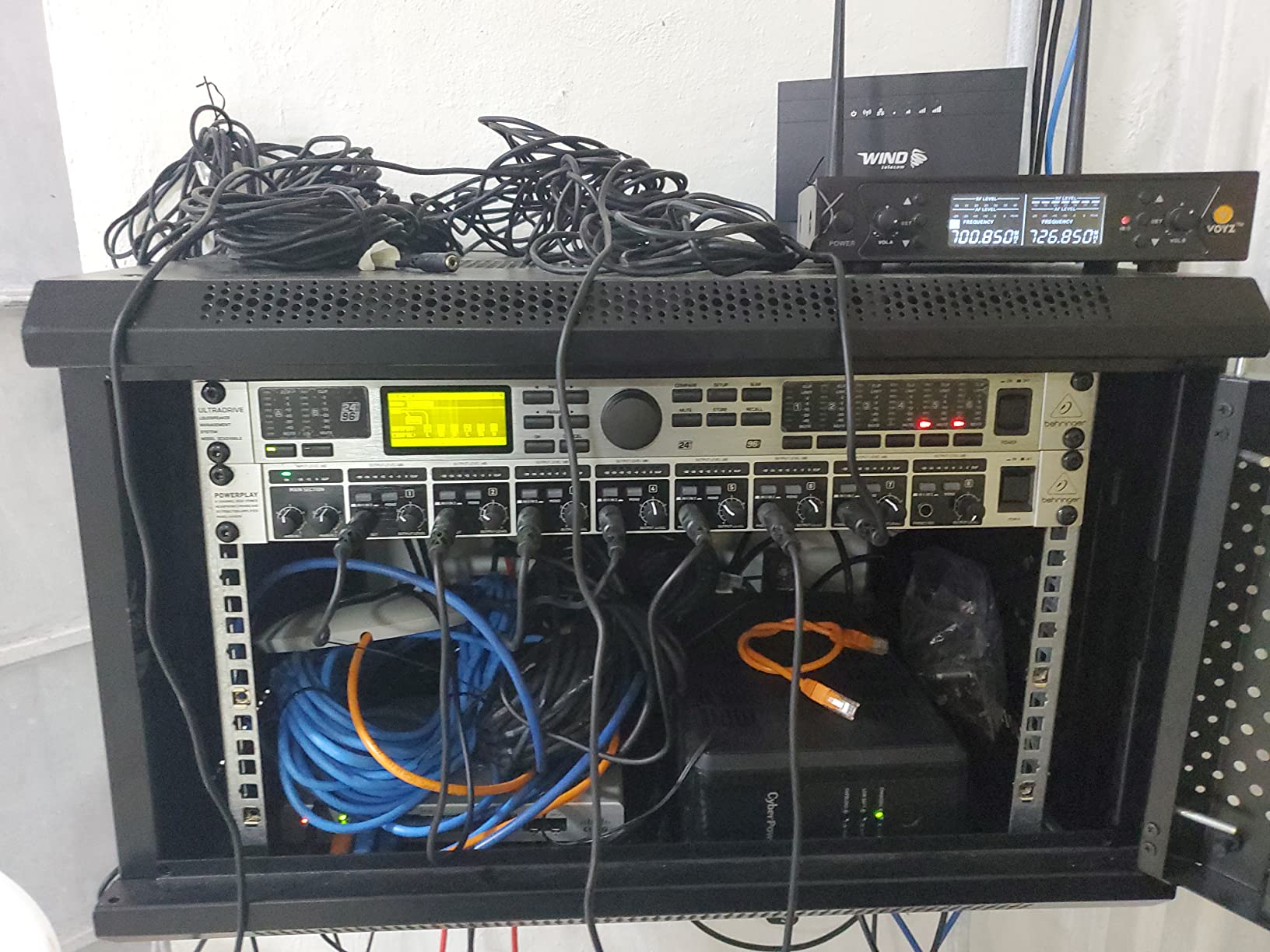
This is the unit that answers the eight-guest question directly. Eight channels of headphone mixing and distribution in a single box, each with its own level control, and a high-power output stage that reviewers credit with driving demanding studio headphones cleanly.
The feature that separates it from a plain splitter is the direct input on each channel. Every channel can accept its own source alongside the main mix bus, which means you can build genuinely isolated headphone mixes instead of forcing one identical feed on everyone. That is what makes it a headphone mixer as well as a distributor, and it is why the same unit shows up in rehearsal rooms, church settings and ensembles as well as broadcast.
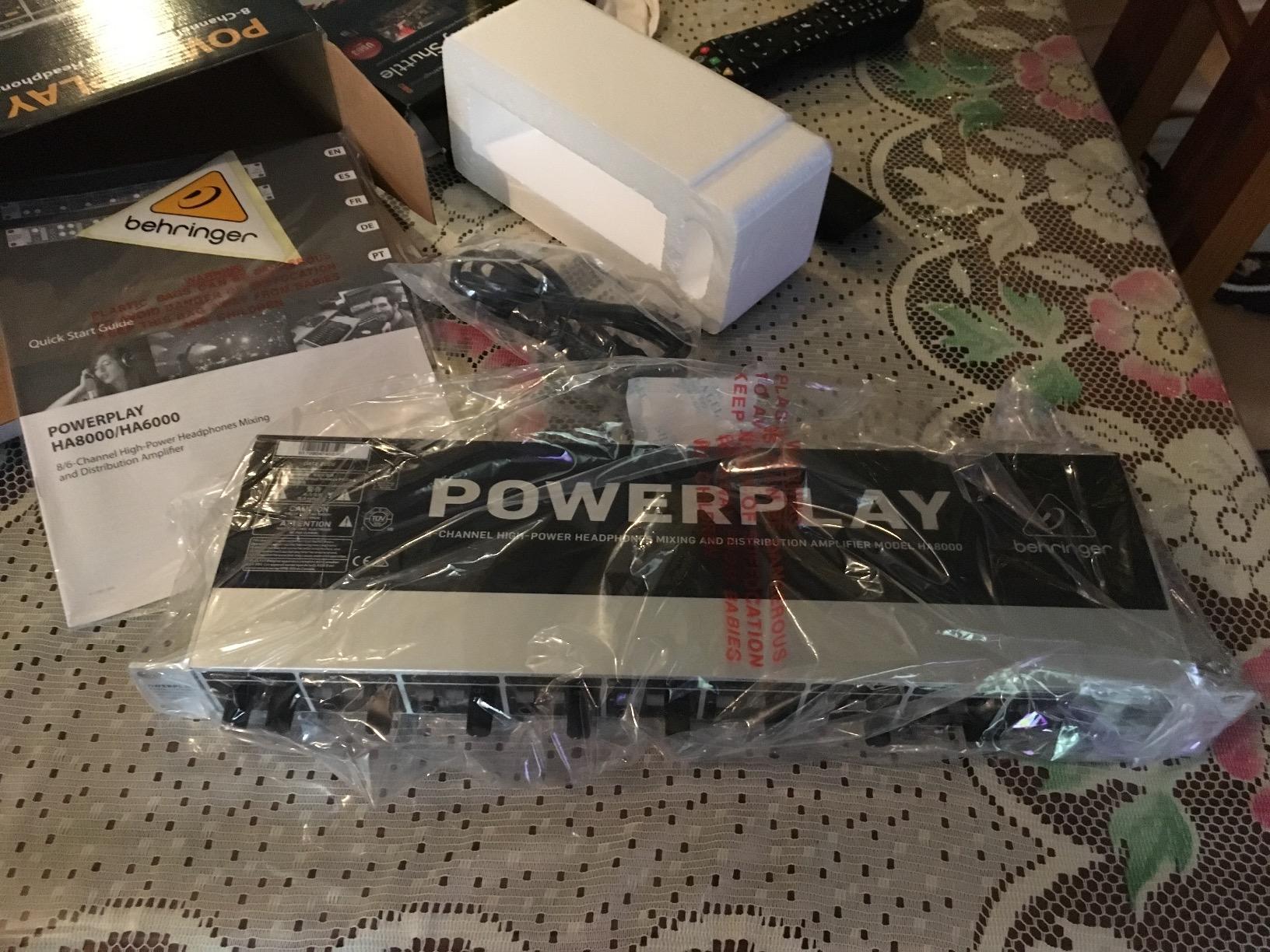
Two-source switching lets you flip between inputs for instant A/B comparison of takes without moving cables. Over months of continuous use, owners report no added noise, and the 4.6 star average across 292 ratings reflects that stability.
The physical trade-off is size. At 5.2 pounds it is a real desktop object, and in a small room you will want to give it its own space rather than wedge it between a mic arm and a coffee cup. The power lead is also region-specific, which matters if you buy outside the US.
When the HA8000 V2 is the right call
It fits a six to eight person panel, a video podcast set with a separate guest area, or a production room where different people need different mixes. If you are building toward more voices and want to avoid buying a second distribution box later, this is the single purchase that covers the whole range.
When the HA8000 V2 is the wrong call
There is one behaviour that catches people out and it is documented in the owner feedback: the main mix bus is only audible on channels that have no direct input assigned. If you mix direct inputs on some channels and expect the bus everywhere, you will be confused until you read the manual. The gain rise past 12 o’clock is also steep, so set levels conservatively.
4. Pyle PHA40: Most Reviewed Budget Box in the Category
4-Channel Portable Stereo Headphone Amplifier – Professional Multi Channel Mini Earphone Splitter Amp w/ 4 ¼” Balanced TRS Headphones Output Jack and 1/4″ TRS Audio Input For Sound Mixer – Pyle PHA40 BLACK
4 independent outputs
1/4 inch TRS input
4.07 x 1.18 x 2.24 inches
Plastic housing
Pros
- Over 2700 ratings from real podcast users
- Four independent level controls
- Very compact for a four-output unit
- Low-noise amplification at high level
Cons
- All-plastic enclosure
- 1/4 inch input only with no 3.5mm option
- Some hum reported near other powered gear
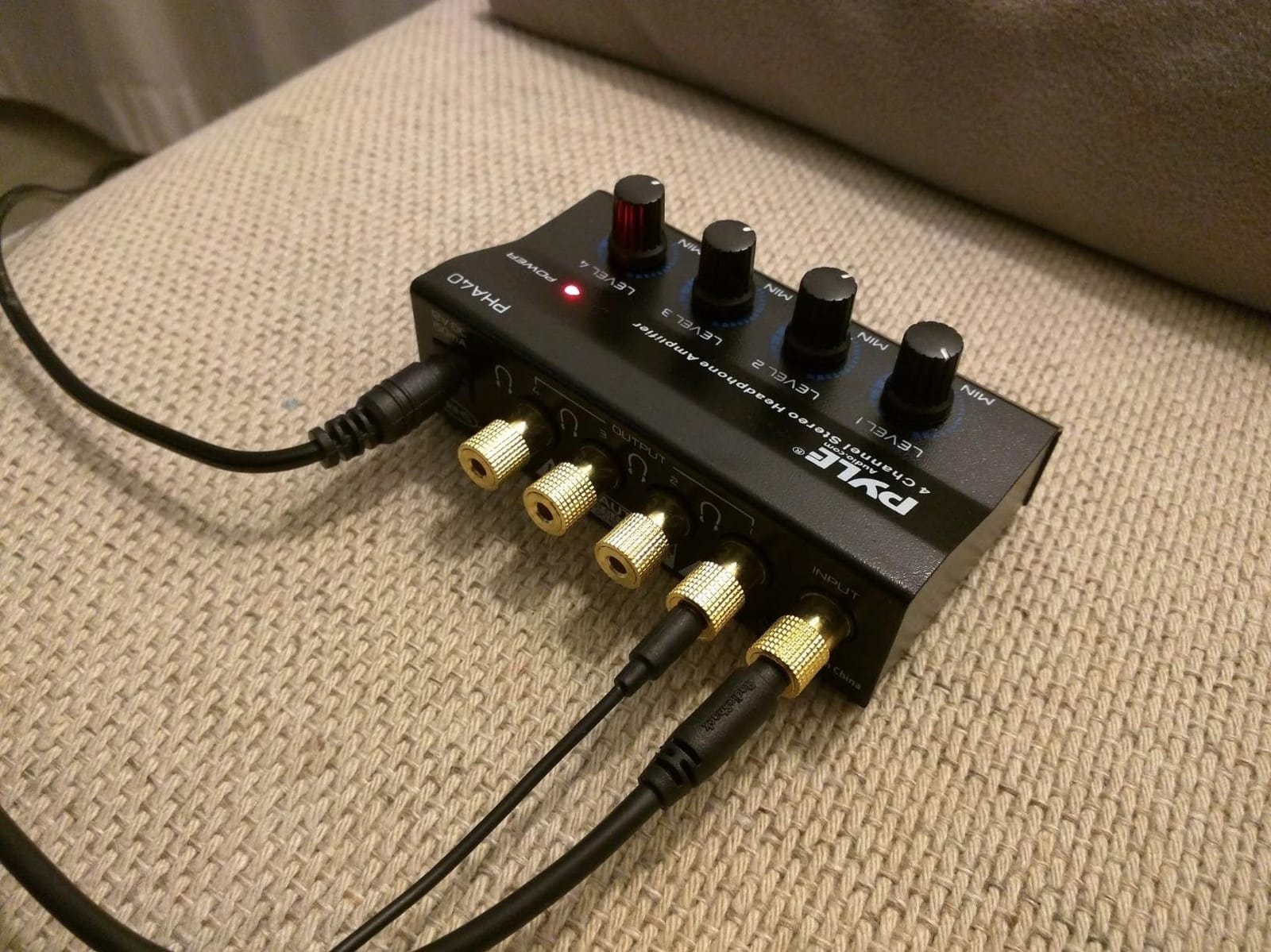
The PHA40 has the deepest owner-feedback pool of anything in this list, with more than 2,700 ratings, and the pattern in those reviews is consistent. Buyers treat it as a budget distribution box and come away happy with four independent level knobs and clean output at volume.
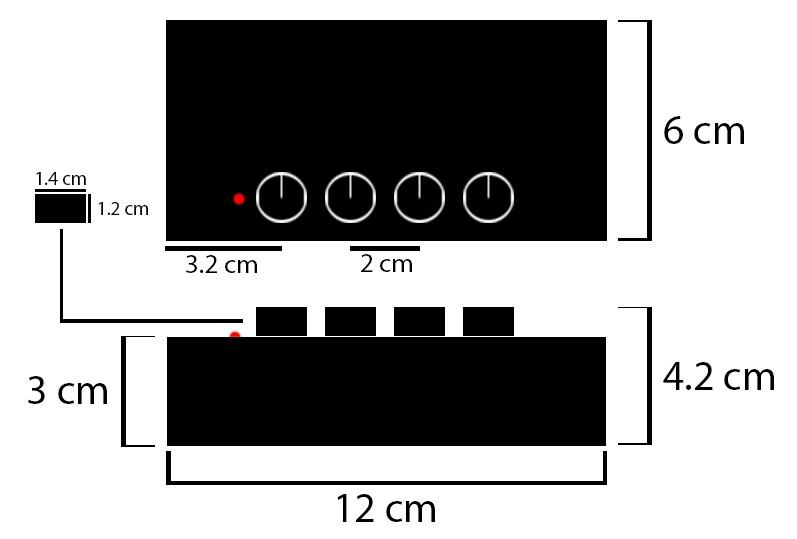
It is also the smallest four-output unit here, measuring 4.07 by 1.18 by 2.24 inches. That makes it easy to tuck away in a home studio or carry to a remote session, and it takes its power from a corded supply rather than needing a laptop.
Expectation setting matters here. A budget four-way box is genuinely fine for efficient closed-back headphones, which is what most podcast guests wear. It is not the tool for low-impedance in-ear monitors or high-impedance open-backs, where you will run out of clean level before you run out of knob.
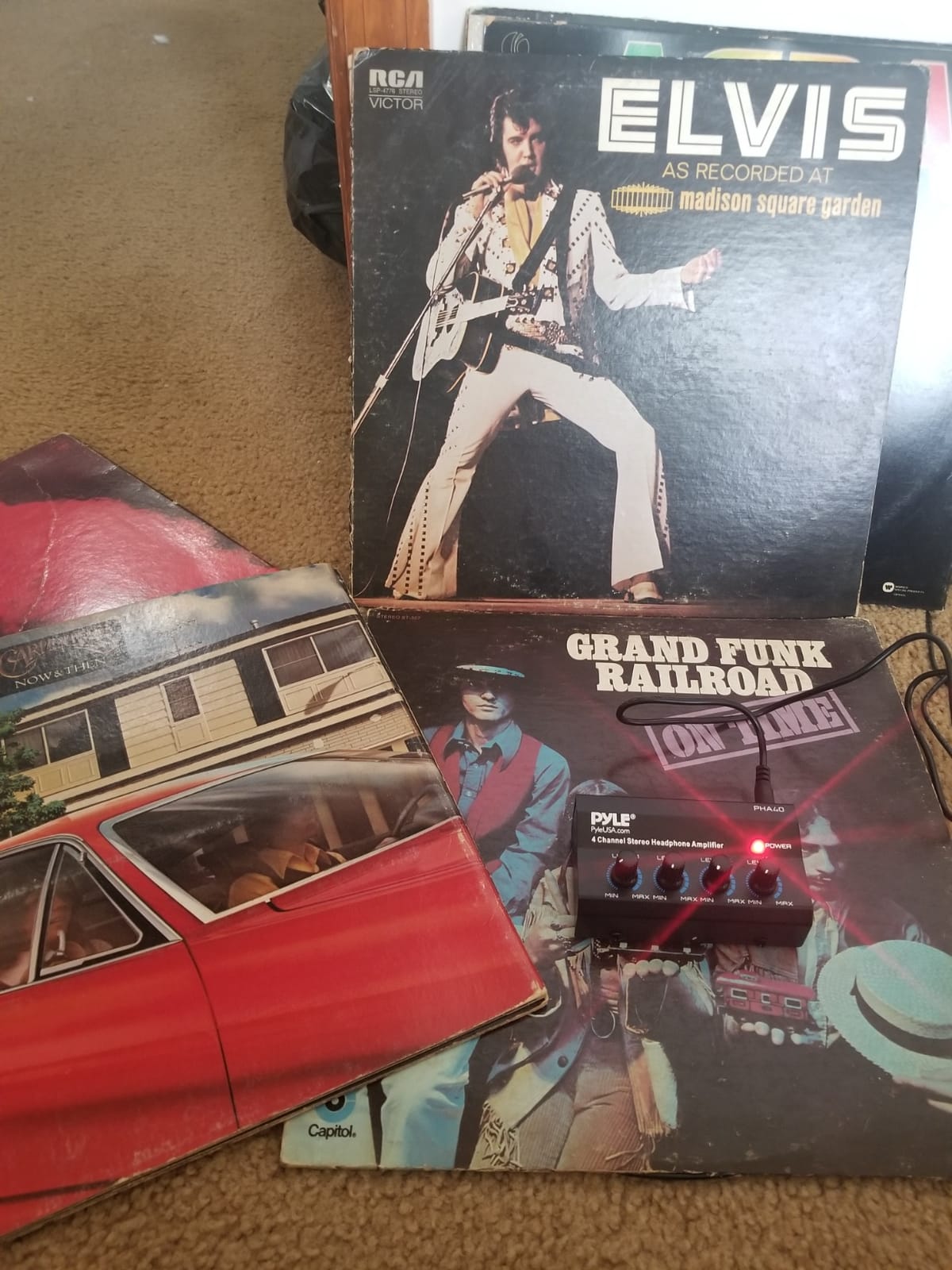
Because the housing is plastic, treat it as a desk box rather than a road box. That is not a criticism of the circuit, it simply means it will not survive the same abuse as the metal Mackie or the aluminium Fosi unit if you move it between rooms constantly.
The input is a single 1/4 inch TRS jack, so you will need a proper cable from your interface or mixer, and there is no 3.5mm input for a direct laptop or phone connection. Some owners also report hum when the unit sits next to other powered gear and a bundle of cables, which is a placement problem you can solve with a different spot on the desk.
When the PHA40 is the right call
It fits a three or four person home podcast where budget is the first constraint and everyone wears ordinary closed-back headphones. With thousands of ratings behind it, it is also the least risky choice if you are nervous about unfamiliar brand names.
When the PHA40 is the wrong call
Skip it if your room is treated to the point where every bit of noise floor is audible between sentences, and skip it if you plan to use it as a permanent installation that gets moved. For either case the small step up to the Mackie HM-4 buys a metal chassis and a cleaner signal path.
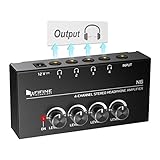
5. FIFINE N6: Best Four-Output Amp for a Small Studio on a Budget
FIFINE N6 4 Channels Metal Stereo Headphone Amplifier for Audio Mixer
1 input, 4 outputs
6.35mm jacks only
12V DC adapter included
Metal build
Pros
- One source split across four outputs with a knob each
- Solid metal construction with tight connections
- Minimal crackle at high volume
- Power adapter and indicator light included
Cons
- No TRS or TS cables in the box
- 6.35mm ports only so 3.5mm needs adapters
- One input and four outputs so it is not a four-input mixer
The FIFINE N6 is the one we recommend to people building a four-person show on the tightest possible budget. Nearly 2,000 ratings at a 4.4 average, and reviewers single out the metal chassis and the stability of the signal with all four headphones connected.
It runs in both stereo TRS and mono TS configurations, so a single properly wired cable from your mixer will feed the whole table. The 12V DC adapter and a power indicator light are included, so there is one less thing to order.
Two things to plan for. The ports are all 6.35mm, so guests on 3.5mm phones or lightweight earbuds need adapters, and the TRS or TS cable itself is not in the box. Budget for four good headphone cables and a couple of adapters on day one rather than discovering it mid-session.
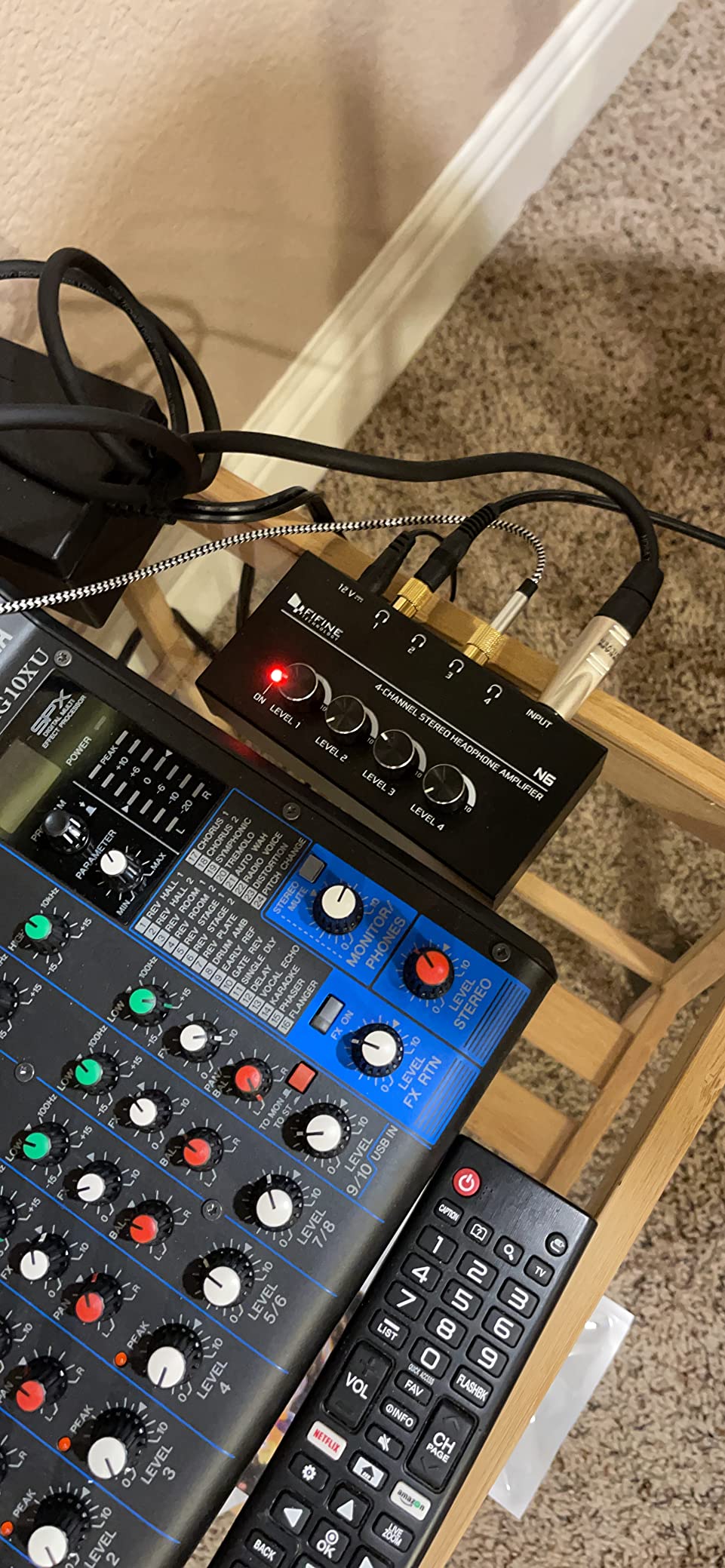
One clarification that trips up first-time buyers, including people posting in beginner studio threads: this is a one-input, four-output distributor, not a four-input mixer. It cannot accept four separate sources. If your room needs individual feeds, look at the Behringer HA8000 V2 instead.
On sound quality, owners report minimal crackle and distortion even at the highest volume setting. For monitoring speech in closed-back headphones that is more than sufficient.
When the N6 is the right call
It suits a home or small studio roundtable where everyone shares one mix and the budget is tight. The metal body is a genuine step up in durability from plastic budget boxes at a similar tier.
When the N6 is the wrong call
It is the wrong shape for a room with mixed headphone impedances or for anyone who needs more than four feeds. It is also the wrong choice if you want guests to plug in and go without adapters, because there is no 3.5mm option anywhere on the unit.
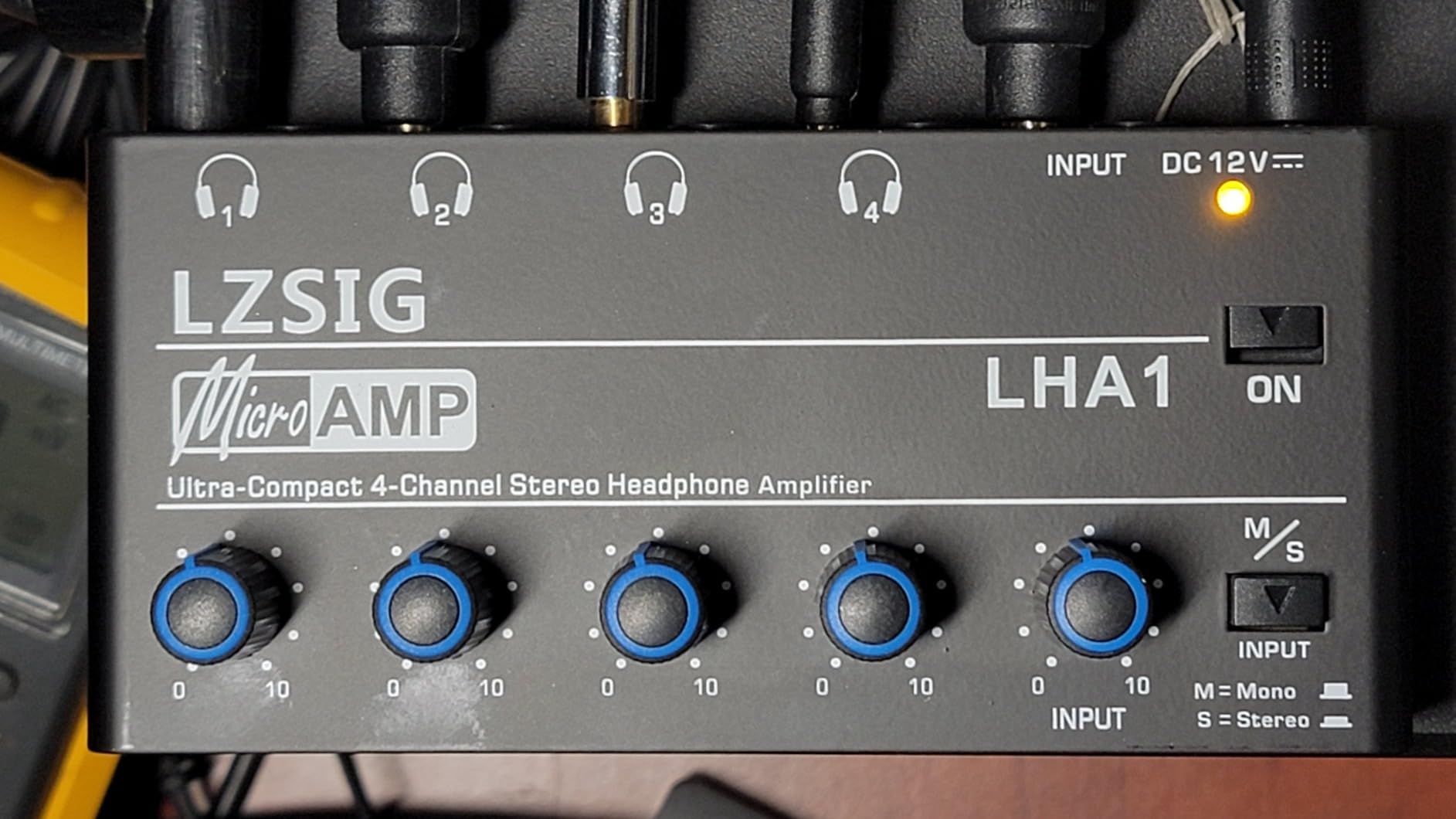
6. LZSIG 4-Channel with Bass Boost: Best Amp for Voice Monitoring
LZSIG Headphone Amplifier with Bass Boost, 1‑IN Multi‑OUT, 12V, 4 Channel
4 independent outputs
Bass boost switch
Stereo and mono switch
4.13 x 2.95 x 0.98 inches
Pros
- Bass boost adds vocal presence for speech monitoring
- Five ROHM low-noise op amps keep the signal quiet
- Works with 3.5mm and 6.35mm plugs without adapters
- Stereo and mono switch handles mic monitor setups
- Metal chassis with heavy-duty knobs
Cons
- Only drives headphones up to about 100 ohm
- No shielded cable included
- Mono mode can invert phase
This is the most podcast-specific unit in the list. The bass boost switch lifts the 400 to 600 Hz and 3000 to 7200 Hz bands, which is exactly the range that carries vocal presence and intelligibility in speech. In a room where guests take off their headphones and check levels by ear, it makes voices easier to place.
Noise handling is the other strength. It uses five ROHM low-noise operational amplifiers, and at 4.5 stars across 698 ratings buyers specifically call out a quiet, distortion-free signal when one source is split to several listeners.
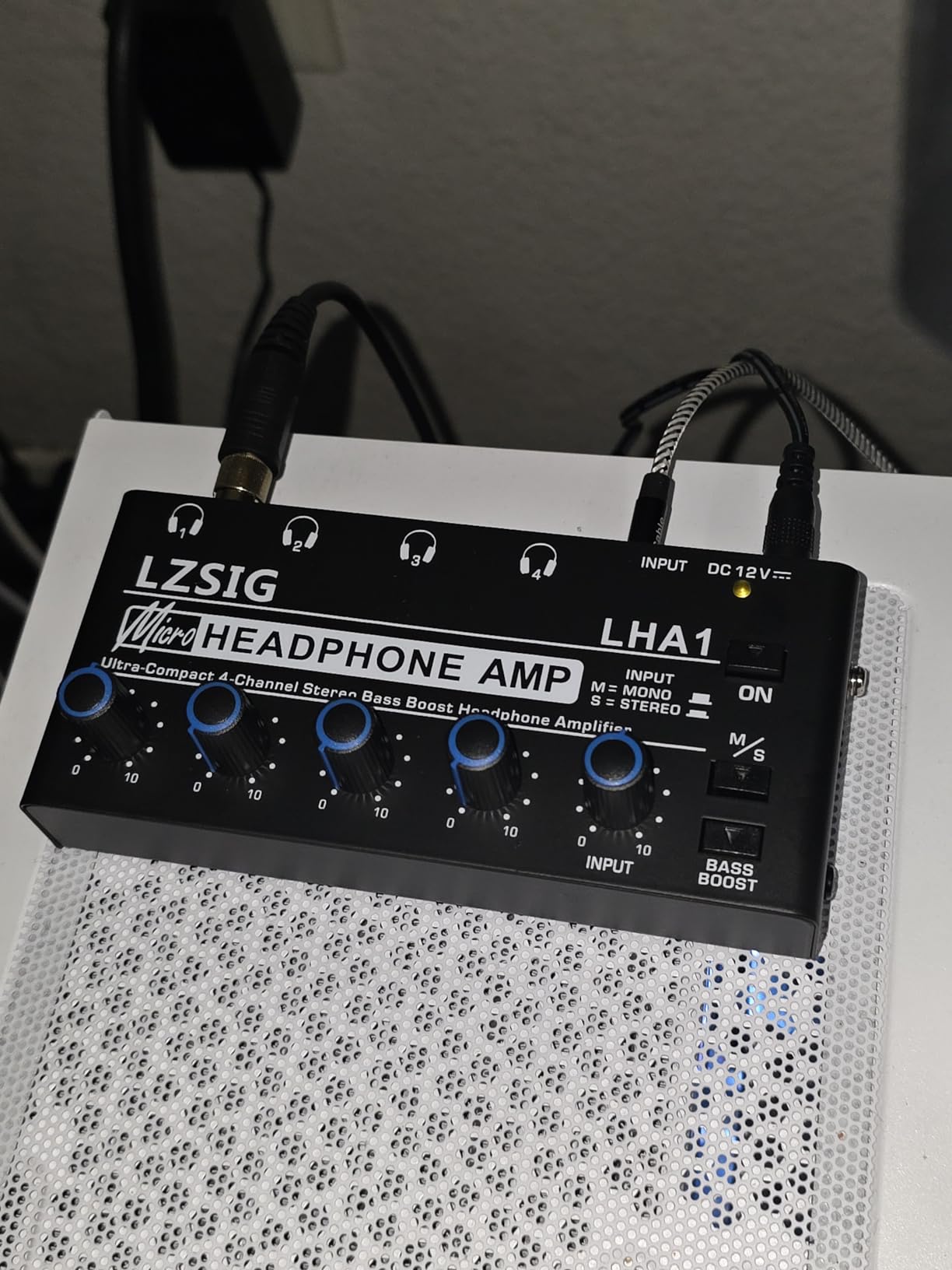
Connector range is unusually good for this class. It works with both 3.5mm and 6.35mm TS and TRS plugs, so you will not be handing out adapters during a session. The stereo and mono switch is also handy if your monitoring source is a single channel mix rather than a stereo one.
It is a thin metal unit at 4.13 by 2.95 by 0.98 inches and 12 ounces, which slides under most desk lips, and the knobs are heavy duty enough for daily sessions.
When the LZSIG is the right call
It fits a show where the guests remove headphones to check levels, or where a producer monitors from across the room and needs speech to cut through. It also suits anyone mixing with one-handed controls between guests, since 3.5mm support removes a common friction point.
When the LZSIG is the wrong call
It only drives headphones up to about 100 ohm impedance, which rules out high-impedance open-backs and most planars. No shielded audio cable is included, and owners note the stereo and mono button feels slightly loose. Switching to mono can also invert phase and reduce perceived output level, so check your mix before you rely on that mode.
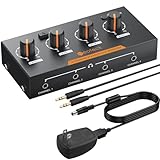
7. Neoteck 4-Channel: High Output Level and Every Cable Included
Neoteck 4 Channel Stereo Headphone Amplifier Audio Mono/Stereo Amplifier
4 independent outputs
5 watts per channel
3.5mm cable included
2.56 x 5.43 x 1.06 inches
Pros
- Very high output level per channel
- Full metal housing cuts interference
- Includes 3.5mm cable plus adapter and power cord
- Mono and stereo button avoids special cables
- Top-mounted power switch
Cons
- Bass response weaker than a direct feed
- A small number of reports of audible hiss
- No equalizer controls
- High gain means turning volume up carefully
The Neoteck is built for level, rated at 5 watts per channel. Owners frequently describe using it to push a pair of quiet headphones or desktop speakers well beyond what an interface headphone jack would manage, which makes it a reasonable choice when a guest’s hearing or their preferred headphone is on the inefficient side.
Build quality is a genuine strength. The full metal housing reduces electromagnetic interference and adds drop resistance, and the top-mounted power switch means you are not unplugging the supply every session.
It also arrives as the most complete box on the desk, by accessories. A 3.5mm audio cable, a power adapter, a power cord and a manual are all in the package, which removes the accessories trip-up that catches people with other budget units.
Reviewers are candid about the trade-offs. Bass response is described as weaker than a direct feed, a small number of owners report audible white noise or hiss, and there are no equalizer controls. For a speech-monitoring box none of that is fatal, but for critical music work it is a limit.
When the Neoteck is the right call
It suits a room where one or two guests wear inefficient headphones and you need real headroom to serve them without the whole table listening to feedback. The included cable and switch also make it friendly to someone setting up for the first time.
When the Neoteck is the wrong call
It is the wrong pick for a treated, acoustically dead room where any noise floor is exposed between sentences, and the wrong pick if you want accurate low-end reproduction. If hiss bothers you, the FIFINE N6 or the Fosi PH05 are quieter choices.
8. STABCL S-800: An Eight-Output Amp That Includes Its Adapters
STABCL Headphone Amplifier 8 Channel, Stereo Headphone Amp with 9 Pcs 6.35mm to 3.5mm Jack, Metal Portable Studio Headphone Amp Splitter, Headphone Mixer with Mono and Stereo for Recording Studios
8 independent outputs
9 adapters included
Mono and stereo switch
11.54 x 5.39 x 2.64 inch package
Pros
- Eight independently controlled outputs in one chassis
- Runs without hum or added noise
- CNC aluminium unibody feels durable
- Top-mounted power button
- Includes nine 6.35mm to 3.5mm adapters
Cons
- Audible pop when plugging a headphone in
- Volume jump when switching mono and stereo
- Single input jack only
- Sound quality adequate rather than hi-fi
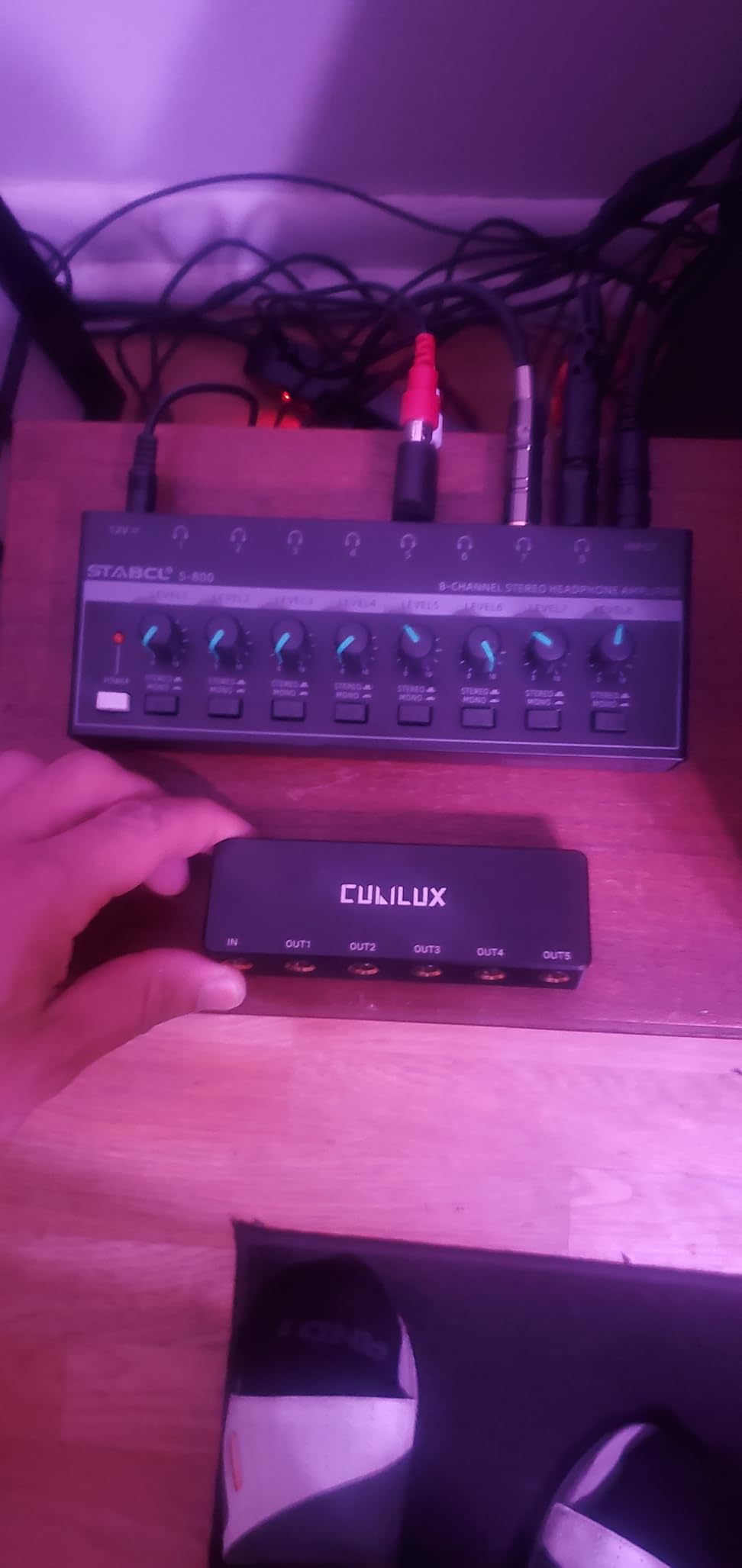
Eight outputs with a knob on each, which makes this the other answer to the large-panel question alongside the Behringer. Where it differs is packaging: nine 6.35mm to 3.5mm adapters are included, so a mixed table of headphone types can be connected in one go.
It uses an intelligent noise reduction chip and a CNC aluminium alloy unibody chassis, and at 4.3 stars across 99 ratings the feedback is consistent about clean running with no hum, squeal or added noise on the signal. The mono and stereo switch is useful for checking how a mix folds down, and the top-mounted power button is easy to reach.
It weighs 1.43 pounds and comes in an 11.54 by 5.39 by 2.64 inch package, so plan desk space accordingly. The 12V AC adapter is included.
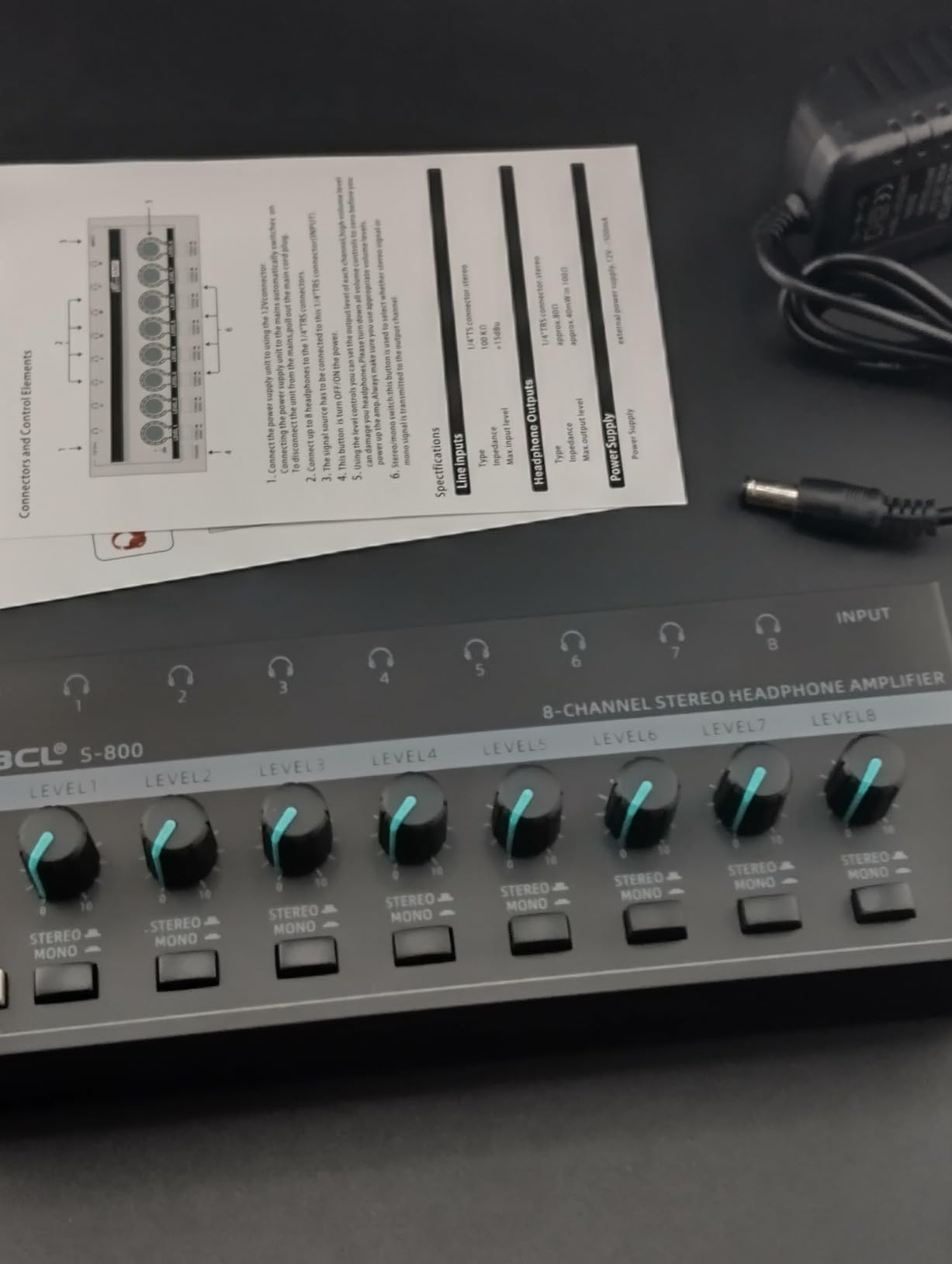
There are three practical quirks to know. Plugging a headphone in produces an audible pop even with that channel turned to zero, which can be picked up by open mics if it happens live. The included adapters do not work with three-ring headphone plugs, so a guest on a gaming headset still needs their own cable. And switching between mono and stereo causes a noticeable volume jump.
Owners also frame the sound quality as adequate rather than reference-grade. For monitoring speech in a podcast room that is an honest trade for eight independent feeds at this size.
When the S-800 is the right call
It fits an eight-person panel on a single box where guests bring a mix of headphone types and you would rather not source adapters separately. The aluminium body also makes it a better fit for a permanent installation than a plastic unit.
When the S-800 is the wrong call
There is only a single input jack, so switching sources means replugging rather than using a selector. For a room that needs isolated per-guest mixes rather than one shared feed, the Behringer HA8000 V2 does the same job with far more flexibility. It is also not the choice if your room is acoustically treated and any pop or noise is a problem.
How Many Headphone Outputs Do You Actually Need?
Count the people who will wear headphones, not the microphones. A guest with two mics and one pair of headphones still consumes exactly one output. Add a spare for yourself if you are the only one who walks around the room, and add a second for a producer cue feed if you have one.
Two people: two outputs. Your interface’s own headphone jacks will do it, and this is the case where a distribution amp is wasted money.
Three or four people: four outputs. This is the most common podcast configuration and the reason a four-way box is the default recommendation in podcast forums.
Five people: five outputs, or a five-output box such as the Fosi PH05 so nobody is doubled up.
Six people: six outputs. Either a five-output amp plus one interface jack, or an eight-channel unit so you have spares.
Seven or eight people: eight outputs on a single box, or two four-output boxes fed from the same line-level source. Daisychaining a second four-way box from the first only works if the first passes a full headphone-level signal onward, and in a pure distribution box it usually does not, so feed both boxes from your interface instead.
One more consideration for video podcasting. Camera operators, a floor manager and a guest in a separate room all count if they wear headphones, which is how a four-person conversation quietly turns into an eight-output job.
How to Wire an Interface to a Distribution Amp and Every Guest
The chain is short and the whole job takes about ten minutes. The key decision is which output on your interface feeds the amp, and getting that wrong is the usual cause of thin or distorted headphone audio.
Step 1: feed the amp from a main mix bus output or a dedicated line-level output, not from the interface headphone jack, unless that is all your interface has. Line-level is a hotter, cleaner signal and it gives the amp proper headroom.
Step 2: use a properly wired stereo TRS cable between the interface and the amp’s input. A mis-wired cable is the most common cause of hum, crackle or one channel dropping out, and it is easy to mistake for a fault in the amp itself.
Step 3: if your guests use 3.5mm headphones, resolve connector size now. The LZSIG and Neoteck units accept both 3.5mm and 6.35mm plugs, the STABCL S-800 includes nine adapters, and everything else is 6.35mm only.
Step 4: plug in one headphone at a time with all volume knobs at zero. Several units in this list produce an audible pop on connection even at zero level, and it will end up on your recording if a mic is open.
Step 5: set every channel to its own level rather than copying one setting to all four. Matching by feel, using the same spoken phrase at a normal volume, takes about a minute and prevents the loudest voice in the room from setting the level for everyone.
Step 6: label each channel at the jack and at the headphone end. In a four-person session this is the difference between a thirty-second fix and a five-minute one every time.
Step 7: give each guest a dedicated cable rather than a shared one, and route cables behind the table. Long cables running past the mic stands pick up noise and create trip hazards in a small room.
For a remote guest over a call, the arrangement is different. You need to mix the call return with your local mic feed before it reaches the distribution amp, so that remote people do not hear themselves delayed against your local voices. A small analog mixer handles that blend, and a two-input box such as the Behringer HA8000 V2 or the STABCL S-800 can serve as the per-channel end of that chain. A distribution amp alone cannot solve a two-source problem, and buying one for that reason is the most common purchasing mistake we see in forum threads.
If you want to sanity-check the whole approach against a broader range of amplifiers, the general headphone amplifier roundup covers the single-listener hardware these boxes are deliberately excluding.
Headphone Amp Buying Guide: What Actually Matters in a Podcast Room
Output count. Count people, then add a spare. Four is the standard configuration and covers the majority of shows, five gives breathing room, and eight solves panels. Ignore any headphone amp advertised without a per-output volume control, because a shared volume means every guest hears the same level regardless of their own preference.
Independent volume per channel. This is the feature that separates a distribution amplifier from a plain headphone splitter. A splitter just divides one signal; a distribution amp gives each person their own knob. A podcaster building an eight-guest room described independent headphone outputs as the entire reason for the build.
Input type and level. One stereo line-level input is the standard, and every unit here is one input. Accepting both 1/4 inch and 1/8 inch sources makes setup painless. If you need more than one source in the chain, you need a mixer in front of the amp rather than a second input on it.
Connector compatibility. Most studio headphones ship with a 1/4 inch TRS plug, so 6.35mm outputs cover the professional majority. Phones and cheaper consumer headphones use 3.5mm, and adapters introduce their own failure points. Units that accept both natively, such as the LZSIG and Neoteck, save you a troubleshooting session.
Headphone choice sets the power budget. The Sennheiser HD 280 Pro, Sony MDR-7506 and Audio-Technica ATH-M50x are the headphones most podcasters arrive with, and all three are efficient closed-back designs that sound clear through any box in this guide, with no amplifier gain to spare. Open-back high-impedance models such as the Sennheiser HD 660S need real current to go loud and stay clean, and that is where the Fosi PH05’s 16 to 300 ohm range and 310mW per channel earn their place. Very low-impedance in-ear monitors run into a different problem at the other end, since some units add noise there. Check the impedance on the headphone, not just the jack size.
Entities you will meet alongside these. Podcast rooms usually pair a distribution amp with a RODE or Audio-Technica mic, an interface from Focusrite or a Zoom LiveTrak-class recorder, and a small mixer for the two-source case. The amp sits at the end of that chain, so match its input to whatever your interface or mixer actually outputs rather than assuming all line outputs behave the same.
Noise floor. In an untreated room this barely matters. In a treated room, where every pause between sentences is a chance to hear a hiss, it matters a lot. Look for units with published noise specifications, such as the PH05’s signal to noise ratio up to 105dB and noise floor as low as 25 microvolts. If your spec sheet lists nothing, set expectations accordingly.
Gain structure. More power is useful only if you can control it. The Behringer HA8000 V2’s gain rises quickly past 12 o’clock and the Neoteck has enough output to startle you, so bring both up slowly. A box you can set to a comfortable level and leave alone is worth more than one with the loudest specification.
Build and placement. Metal housings, from the Mackie through the Fosi and the STABCL, resist repeated handling in a room where boxes get moved between sessions. Plastic units are fine on a permanent desk position. Either way, keep the amp away from a bundle of power cables, since several units here are documented to pick up hum when placed next to other powered gear.
Budget reality. Cheap four-way units are genuinely good enough for efficient closed-back headphones on speech, and the review counts behind them are enormous. The gap between a budget box and a metal one is mostly durability and noise, not audible quality in a normal room. Spend on output count first, then on build.
When budget units fall short. An owner of one small personal-monitor amp reported only a 20 to 25 percent volume increase and described it as not ultra loud, which is a fair warning: small amps give you a modest lift, not unlimited level. If your guests wear inefficient headphones, buy the power.
Frequently Asked Questions
Is the Behringer HA400 any good?
The HA400 is the four-output distribution box most podcast beginners end up with, and it is the organic default recommendation across podcast forums for a reason: it gives every person their own volume knob from a single source. Its weaknesses are shared by every box in the same class, including a 1/4 inch-only input and modest power for high-impedance headphones. For a four-person roundtable with ordinary closed-back headphones it does the job. If you want more output count, more headroom or a quieter floor, the Mackie HM-4 and the Fosi Audio PH05 cover the same class with more capability.
Do I need a headphone amp for podcasting?
You need one when the number of people wearing headphones exceeds the headphone outputs your interface or mixer already provides. Most audio interfaces ship with one or two headphone jacks, so a three-person show is already beyond the limit. Solo hosts and two-person shows can usually use the interface outputs directly. Independent per-guest volume control is the second reason, because it stops one talker dictating the level for everyone else.
How many headphone outputs do I need for podcast guests?
Count the people who wear headphones, not the microphones. Two people need two outputs, a four-person roundtable needs four, a five-person panel needs five, and a six to eight person panel needs eight. Add one spare output for a producer or a floor manager if they wear headphones too. Most podcast forums settle on a four-output box because that is the most common guest count.
Can I use one headphone jack for two people?
You can split it electrically with a headphone splitter, but then both people share one volume control and turning up for one turns up for the other. A distribution amplifier solves the same problem properly by giving each output its own knob. If the only reason you are considering a splitter is that your interface has two jacks and you have three people, a four-output box is the right purchase.
What is a headphone distribution amp?
A headphone distribution amplifier is a small box that takes one stereo line-level feed from an audio interface or mixer and splits it to several headphone outputs, each with its own volume control. It lets a host and every guest monitor the same mix at their own level. Most have between four and eight outputs, 1/4 inch TRS headphone jacks, and a single stereo input.
Why is there static in my headphones while recording?
The most common causes are a mis-wired or unbalanced TRS cable between your interface and the amp, a power supply or cable bundle sitting next to the unit, and a source with more noise than the amp can hide. In an acoustically treated room a budget box’s noise floor becomes audible between sentences. Start by reseating the input cable, moving the amp away from power cables, and checking whether the hiss is present on the interface headphone jack too.
What headphones work best with a distribution amp?
Efficient closed-back studio headphones, including the Sennheiser HD 280 Pro and Audio-Technica ATH-M50x class, run cleanly through any of the four-output boxes in this guide and need no extra power. High-impedance open-backs and planar magnetic headphones need a unit with real output current, such as the Fosi Audio PH05. Very low-impedance in-ear monitors can reveal noise in smaller units, so match the amp to the headphone before you buy.
Conclusion: Which Headphone Amp Your Podcast Room Needs in 2026
For most shows, the Mackie HM-4 is the headphone amplifier we recommend: four independent outputs, a metal chassis and a clean signal in a small box that fits anywhere. If your guests bring demanding headphones or you are running a five-person panel, the Fosi Audio PH05 adds the impedance range and the extra channel. If you are building for six people or more, the Behringer HA8000 V2 covers a full panel on one box and gives you per-channel direct inputs for isolated mixes, with the STABCL S-800 as a lighter alternative that includes its adapters.
Pick on output count first, then on noise and build, and ignore every single-listener amp in the shopping results. Wire it from a line-level output, label the channels, and give every guest their own volume. More details on the hardware side live in our broader headphone amplifier roundup.