
If you want one ride-on toy that a 2 year old can genuinely use today and still pedal at four, the Fisher-Price Harley-Davidson Tough Trike is the pick we keep coming back to. It carries a 4.7 star rating across more than 26,000 reviews, holds up to 55 pounds, and has a wide frame that does not tip when a toddler leans back.
Age two is the awkward middle of the ride-on world. Kids are walking steadily but still top-heavy in a way that catches out a narrow foot-to-floor car, tall enough that low seat heights leave their knees at their chin, and short enough that pedal reach matters more than the manufacturer’s age label suggests. Most 2 year olds also abandon a ride-on within months, which is why the toys that convert from push mode to ride mode tend to survive longest.
We compared 12 of the most-reviewed ride-on toys rated for this age group and scored them on the things that actually decide whether a toy gets used daily: stability, seat height, weight headroom, wheel and floor behaviour, and how long the build takes. Last tested in October 2026. If you are still deciding between a car and a balance bike, the balance bike option is worth a look before you buy, and if you are tempted by a battery-powered car, our electric ride-on car guide explains when that stage actually begins. We cover both below.
Table of Contents
Quick Picks: The 12 Best Ride-On Toys for 2 Year Olds (October 2026)
Fisher-Price Harley-Davidson Tough Trike – Best overall. 4.7 stars from 26166 reviews, a 55 lb limit and rugged tread tires, though the seat pops off easily.
Step2 Whisper Ride II – Best push car. Genuine stroller alternative with whisper-quiet wheels and a foldable handle, but the build runs long.
KRIDDO Toddler Tricycle – Best value pedal trike. Tool-free assembly in minutes and a wide wheelbase, with no brakes at all.
Radio Flyer Scoot 2 Scooter – Best 2-in-1. Flips from a seated ride-on to a standing scooter in seconds, built from plastic rather than metal.
KRIDDO Toddler Balance Bike – Best for balance practice. Pedal-free 12 inch bike rated to 110 lb with never-flat tires, but the bars drift out of alignment.
newyoo TR007 5-in-1 Tricycle – Best for growth. Five ride modes from 1 to 3 years with a rotating parent steering handle, at nearly 10 pounds.
Radio Flyer Creativity Car – Best first ride-on. 3-in-1 walker-to-ride-on design with 17 sensory activities and a 4.8 star rating.
SEREED Light-Up Wheel Tricycle – Best for sensory play. Glowing rear wheels that need no batteries plus a 3-position adjustable seat.
SEREED Toddler Balance Bike – Best for quiet indoor riding. Silent EVA airless tires, 110 lb frame, and a 12.6 inch starting seat height.
Step2 Push Around Buggy – Best stroller replacement. Folding handle, seat belt, horn and under-hood storage, at 14.2 pounds to lift.
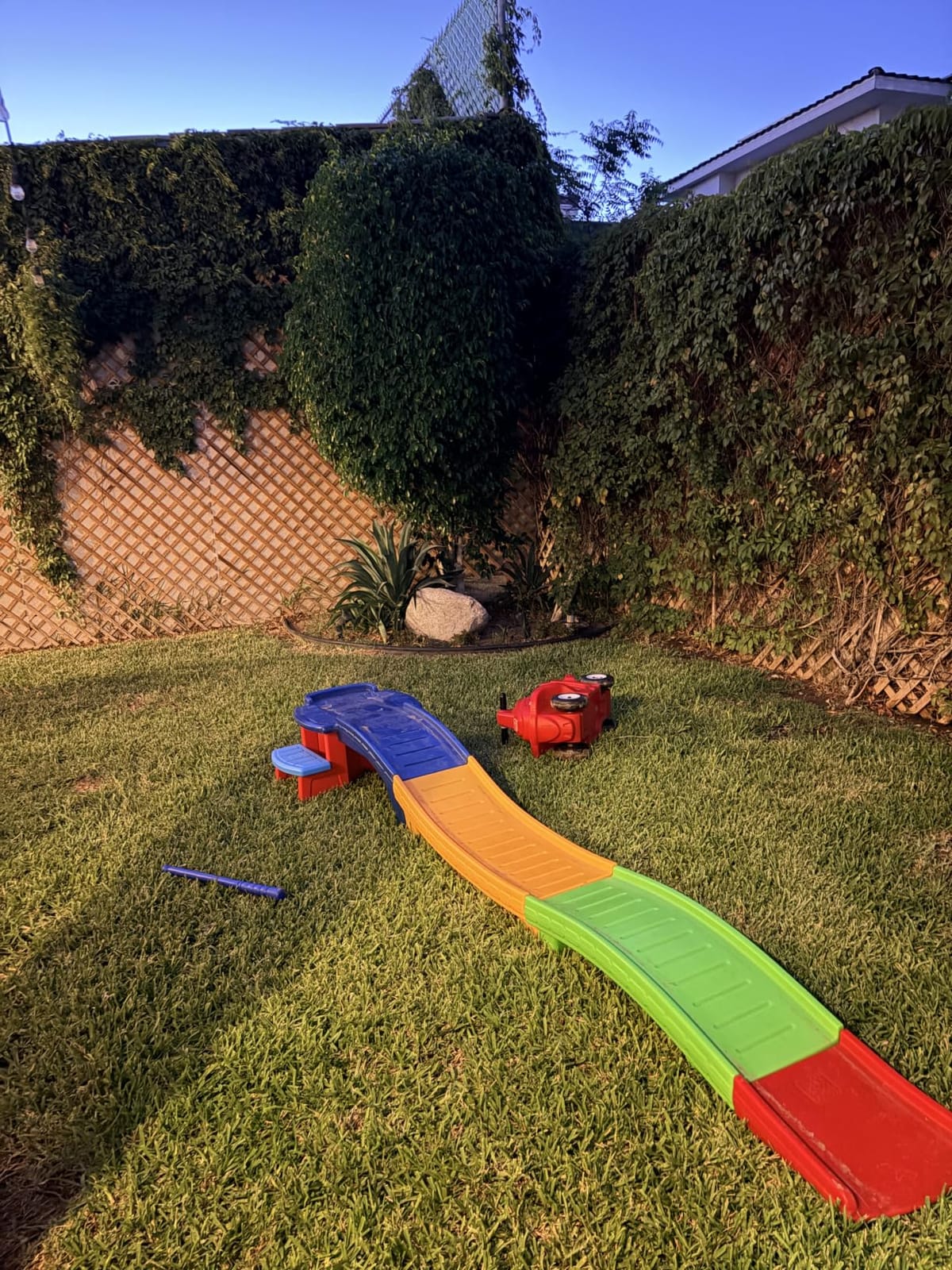
Step2 Up & Down Roller Coaster – Best backyard set. A 9-foot track with an ATV-style car that comes apart for storage.
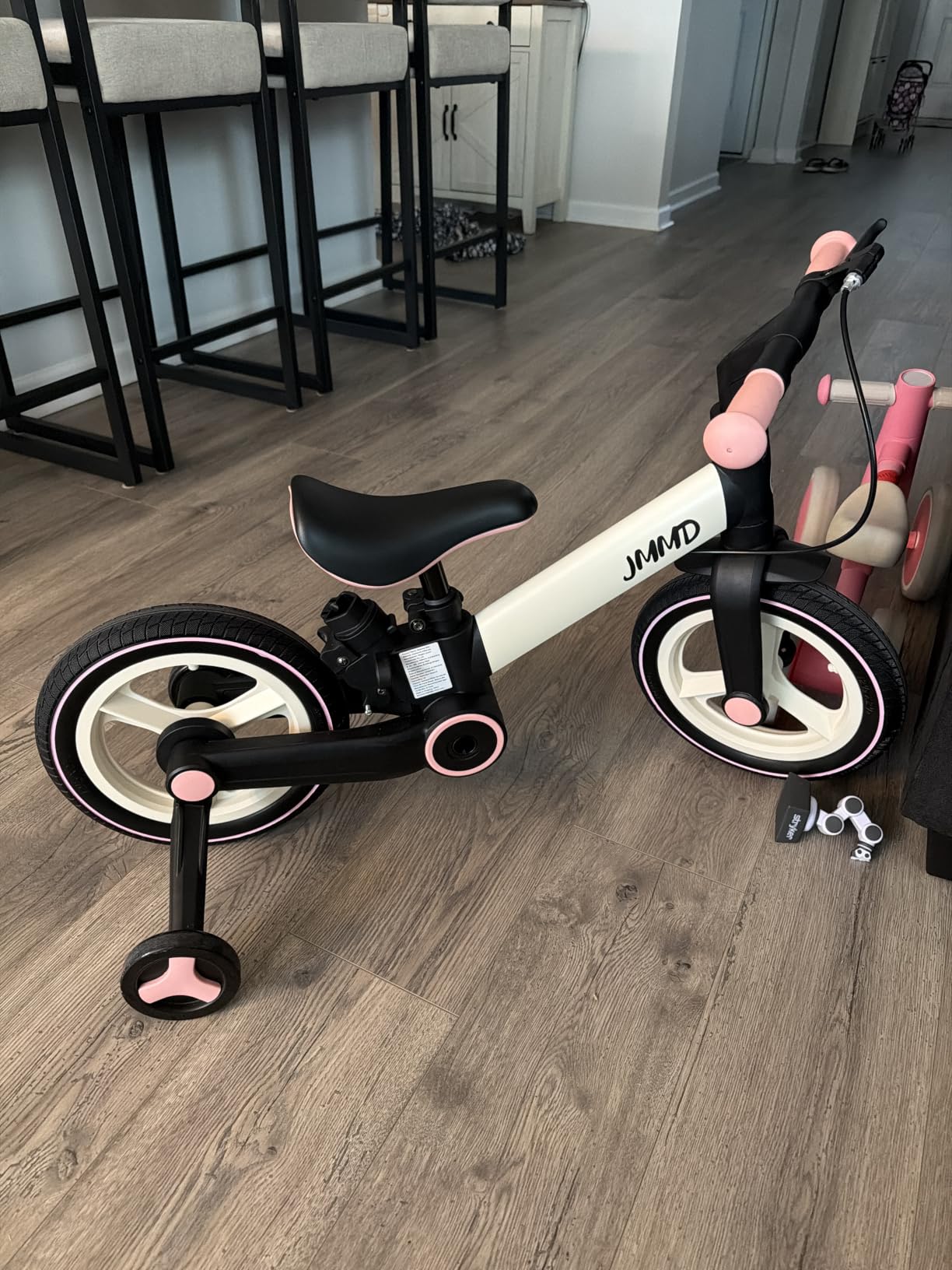
JMMD 6-in-1 Toddler Bike – Best for travel and storage. Folds with one button press and converts through six modes to a pedal bike with training wheels.
Top 3 Best Ride On Toys for 2 Year Olds In 2026
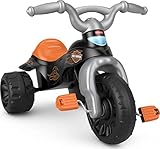
Fisher-Price Tough Trike
- 55 lb weight limit
- ages 2-5
- Wide wheelbase frame
- Lift-up seat with storage

Step2 Whisper Ride II
- Extra-wide parent push handle
- Whisper-ride wheels
- Foldable handle
- 50 lb limit

KRIDDO Toddler Tricycle
- Tool-free snap assembly
- Wide wheelbase
- Silent shock-absorbing wheels
- Ages 2-5
All 12 Ride-On Toys Compared Side by Side (October 2026)
| Product | Specifications | Action |
|---|---|---|
| Fisher-Price Harley-Davidson Tough Trike |
|
Check Latest Price |
| Step2 Whisper Ride II Push Car |
|
Check Latest Price |
| KRIDDO Toddler Tricycle |
|
Check Latest Price |
 Radio Flyer Scoot 2 Scooter Radio Flyer Scoot 2 Scooter |
|
Check Latest Price |
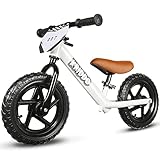 KRIDDO Toddler Balance Bike KRIDDO Toddler Balance Bike |
|
Check Latest Price |
 newyoo TR007 5-in-1 Tricycle newyoo TR007 5-in-1 Tricycle |
|
Check Latest Price |
 Radio Flyer Creativity Car Radio Flyer Creativity Car |
|
Check Latest Price |
 SEREED Light-Up Wheel Tricycle SEREED Light-Up Wheel Tricycle |
|
Check Latest Price |
 SEREED Toddler Balance Bike SEREED Toddler Balance Bike |
|
Check Latest Price |
 Step2 Push Around Buggy Step2 Push Around Buggy |
|
Check Latest Price |
 Step2 Up and Down Roller Coaster Step2 Up and Down Roller Coaster |
|
Check Latest Price |
 JMMD 6-in-1 Toddler Bike JMMD 6-in-1 Toddler Bike |
|
Check Latest Price |
1. Fisher-Price Harley-Davidson Tough Trike – Best Overall Tricycle
Fisher-Price Harley-Davidson Tough Trike Toddler Toy, Max 55 lb
Ages 2-5 years
Max weight 55 lb
7.5 lb toy
28 x 18 x 20 in
Pros
- Sturdy frame built for daily outdoor use
- Under-seat storage behind a lift-up seat
- Easy-grip handlebars sized for small hands
- Light enough for a toddler to move alone
- Rugged tread tires for rough ground
Cons
- Seat detaches easily and is awkward to refit
- Pedal reach is a stretch for shorter two-year-olds
- Assembly needs extra tools and patience
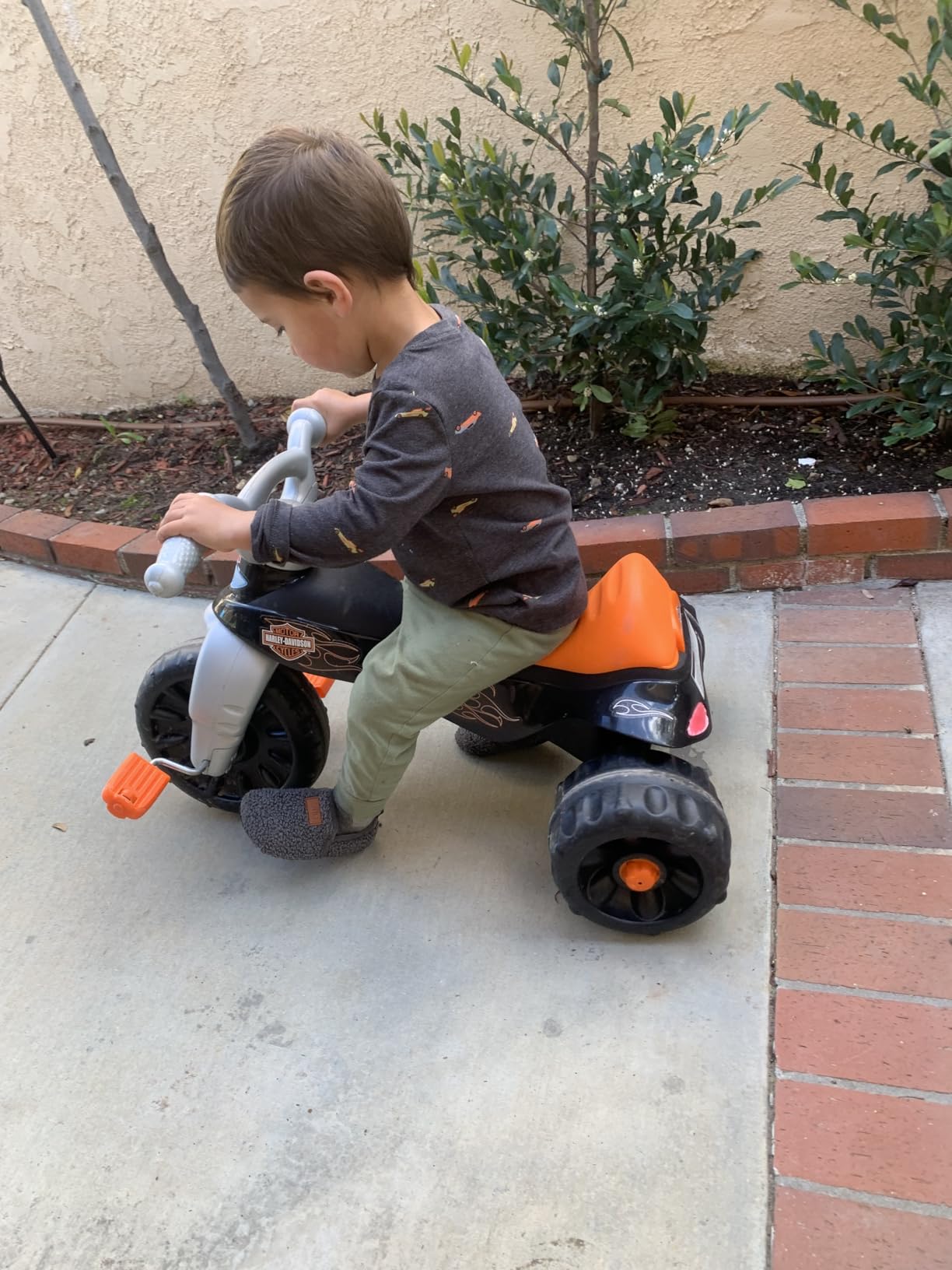
The Tough Trike is the one we put in front of a parent who wants a single answer. It is a kid-powered pedal tricycle rated from 24 months to 5 years, with a 55 pound ceiling that comfortably covers a three-year-old. More than 26,000 ratings average 4.7 stars, and the volume of feedback is itself useful: when a complaint shows up, it shows up hundreds of times, which makes the known weak points easy to plan around.
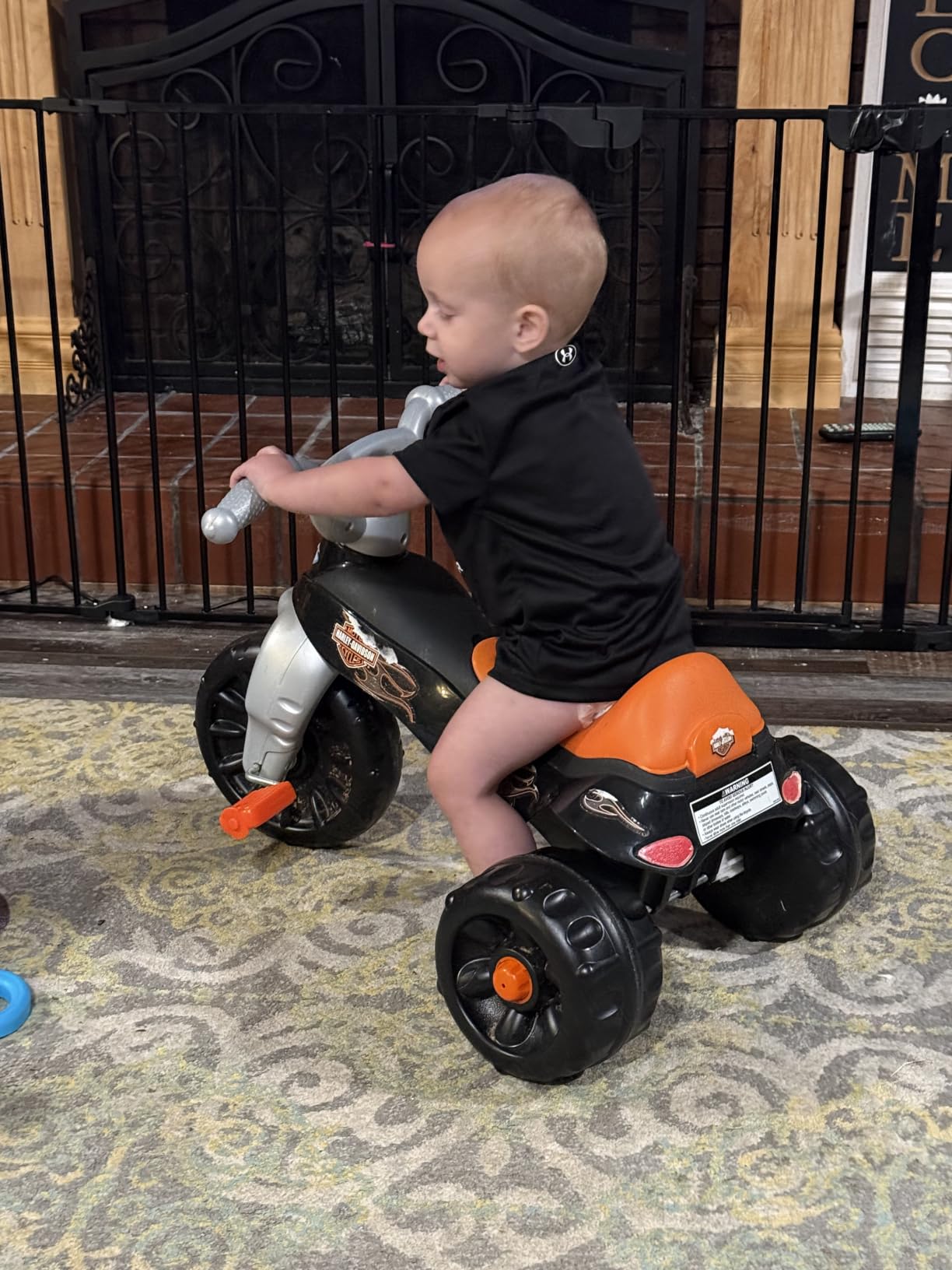
What holds it up is geometry. The wide wheelbase and low frame mean a toddler leaning back to look where they are going does not put the rear wheels up, which is the single most common tipping complaint we see about ride-on toys in this age band. The tires have deep treads and cope with grass and gravel better than the hard plastic wheels on most push cars.
The lift-up seat hides a storage compartment, which in our house is the difference between a toy that survives the first week and one that does not. Snacks, a spare shirt and a small toy all fit, and it teaches cause and effect every time a two-year-old works the latch.
There are real trade-offs. The seat is the weak link: it lifts out easily, which is great for storage and annoying when a child kicks it loose mid-ride, and refitting it takes a firm two hands. Pedal reach is also a genuine issue for smaller two-year-olds, though most master it within a few weeks. Expect 30 to 60 minutes over a couple of evenings for the build.
When it works best for a 2 year old
This is the right pick for a child who is already walking confidently and has space to ride outdoors, whether that is a driveway, a sidewalk loop or a flat yard. Because it has no motor and no battery, there is nothing to charge and nothing that dies in storage over winter. Parents on r/toddlers consistently favour exactly this kind of simple pedal design when durability is the worry, and the review volume here backs that up.
At 7.5 pounds it is light enough that a two-year-old can drag it back into the garage themselves, which matters more than it sounds when you are the one retrieving it from a neighbour’s driveway at dusk.
When to pick something else
Skip it indoors. The pedals and the plastic body make it loud on hardwood, and a 2 year old will not steer a pedal trike around furniture. If your child is still hesitant on their feet, the 3-in-1 walker design in pick 7 is a gentler starting point, and if your child pedals backwards as often as forwards, be aware this trike has no brakes to help.
2. Step2 Whisper Ride II – Best Push Car for Long Walks
Step2 Whisper Ride II Kids Push Car, Ride-On Car with Seat Belt and Horn, Quick Fold Handle, Stroller Alternative, Toddlers and Preschoolers Ages 18+ Months, Blue
Ages 18 months-4 years
Max weight 50 lb
45.5 x 19 x 34 in
2 year warranty
Pros
- Whisper-ride wheels glide quietly on floors and sidewalks
- Extra-wide parent handle works as a real stroller alternative
- Cup holders and under-hood storage
- Double-walled plastic wipes clean easily
- Long age range with room to grow
Cons
- Assembly runs long with picture-only instructions
- Steering needs a press on the handle to lift the front end
- Detaching the handle needs a wrench
- Handle cup holder too narrow for most bottles
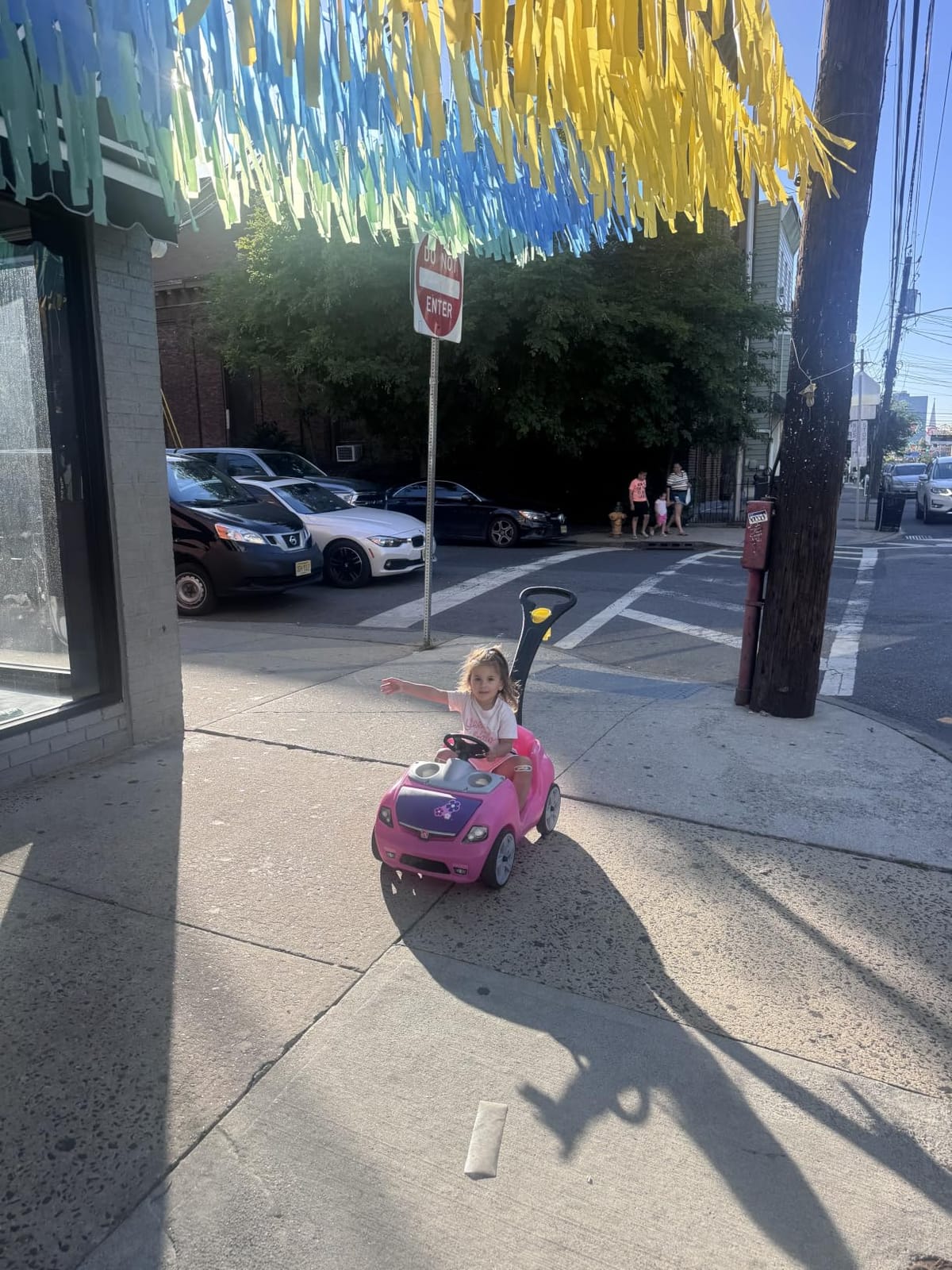
The Whisper Ride II solves a different problem: how do you let a two-year-old move under their own power without giving up control on a street. The answer is the extra-wide rear grip handle. You push from behind like a stroller, the child sits up front steering a working horn and a full-size steering wheel, and you control the speed.
At 4.6 stars across more than 16,000 reviews, this is one of the most proven push cars in the category, and the wheel design is the reason. The whisper-ride wheels are wide and soft enough to roll over tile, hardwood and sidewalk without the harsh scraping sound that makes most plastic-wheeled ride-ons unusable indoors.
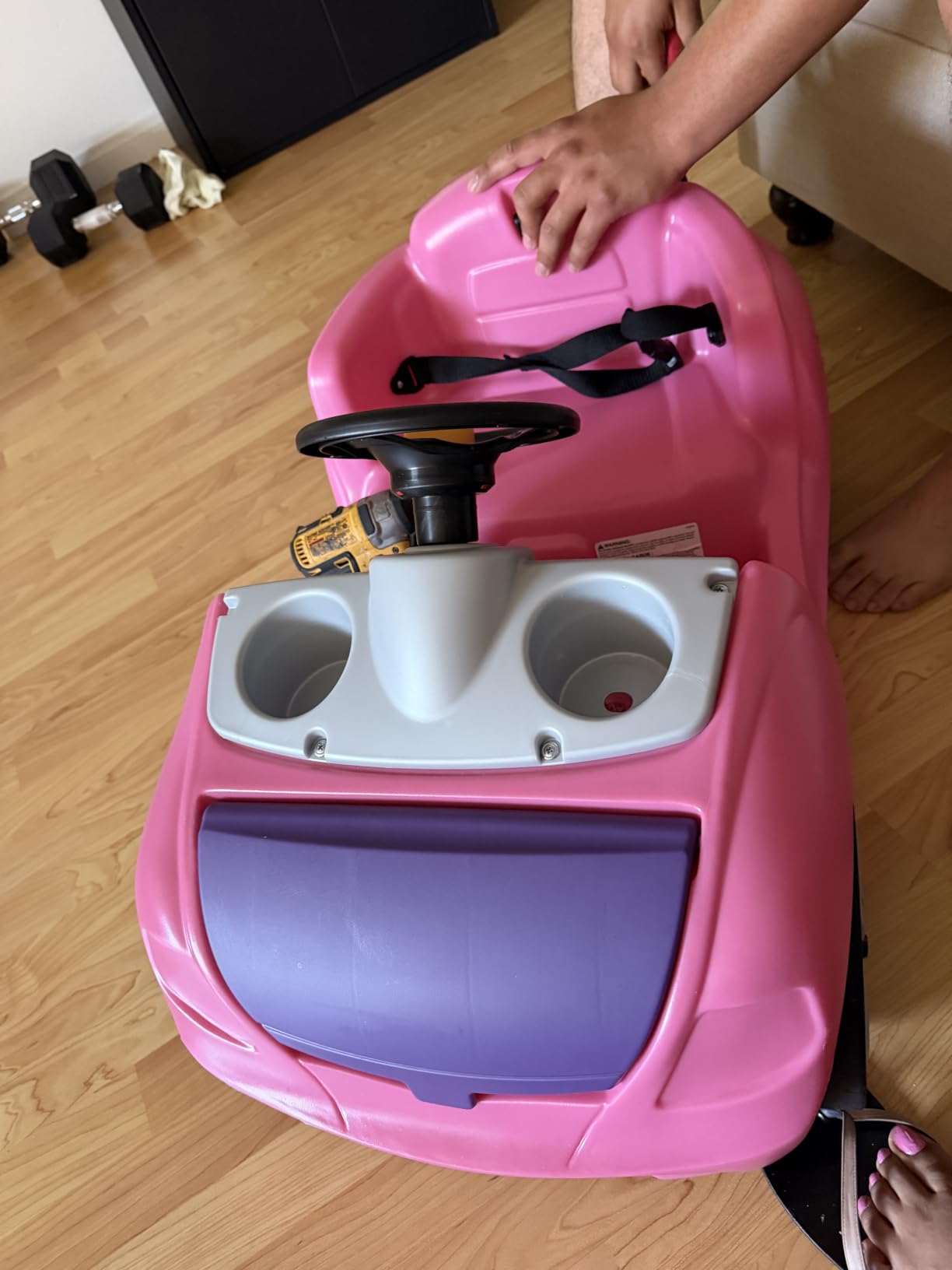
The cabin is roomier than the price and footprint suggest, with two cup holders and a storage area under the hood. The double-walled plastic body resists chipping and fading, and the whole shell wipes down with a disinfectant cloth, which matters in a house with a crawling sibling.
Assembly is the honest drawback. Owners consistently describe a build of an hour and a half to two hours with picture-based instructions, and removing the handle for car-boot storage requires a wrench and pliers. Steering is also unconventional: the front wheels are fixed, so turning means pressing down on the handle to lift the front end and pivot. It works, but a two-year-old cannot do it alone in a tight hallway.
What we checked before recommending it
We looked at seat height and turning clearance in a hallway, and at whether a two-year-old could get in and out without help. They can, because the cabin sides are low and the floor is flat. We also confirmed the belt latches one-handed, which is a small thing that matters when you are doing it with a wriggling child and a full bag.
The 50 pound weight limit is fine for the 2-to-3-year-old window and is the main reason the age range extends to 4 years in practice. At roughly 7 kg, it is heavy enough to feel solid and light enough for one adult to manage alone.
Where it falls short
There are almost no in-car play features beyond the steering wheel and horn, so a child who wants sensory activity will be bored within a few minutes of the ride itself. It is also not a gravel or grass toy, and a heavy kid pushing a hard surface on fixed wheels will lean forward hard. If you want something a child powers entirely alone, look at pick 4 instead.
3. KRIDDO Toddler Tricycle – Best Value Pedal Trike
KRIDDO Toddler Tricycle for Toddlers Age 2-5, Tool-Free Trike
Ages 2-5 years
9 lb toy
26.5 x 18.3 x 18.3 in
1 year warranty
Pros
- Genuinely tool-free snap-together build in about 10 minutes
- Wide wheelbase with extended rear wheels resists roll-over
- Carbon steel frame handles daily abuse
- Silent shock-absorbing wheels are kind to floors
- Contoured seat doubles as a carry handle
Cons
- No working brakes
- Pedalling backwards rolls the trike into obstacles
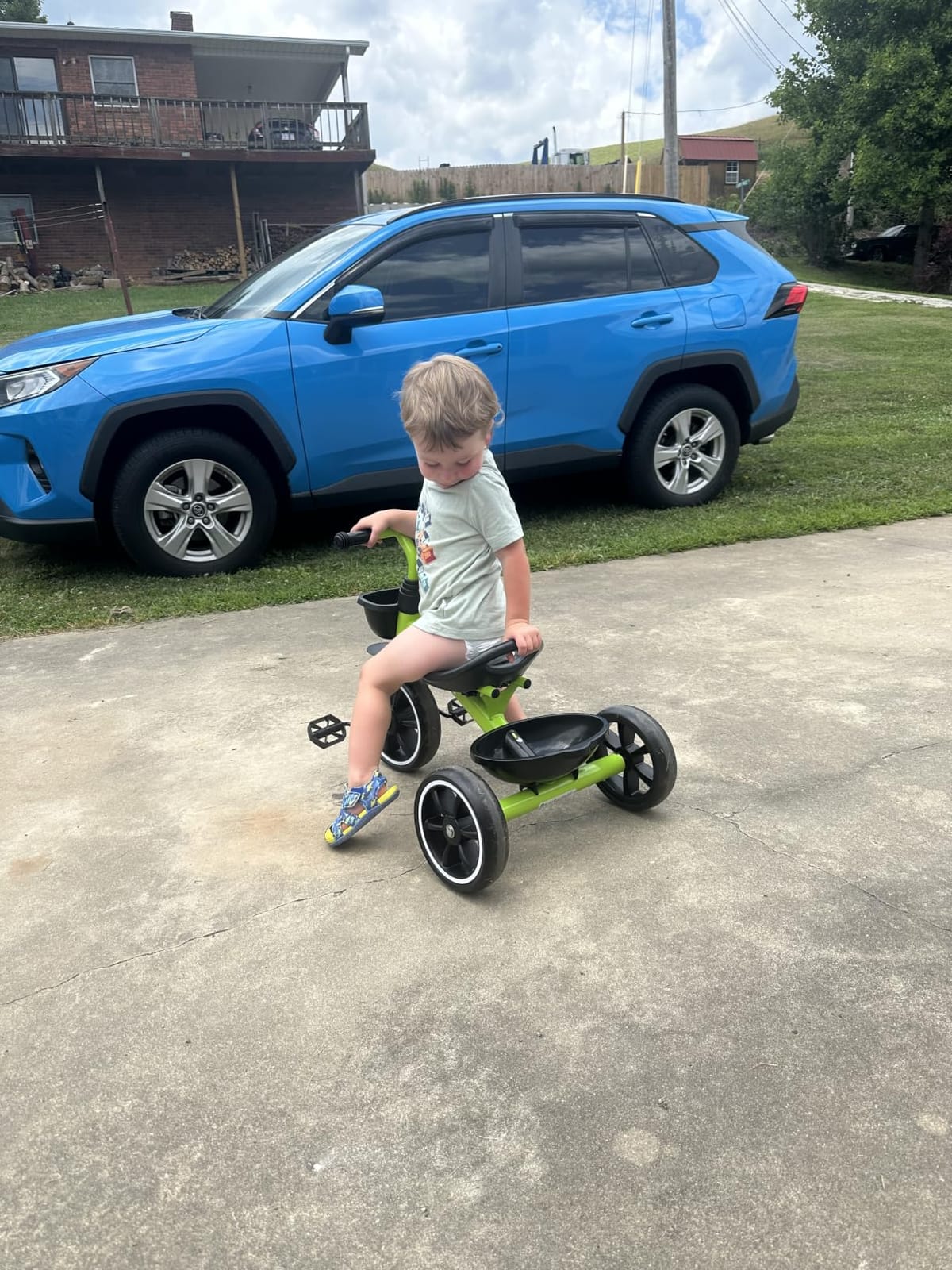
Assembly is the first thing you notice about this trike, and it is the best thing about it. It snaps together without tools in roughly ten minutes, which is close to unheard of in this category and removes the single most common complaint parents have about ride-ons. The carbon steel frame is a step up from the plastic bodies most competitors use at this level.
It holds a 4.6 star rating across nearly 8,000 reviews. The wide wheelbase and the extended rear wheels are what make it forgiving: the rear axle sits wider and further back than on a standard trike, so a two-year-old leaning into a turn is far less likely to roll it over.
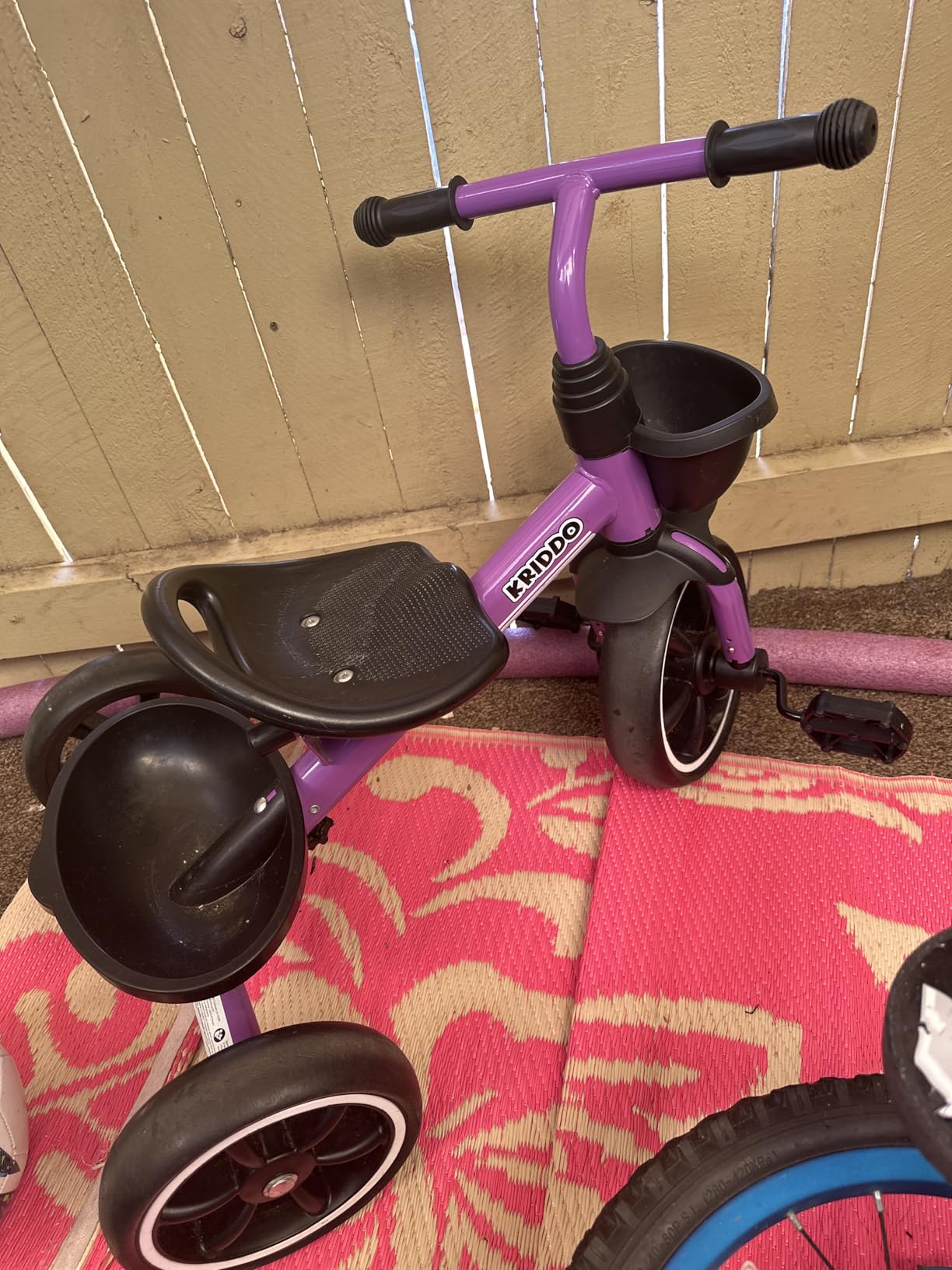
The wheels are the other differentiator. They are shock-absorbing and near-silent, so this trike can go from a paved driveway onto a playroom floor without the sudden noise change. The seat is contoured for small bottoms and doubles as a carry handle, which is a genuinely useful feature when a 9 pound trike needs to come inside at bedtime.
What you give up is stopping power. There are no brakes, and because the drive train is fixed, a child who pedals backwards simply rolls backwards. In an open yard that is harmless. In a hallway, next to a wall or a table, it is a genuine consideration, and it is worth teaching the back-pedalling behaviour before the first ride rather than after the first collision.
Who this suits best
This is the trike for a family that wants real pedal riding without a forty-minute build on a weeknight. It suits a two-year-old who can already sit steadily and reach a pedal, and it works equally well on a patio, a lawn or a playroom floor.
BPA-free materials and a matte, nontoxic paint finish are worth knowing about if the toy gets chewed, which it will. The two baskets at the front and rear also extend the useful life: a child who can carry things in them has a reason to keep riding after the novelty fades.
When another model fits better
If your child pedals with real force or your ground is sloped, you will want the front brakes on the Fisher-Price Tough Trike in pick 1, or the parent-controlled steering on pick 6. And if the build time on delivery day is a deal-breaker in a small apartment, this is the one to buy.
4. Radio Flyer Scoot 2 Scooter – Best 2-in-1 Ride-On and Scooter
Radio Flyer Scoot 2 Scooter, for Kids Ages 1-4, Pink, Toddler Ride On Toys
Ages 1-4 years
Max weight 50 lb
5.5 lb toy
22 x 13.8 x 24.8 in
Pros
- Flip deck converts a seated ride-on into a standing scooter in seconds
- Four-wheel base gives beginners real stability
- Quiet wheels that do not mark hardwood
- Built-in storage for stuffed animals
- Folds flat and weighs only 5.5 pounds
Cons
- Plastic body rather than the metal buyers expect
- Handlebar height adjustment is awkward
- Size can fall between the 1-year and 3-year stages
The Scoot 2 is the answer to the complaint that keeps appearing on parent forums: ride-on toys get outgrown too fast. A seated 2-year-old rides the foot-to-floor base, then a three-year-old flips the deck and stands on the same frame, and the toy stays in use. Parents on r/toddlers and r/beyondthebump repeatedly name convertible designs like this as the reason a ride-on lasted past a single birthday.
The four-wheel base is what makes it work at two. Unlike a two-wheel scooter that a beginner falls off sideways, the wide footprint resists tipping, and the seat is low enough that a small child can mount it without climbing.
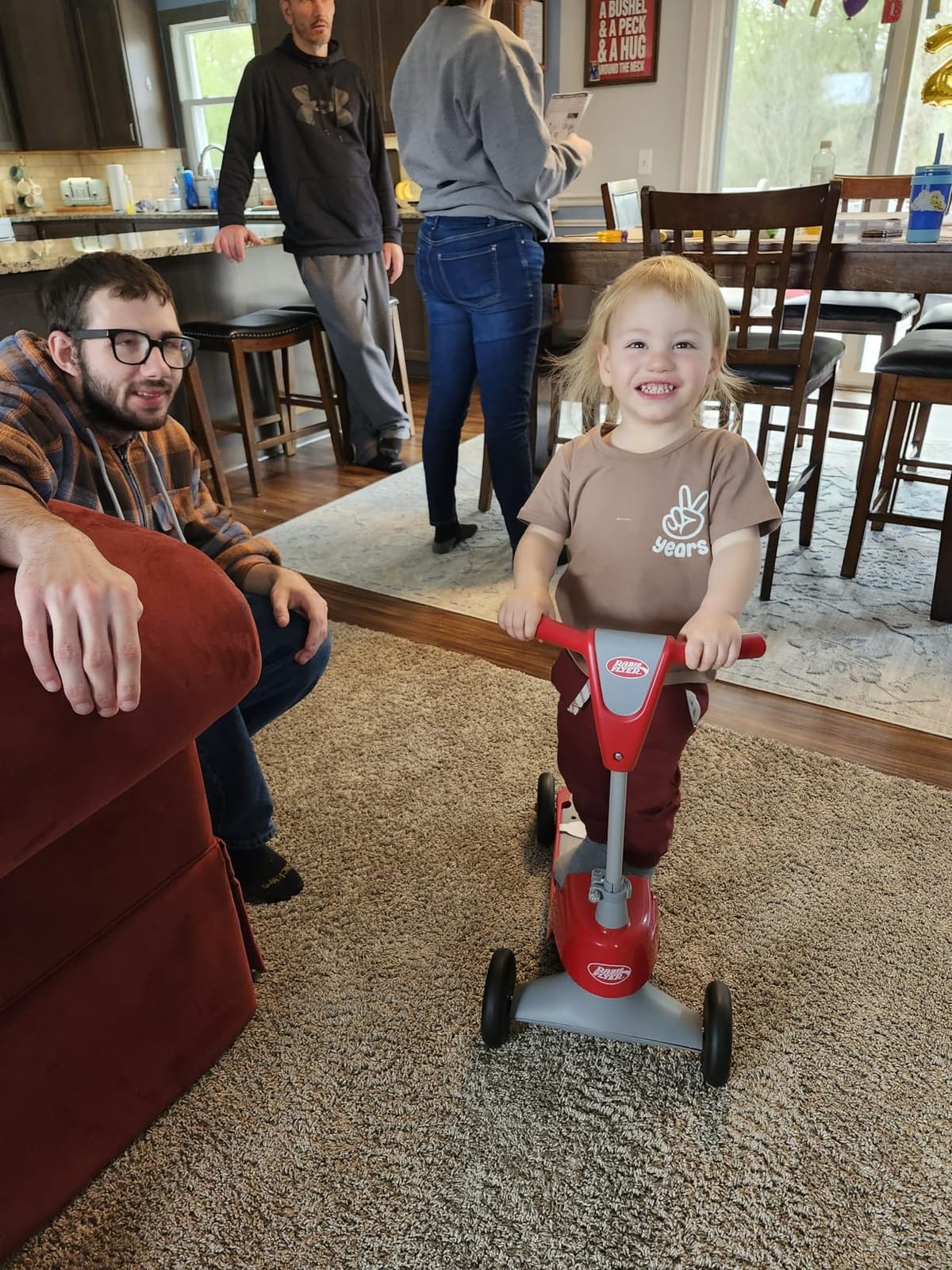
At 5.5 pounds with a foldable frame, it is the most portable option in this roundup. It fits in a hall cupboard, it comes to the grandparents’ house in a hatchback, and a child can carry it themselves down a flat path. The quiet wheels mean it is one of the few ride-ons we would genuinely leave on a hardwood floor.
Two things temper the recommendation. The body is plastic rather than the metal some buyers assume a Radio Flyer badge implies, and the handlebar height adjustment is fiddly enough that an adult will do it rather than the child. It is also a size that can fall between stages: fine for many two-year-olds, large for a smaller one-year-old, short for a confident three-year-old on the standing mode.
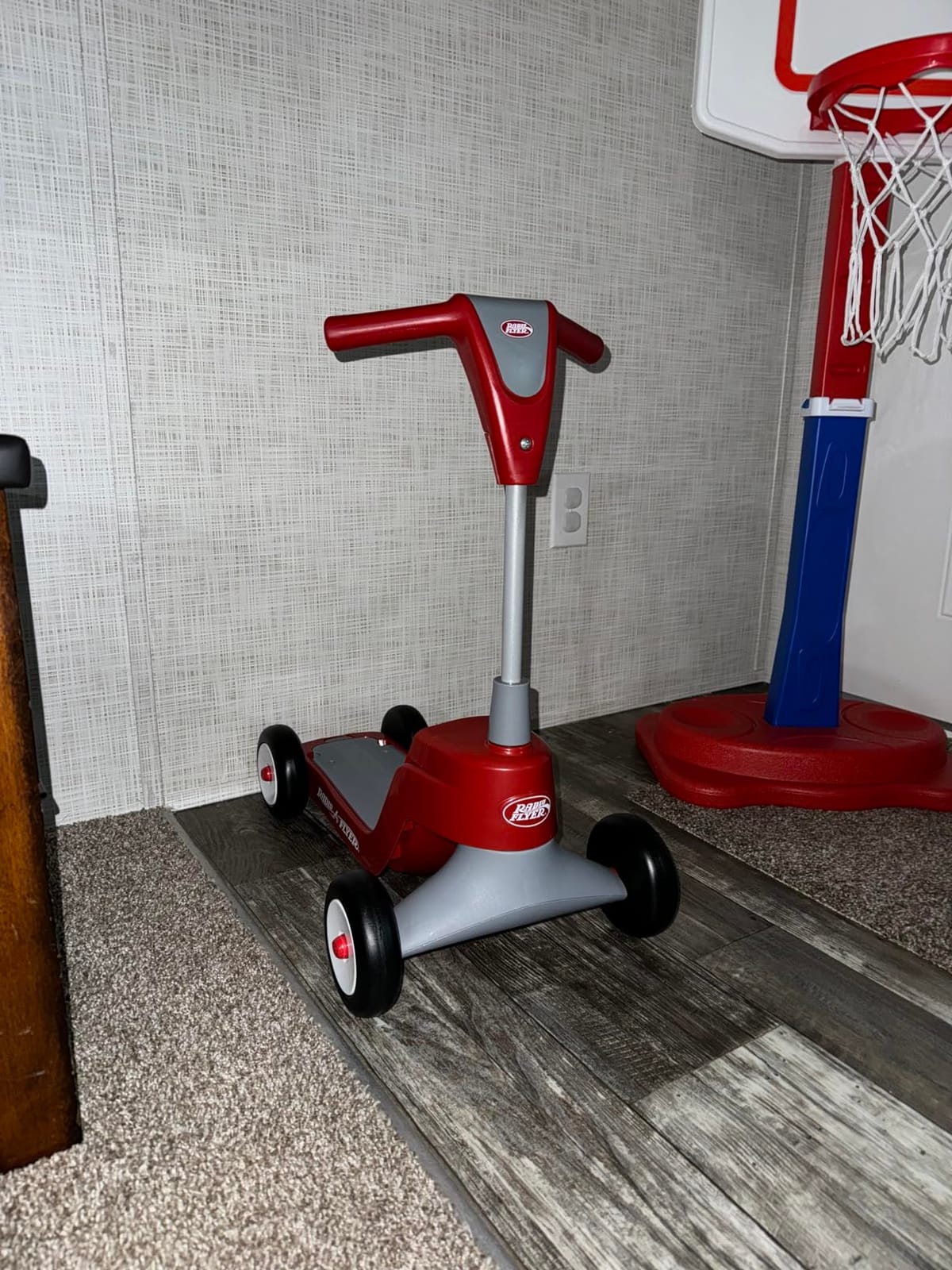
How the flip-deck conversion actually works
The deck is hinged at the front. In ride-on mode it lies flat to form a footboard; pressed down and locked, it stands upright so a taller child rides the same frame standing, steering left and right with body lean. Conversion takes seconds with no tools, which is the feature that extends the toy across stages 1 to 4.
Worth knowing: the ride-on mode is foot-to-floor, not pedal. A child who wants a tricycle rather than a scooter should skip to picks 1, 3 or 6.
Where it is the wrong tool
The four-wheel base makes it stable but slower to turn, so it will not zig-zag down a path the way a balance bike does. On a slope there is no brake and no parent handle, so keep it on flat ground. If your priority is balance development rather than a two-stage toy, the balance bikes in picks 5 and 9 are a more direct route.
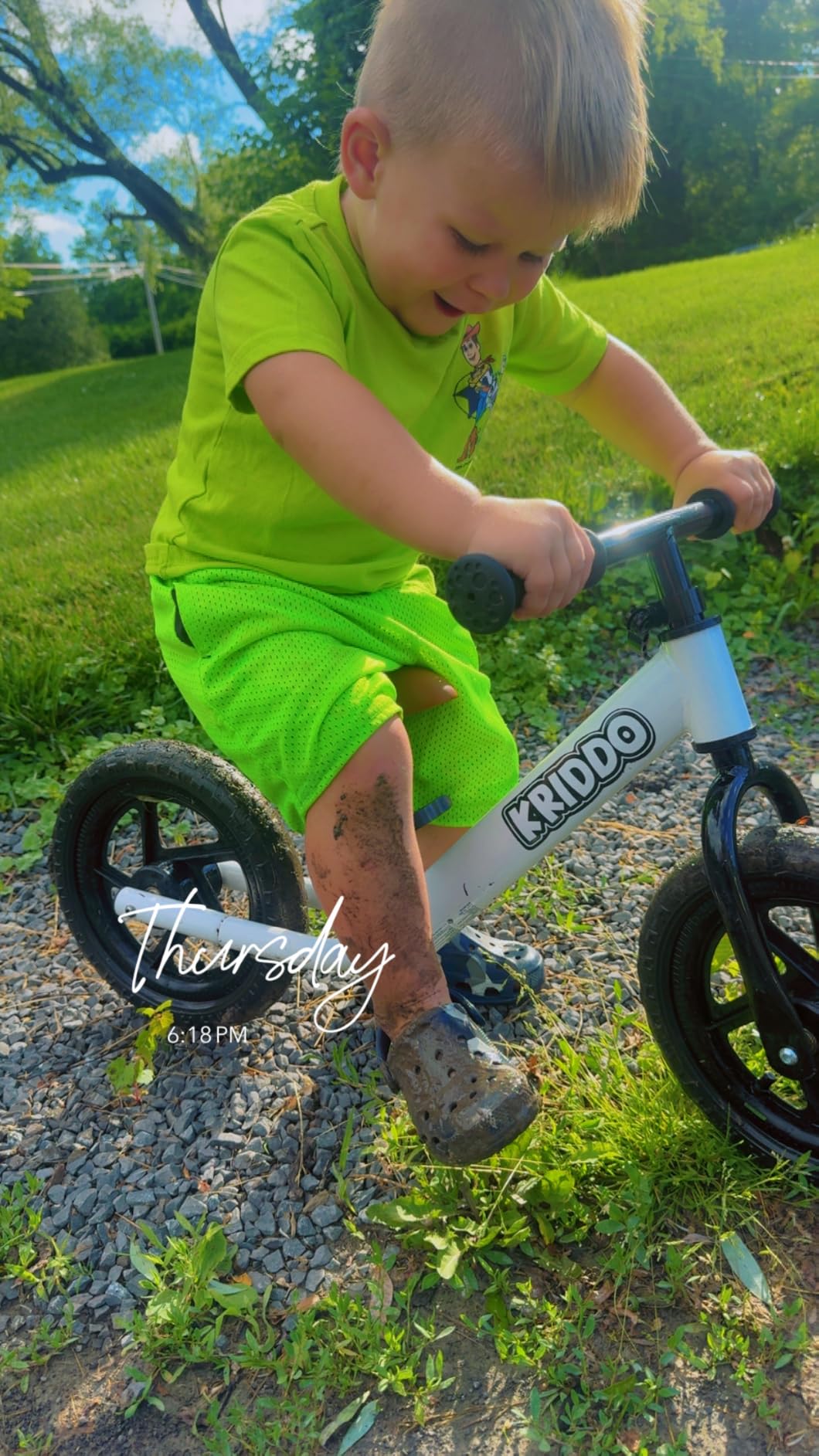
5. KRIDDO Toddler Balance Bike – Best for Balance Practice
KRIDDO Toddler Balance Bike 2 Year Old, Gift for 2-3 Boys Girls, Adjustable
Ages 2-5 years
Frame rated to 110 lb
6.6 lb bike
12 inch wheels
Pros
- Pedal-free design that builds balance and steering directly
- 110 lb carbon-steel frame outlasts most toddler bikes
- Never-flat tires roll smoothly over grass and sidewalks
- Tool-light assembly most parents finish in minutes
- Customizable name plate with sticker sets
Cons
- Handlebar and seat drift out of alignment with use
- Wheels are plastic rather than rubber
- Short learning curve before a new rider is confident
A balance bike has no pedals by design, and that is the whole point. A two-year-old sits on a 12 inch frame, puts both feet flat on the ground, and pushes with them. There is nothing to coordinate, so they learn to balance and steer before they ever have to manage a drivetrain. Many parents on parent forums describe it as the first step that made their child confident on a pedal bike later.
This one holds a 4.6 star rating across roughly 5,800 reviews. The frame is wide carbon steel rated to 110 pounds, which is far more headroom than a typical toddler bike gives you, and the soft PU saddle plus rubber grips are kinder than most.
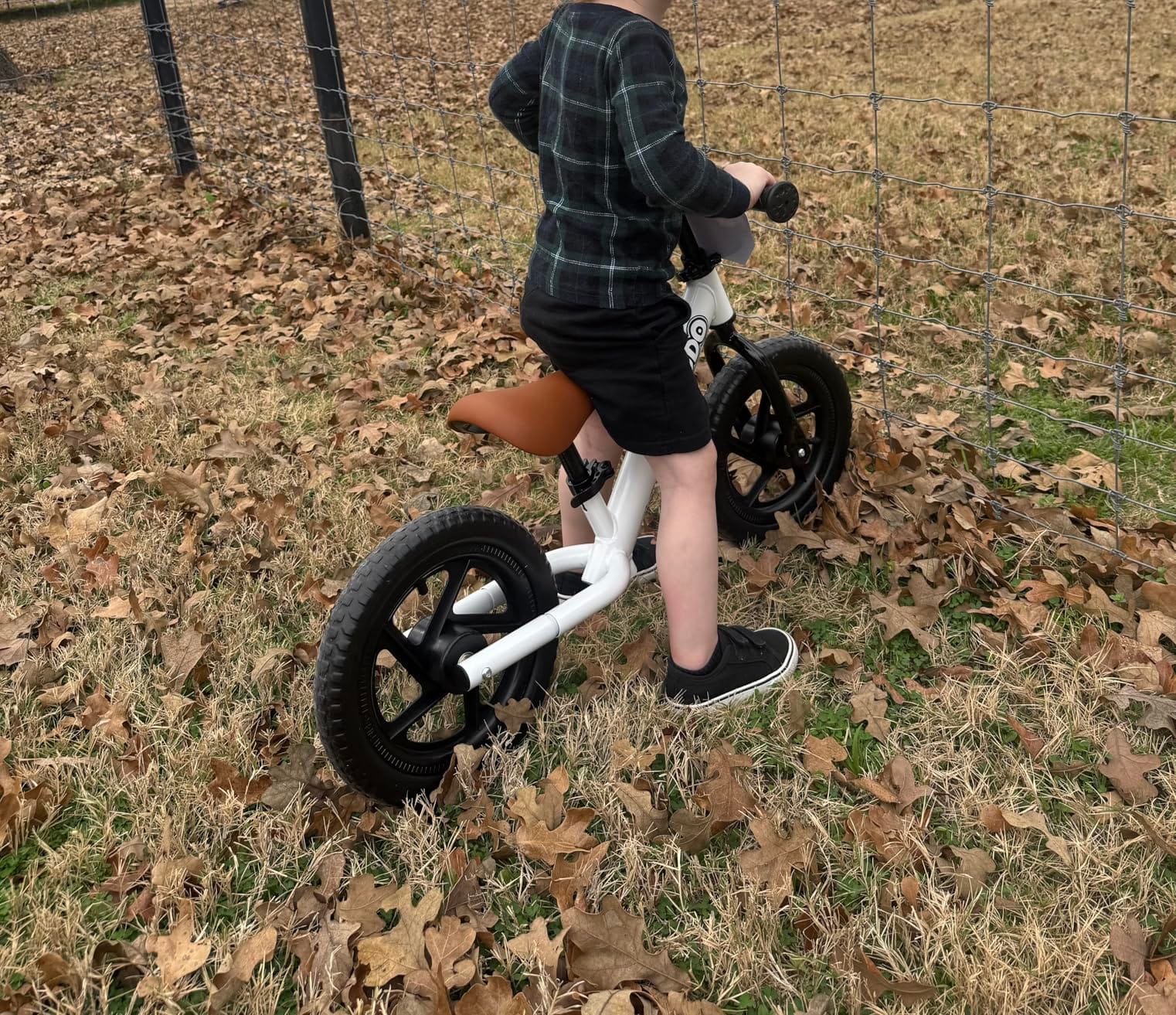
The extra-thick never-flat tires are the practical highlight. They roll over grass, gravel paths and pavement without puncturing, and they do not need checking, which removes a task from an already busy list. Adjustments are quick-release, so as your child grows you raise the seat in seconds rather than reassembling anything.
There is one design flaw that comes up repeatedly and is worth knowing before you buy. The handlebar and seat cannot be tightened enough to hold true alignment, so they gradually rotate out of position with use. It is not dangerous, but it means a monthly 30-second re-tightening, and a child who rides confidently will steer with a crooked bar.
Why we rate it higher than other balance bikes
The combination of a 110 pound frame rating and never-flat tires is what separates it. Most pedal-free toddler bikes on the market are rated far lower and use air-filled tires that go flat. This combination means a child who starts at two can keep riding it well past the age when most balance bikes are abandoned.
Assembly is quick and tool-light, and the removable name plate with three sticker sets is a small touch that reliably absorbs a toddler’s attention at the start of a ride. Weights of 6.6 pounds mean a child can pick the bike up and reposition it themselves.
When a ride-on car is the better buy
A balance bike asks a child to stand and stride, so it is a poor fit for a child who still walks with a wobble or prefers sitting. If your child is confident on their feet but wants a seat, a foot-to-floor car like the Radio Flyer Creativity Car in pick 7 is the right starting point instead. And on slopes, no-brake balance bikes should only be used on flat ground with an adult close.
6. newyoo TR007 5-in-1 Tricycle – Best Convertible for Growth
newyoo TR007 5-in-1 Tricycle for Toddlers 1-3, Toddler Bike, Birthday Gift
Ages 1-3 years
Max weight 35 lb
9.7 lb toy
5 ride modes
Pros
- Five modes keep the toy useful from age 1 to 3
- Rotating 135-degree parent handle gives real control
- Button adjustments for handlebar
- seat and pedals
- Carbon steel frame with EN188 and ASTM approval
- EVA shock-absorbing solid wheels
Cons
- Heaviest option here at 9.7 pounds
- Low 35 lb weight limit versus most competing tricycles
- Mode conversion adds complexity
The TR007 does the thing parents on r/daddit ask about most: it starts as a parent-pushed tricycle and finishes as a pedal bike. There are five modes, and the button adjustments mean each transition takes seconds rather than a re-build.
What makes it genuinely different is the parent steering handle. It rotates 135 degrees and adjusts to adult height, so an adult can actually steer the trike rather than just push it in a straight line. On a path near a road, or on the kind of uneven ground that makes new riders wobble, that is a real safety difference rather than a gimmick.
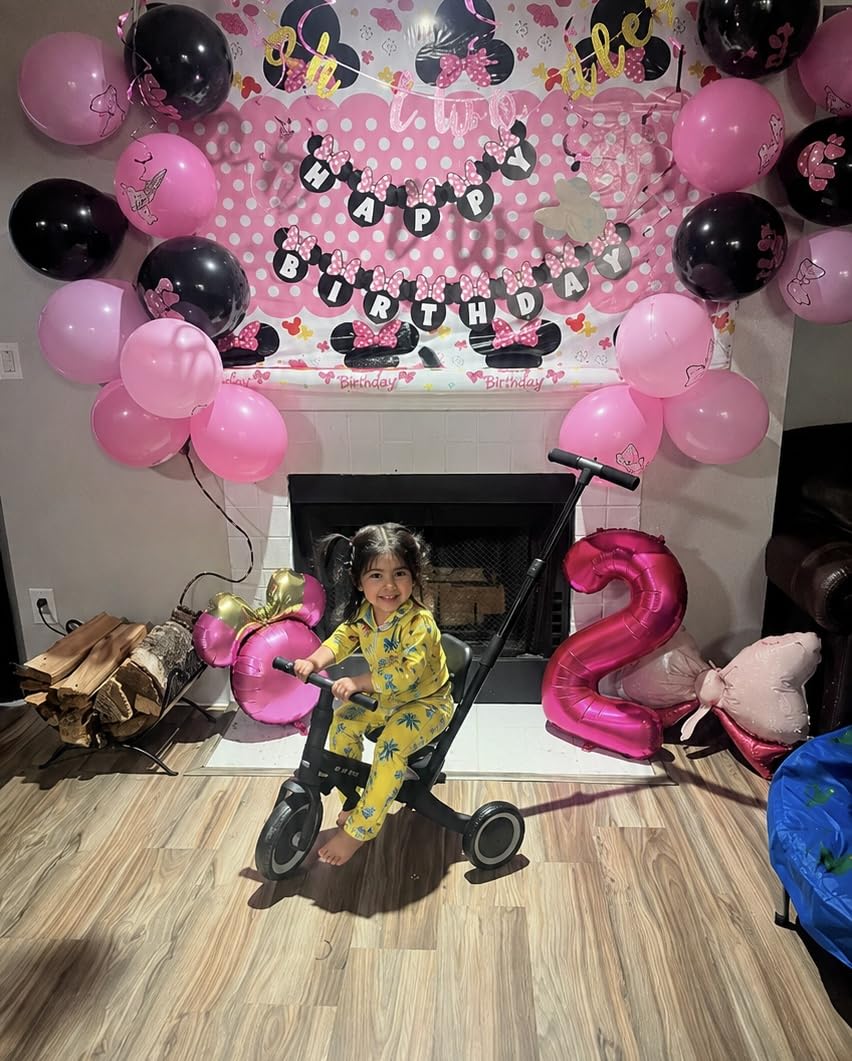
It holds a 4.5 star rating from more than 5,300 reviews, and it is the top-ranked item in the kids’ tricycles category. The carbon steel frame is EN188 and ASTM approved, and the EVA solid shock-absorbing wheels take the harshness out of a cracked driveway.
It weighs 9.7 pounds, heavier than the pedal trikes and balance bikes in this roundup, so a small two-year-old cannot really self-propel it and will be reliant on the handle. And the weight limit is only 35 pounds, well under the 50 and 55 pound ceilings on picks 1, 2 and 10, which means growth past the age of three is off the table.
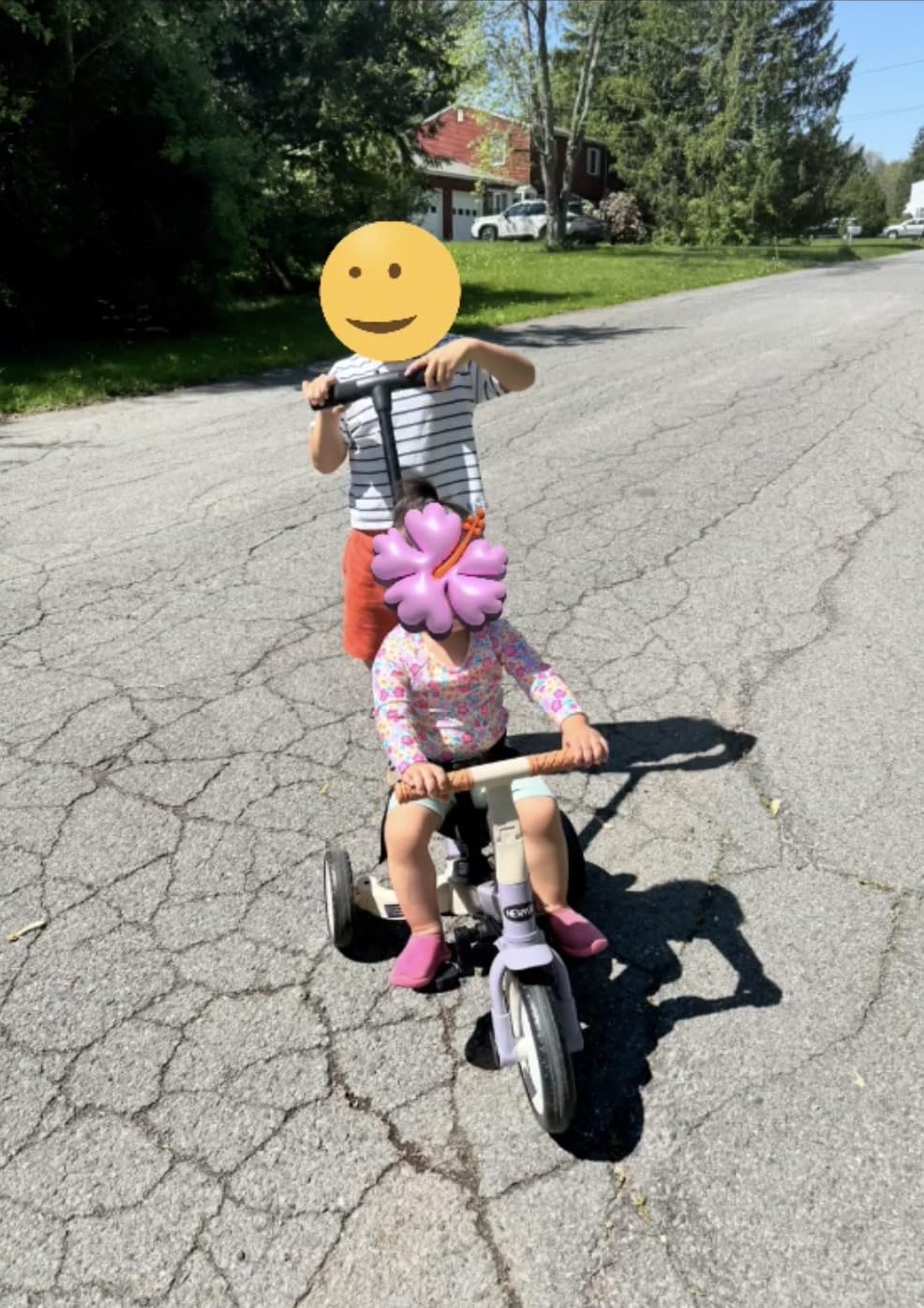
When five modes are worth the trade-offs
The conversion earns its keep when you have one child and a narrow age window. A family starting a child at 18 months and wanting pedal riding by three gets five distinct stages from a single frame, which is where the value sits. Parents who gifting across siblings can hand the toy down a full stage at a time.
We would pair it with an outdoor surface. The wheels handle grass and light gravel, but the low weight limit and stiff frame mean it is a driveway and yard toy rather than an indoor one.
When one good tricycle beats a convertible
If you only need a pedal trike for ages 2 to 5 and want it to survive a third birthday, the higher weight limit on the KRIDDO in pick 3 or the Tough Trike in pick 1 is worth more than five modes. The 35 pound ceiling on this one arrives quickly, and a child who has grown into it will be frustrated by the stop.
7. Radio Flyer Creativity Car – Best First Ride-On at 12 Months
Radio Flyer Creativity Car, Toddler Ride On Toys, for Toddlers 1-3
Ages 1-3 years
Max weight 42 lb
4.9 lb toy
21.5 x 10.5 x 16.3 in
Pros
- Highest rated here at 4.8 stars from 2117 reviews
- 3-in-1 design works as pre-walker
- walker and ride-on
- 17 interactive activities hold attention
- Under 5 pounds yet tip-resistant
- Silent wheels glide over hardwood
- Arrives largely assembled
Cons
- Front wheels do not pivot with the steering wheel
- 42 lb limit is lower than most
- Pedal-free so it is a scooter-style ride
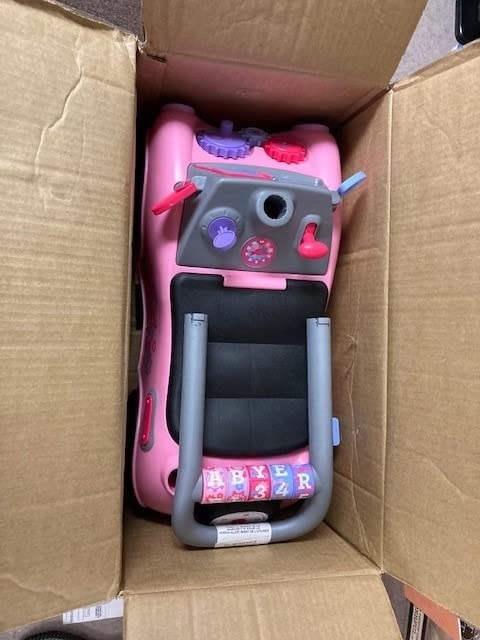
This is the highest-rated product in the roundup at 4.8 stars, and the reason is that it covers the widest age span for the least commitment. The 3-in-1 design works as a push walker, a ride-on and a sensory play vehicle, which means it can go in a cupboard at 12 months and still be a working ride-on at nearly 3.
The 17 sensory activities are the reason for the rating. Interlocking gears that turn each other, sliding beads, a clicking spare tyre, folding mirrors, a horn and an interactive dashboard give a two-year-old something to do with their hands while they scoot around on the footboard. That matters more than it sounds, because the fastest way a ride-on gets abandoned is boredom.
At 4.9 pounds it is the lightest ride-on here, and the anti-tip walker base keeps it stable despite that. The wheels are silent and floor-friendly, so this is one of the few models we would let a toddler use on hardwood. The flip-up seat opens onto a small storage compartment, and the whole thing arrives largely assembled.
The caveat is steering. The front wheels do not pivot with the steering wheel, so a turn is a gentle slide of the whole car rather than a wheel movement, and a two-year-old has to lean into it. At 42 pounds, the weight limit is also lower than most of the field.
Who it works for at two years old
A two-year-old who can walk but cannot yet pedal is exactly the child this suits. They sit, put their feet on the floorboard and push. There is no drivetrain to master, no handle for an adult to wrestle, and the sensory panel rewards them for staying put and exploring the controls.
It is also the one to buy if you are not sure the child is ready for anything more advanced. A hesitant rider on a first trike stalls at the pedals; a hesitant rider on this just scoots.
When it is not enough
At three, a child who is ready for real pedalling will outgrow it, and the 42 pound limit means that window arrives sooner than with the Tough Trike. It is a first ride-on rather than a long-term one. For outdoor pedal riding with a longer runway, move up to pick 1 or pick 3.
8. SEREED Light-Up Wheel Tricycle – Best for Sensory Play Outdoors
SEREED Colorful Lighting Toddler Tricycle Gift Toy for Ages 2-5 Boys Girls
Ages 2-5 years
6.6 lb toy
29.5 x 17.3 x 20.1 in
3-position seat
Pros
- Light-up rear wheels need no batteries
- Tool-free spring-loaded assembly in minutes
- 3-position seat and 2-position handlebar give real growing room
- Light enough at 6.6 lb for a toddler to move
- Detachable front and rear baskets
- Removable pedals for pre-pedal scooting
Cons
- Pedals can sit too far back for shorter two-year-olds
- Pedal size itself is small
- Height rather than weight is the limiting factor
The light-up rear wheels are the draw here, and the part parents care about is that they need no batteries. The wheels glow and spin as the trike rolls, generated by the motion itself, so there is nothing to charge, nothing to replace, and nothing that stops working in a cupboard over winter. For dusk play on a driveway, that is a genuine safety and enjoyment gain.
It holds a 4.7 star rating from more than 1,600 reviews, with a large share of five-star ratings. The build is a spring-loaded snap assembly that needs no tools, and the whole trike weighs 6.6 pounds, light enough for a two-year-old to move it themselves.
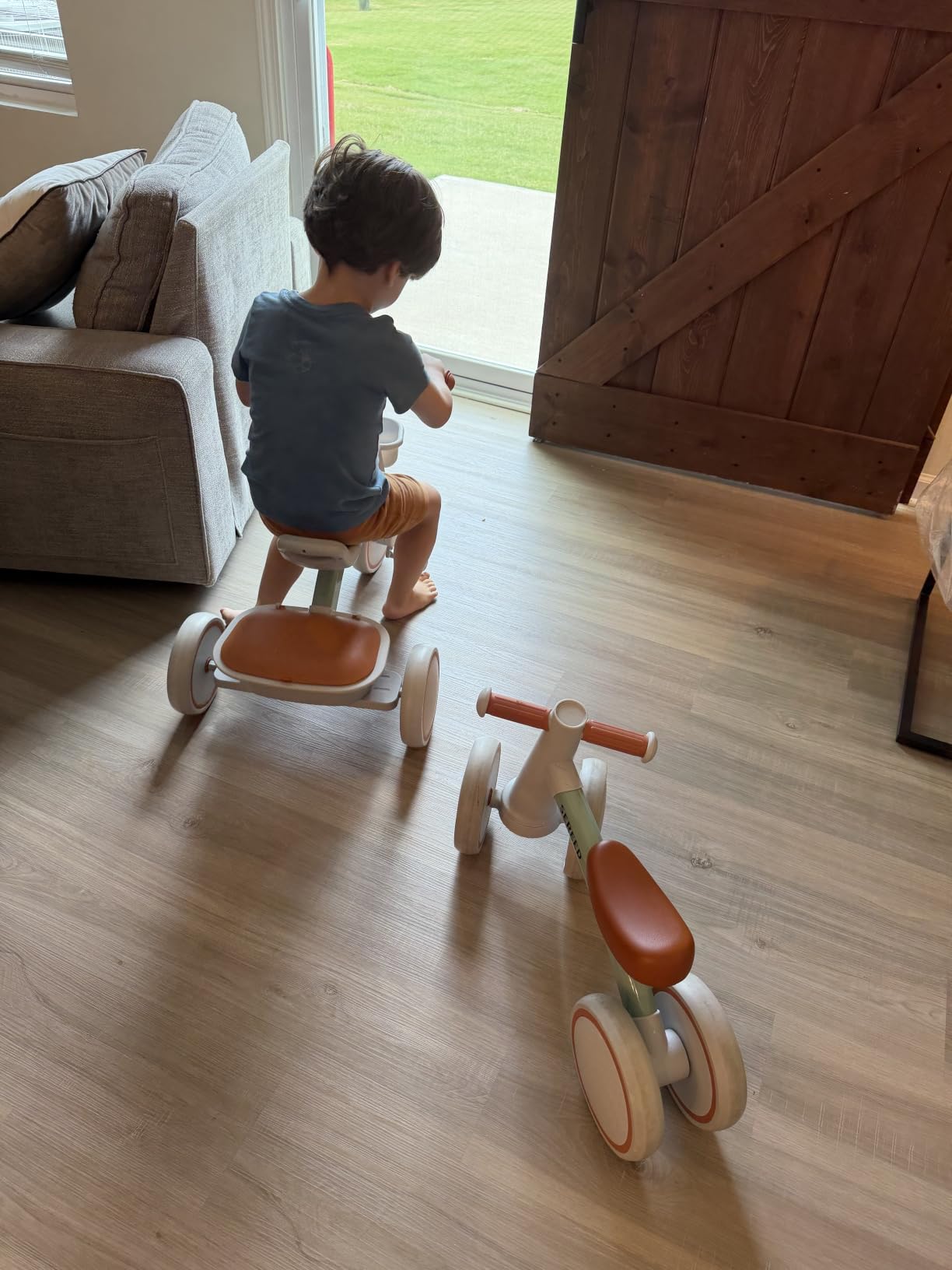
The adjustability is unusually good at this level. A 3-position seat and 2-position handlebar let you set the fit in a way that carries the trike from a small two-year-old into age four or five, which addresses the outgrowing complaint parents raise most. The detachable front and rear baskets hold snacks and small toys, and the pedals come off entirely so a child can scoot before they master pedalling.
The recurring weakness is pedal reach. Shorter two-year-olds cannot touch the pedals until they have grown, and the pedals themselves are described as small. In practice that means the trike is used as a push-along for the first few months rather than being a failure, but it is worth knowing if you have a small two-year-old and a low footrest.
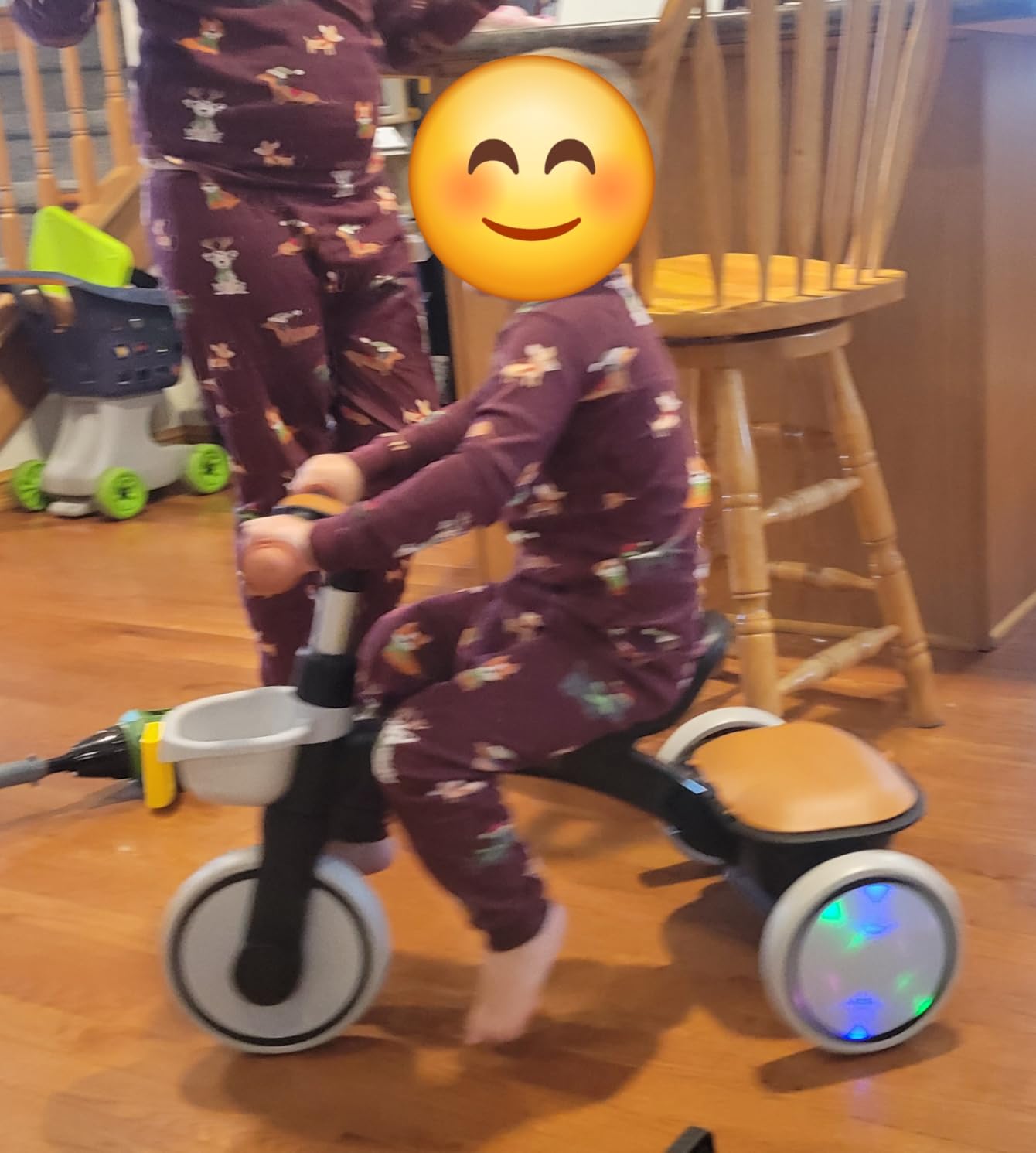
What the light-up wheels are actually like
They are colourful translucent wheels with a spiral core that catches and throws light as the rear axle turns. Because the effect comes from rotation, it is brightest at speed and fades to nothing when the trike stops, which naturally rewards a child for making it move. There is no switch to forget and no battery door for a toddler to open.
They also add a visible glow at dusk that helps a parent locate a child on a driveway without reaching for a torch.
When a plain trike is the better call
Light-up wheels are decoration on top of a solid trike, so judge it as a trike first. If pedal reach is a worry, the Tough Trike in pick 1 has a larger frame and a 55 pound limit, and if you want a tool-free build with more stability, the KRIDDO in pick 3 has a wider wheelbase. Outdoors on grass and pavement, this one is the most exciting of the three for a two-year-old.
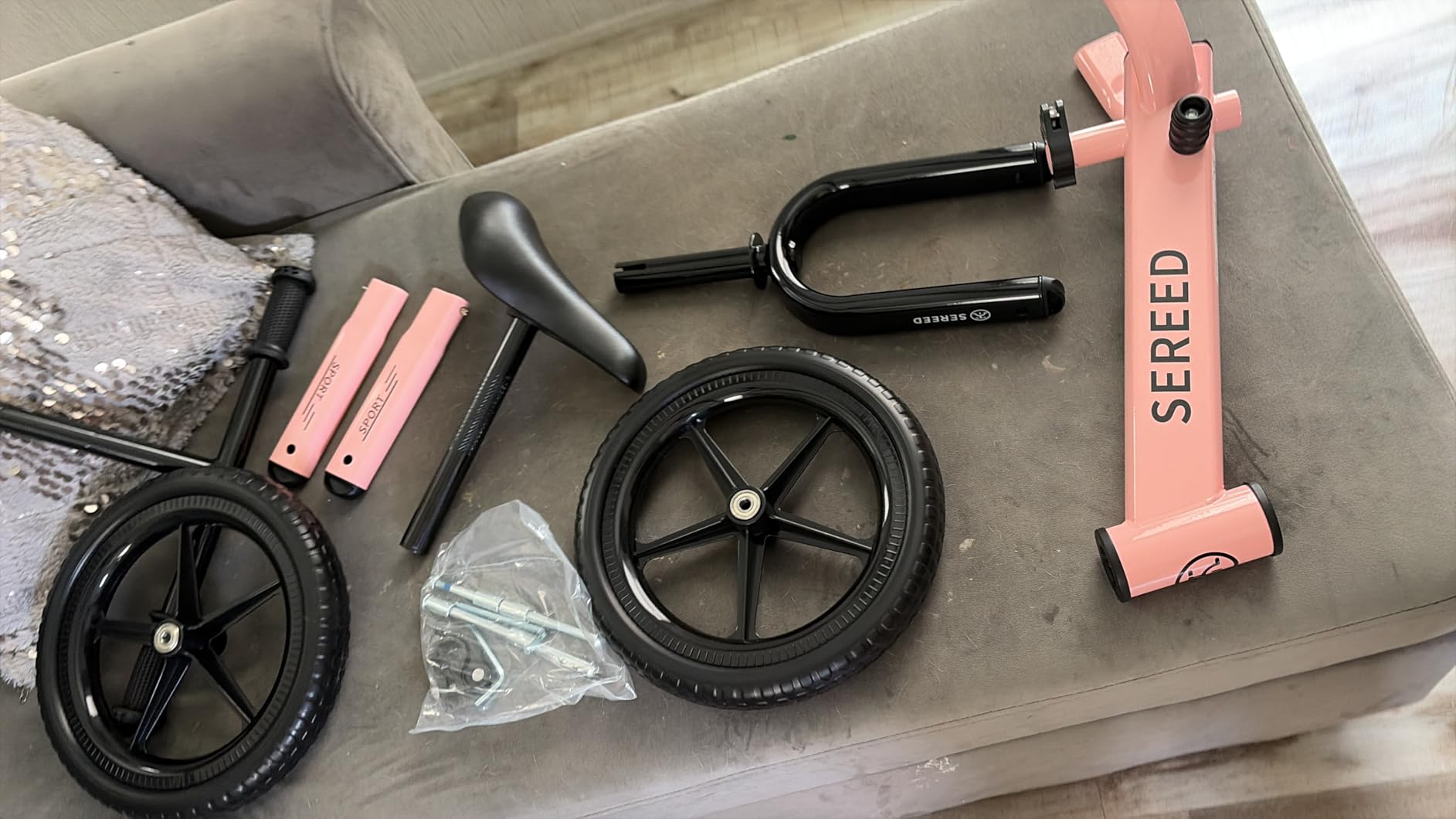
9. SEREED Toddler Balance Bike – Best for Quiet Indoor Riding
SEREED Toddler Balance Bike 2 Year Old, Gift for 2-3 Boys Girls, Adjustable
Ages 2-5 years
Frame rated to 110 lb
7.8 lb bike
11 inch EVA wheels
Pros
- EVA airless tires are silent
- grippy and never flat
- Tool-free quick-release seat and handlebar adjustment
- 110 lb carbon-steel frame
- 7.8 lb so a child can push it and a parent can load it
- Customizable plate and stickers included
- 2 year manufacturer warranty
Cons
- No brakes
- 12.6 in starting seat height is high for the smallest two-year-olds
- Rigid suspension gives no cushioning on rough ground
This balance bike is the quietest indoor option in the roundup, and the tires are the reason. The EVA foam airless wheels produce no hum on hardwood and no hiss on carpet, they grip a smooth floor instead of skating, and they will never go flat because there is no air inside them. For a two-year-old who wants to ride but lives in a flat, busy apartment, that combination is hard to beat.
It holds a 4.7 star rating from around 1,480 reviews. The carbon-steel frame is rated to 110 pounds, which is unusually high for a toddler balance bike and means the bike survives well past the age it is sold for.
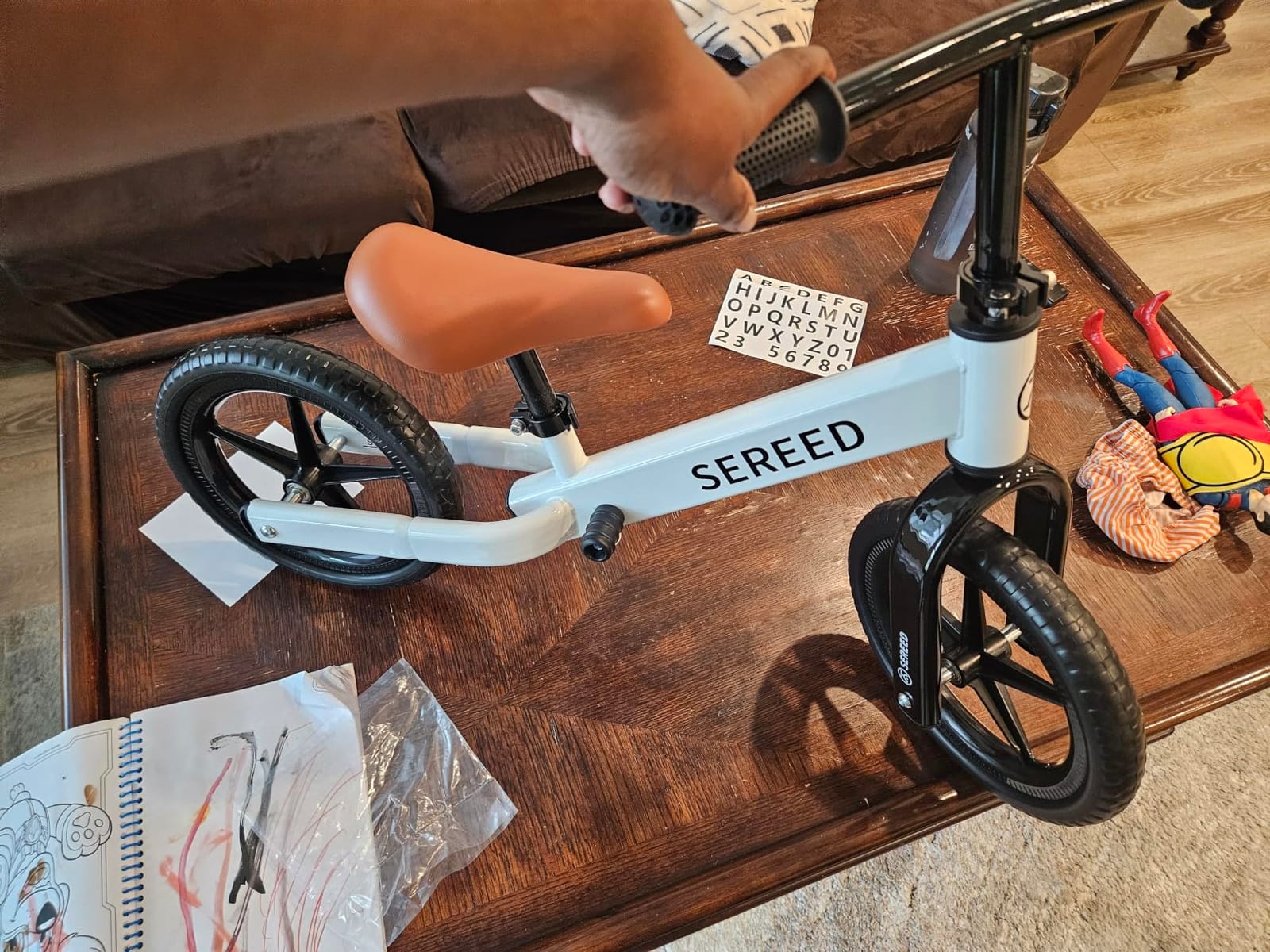
Adjustment is tool-free quick-release for both the seat and the handlebar, so as your child grows the whole fit changes in seconds. A footrest pad, rubber grips and a soft saddle round out a bike that is clearly designed for a very small rider, and the removable plate with stickers is a reliable head-turner.
Two fit notes matter for a two-year-old specifically. The starting seat height is 12.6 inches, which is high for the smallest children, so expect to drop the seat to its lowest position on day one. And like all balance bikes there are no brakes, which is normal for the category but worth remembering on any sloped surface.
Why EVA wheels matter indoors
An air-filled tire on a sealed floor is a squeak every few feet, and a hard plastic wheel is a rattle. EVA foam sits between the two: it absorbs the contact, produces almost no sound, and has enough grip to stop a child skidding on a polished floor. It is also puncture-proof by construction, so there is no pressure check to forget.
At 7.8 pounds and 32 inches long, this bike folds into a car trunk for travel to grandparents or a park, which is one of the reasons balance bikes stay in use for years in families who move.
When a balance bike is the wrong choice
It requires the child to stand and stride, so a toddler who is still walking unsteadily will struggle. If your child wants a seat, a low push car or a 3-in-1 walker-to-ride-on is a better fit. On gravel or grass, the rigid suspension transmits every bump, so for rough outdoor ground the KRIDDO balance bike with never-flat tires in pick 5 is the sturdier option.
10. Step2 Push Around Buggy – Best Stroller Replacement
Step2 Push Around Buggy Kids Push Car, Ride On Toy, Stroller Substitute, Includes Seat Belt & Horn, Made of Durable Plastic, Max Weight 50 lbs., For Toddlers 1.5-4 Years Old, Pink
Ages 1.5-4 years
Max weight 50 lb
14.2 lb toy
43.5 x 17.8 x 34.5 in
Pros
- Double-walled plastic body resists chipping and fading
- Easy to assemble and easy to wipe clean
- Whisper-ride wheels roll smoothly and quietly
- Adjustable seat belt
- Under-hood storage and cup holders
- Folding handle for transport
Cons
- Not suitable for rough terrain or gravel
- Tiring to push for taller adults
- Adult assembly required
- 50 lb weight ceiling
The Push Around Buggy does one job and does it well: it replaces a stroller for a child who has outgrown the carrier but is not walking reliably. The extra-wide rear handle folds down for storage, the body is double-walled plastic that wipes clean, and the whole thing comes apart enough to fit in a car.
At 4.7 stars across close to 10,000 reviews, this is one of the most established push cars available, and the feedback is unusually consistent. Parents mention durability, straightforward assembly and a child who is genuinely happy to be pushed rather than carried.
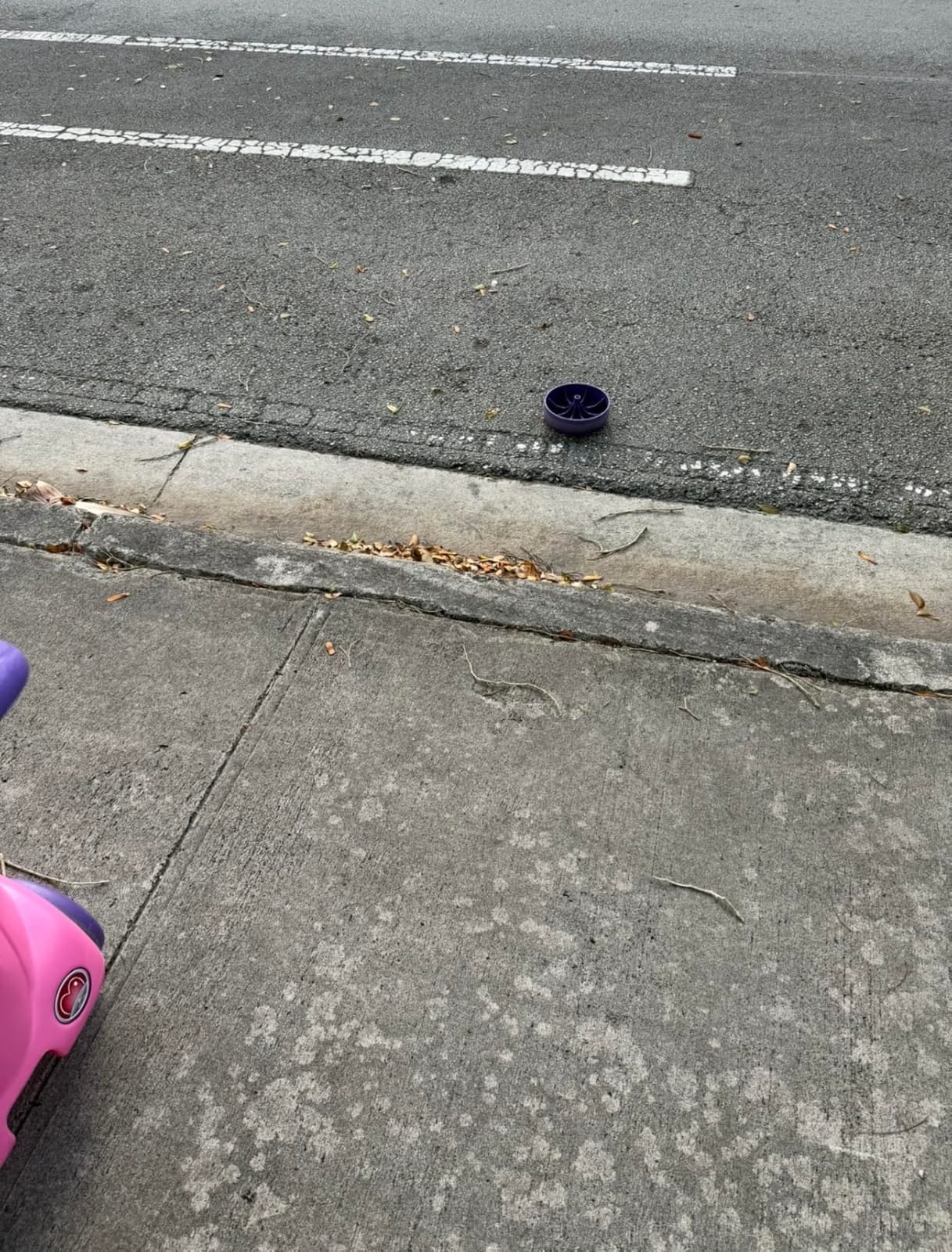
The details are good for the age group. There is an easy-latch adjustable seat belt, a real working horn, a steering wheel, cup holders and a storage compartment under the hood for snacks and toys. The whisper-ride wheels are the reason it is quieter than most plastic-wheeled push cars, and the belt latches one-handed, which matters more than it sounds.
One number decides it. At 14.2 pounds it is one of the heavier things in this roundup, and taller adults report pushing it at an angle that gets tiring on a long walk. It also needs adult assembly. And it is built for pavement and smooth paths, not for gravel driveways or grass, which is a real constraint for anyone on a country road.
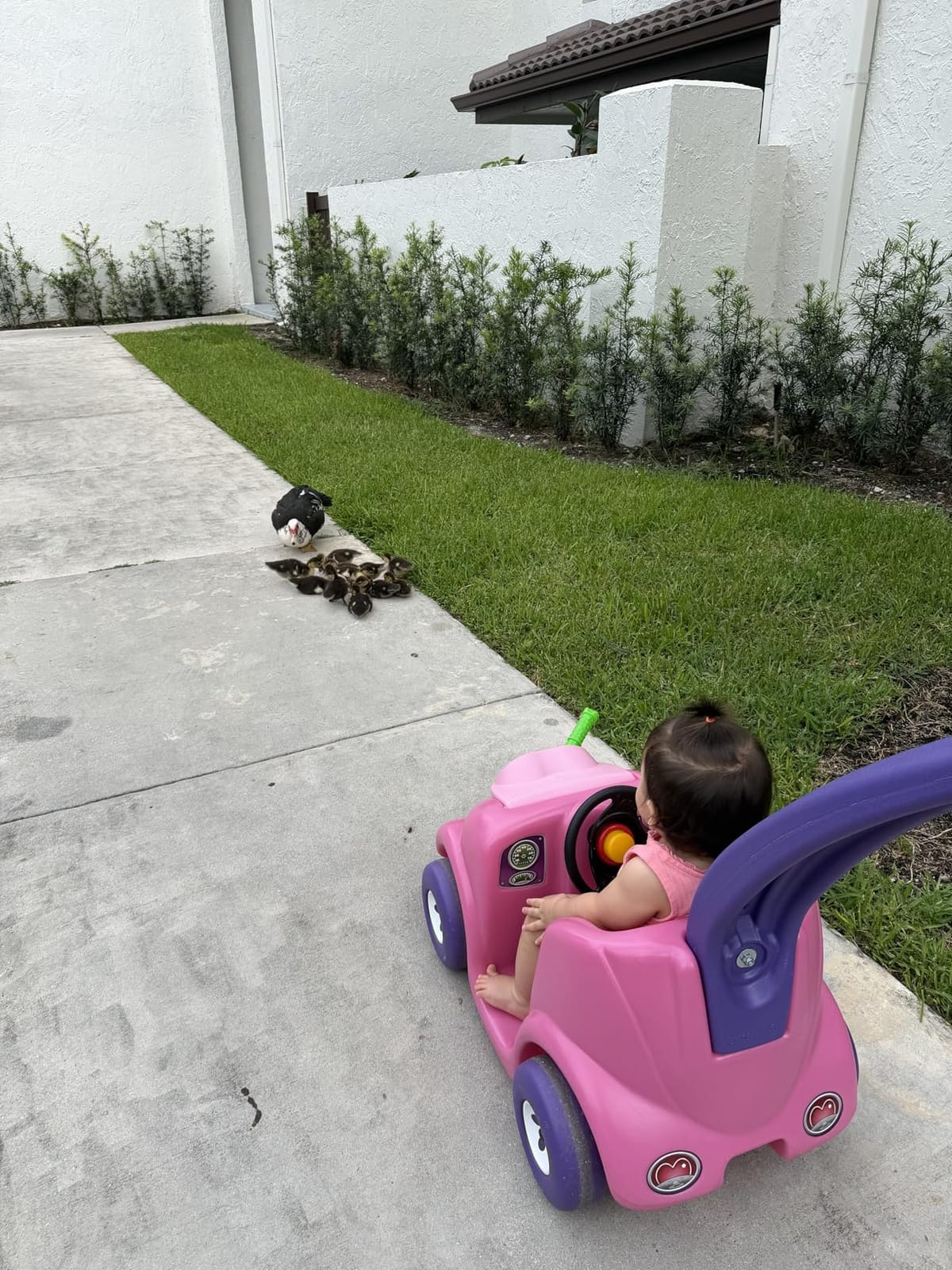
Push car against stroller: which do you need
Choose a push buggy when your child can sit unsupported, wants to steer, and needs to be pushed on a smooth surface. Choose an actual stroller when the child cannot yet sit reliably, or when you need it to fold into a narrow space and go on public transport.
The Buggy wins on the child’s experience: they are upright, they can see everything, and the horn and steering wheel give them a job. You lose on weight and on rough-ground ability.
When the Whisper Ride II is the better buy
If two children will use it or you expect a long walk each day, the Whisper Ride II in pick 2 is lighter to push, has a slightly longer age range and carries a two-year limited warranty. Choose the Buggy when the lower weight limit is not a concern and the pink finish matters more than the warranty.
11. Step2 Up & Down Roller Coaster – Best Backyard Ride-On Set
Step2 Up & Down Roller Coaster Kids Ride On Toy, Push Car, Indoor/Outdoor Playset, Made of Durable Plastic, Max Weight 50 lbs., for Toddlers 2-5 Years Old, Multicolor
Ages 2-5 years
9-foot track
Max weight 50 lb
110 x 27 x 12.8 in
Pros
- Nine-foot track and ride-on car create a full play setup
- Dismantles for storage and reassembles easily
- Recessed retainer wells hold the car until the ride starts
- Durable double-walled plastic
- Works indoors or outdoors
- Expands with an additional track pack
Cons
- Needs a 9-foot stretch of clear space
- Large footprint
- Expansion pack sold separately
Every other pick on this list is a vehicle. This one is a small ride-on playset: a 9-foot roller coaster track and an ATV-inspired car your child climbs into, pushes off from, and rides down. For a two-year-old on a flat lawn, the difference in play value is enormous, because there is a climb, a queue, a launch and a descent rather than just a seat and some wheels.
It holds a 4.7 star rating from more than 7,800 reviews, with a high share of five-star ratings. Parents mention the same three things repeatedly: the durability of the double-walled plastic, the assembly and disassembly, and the gross motor development it encourages.
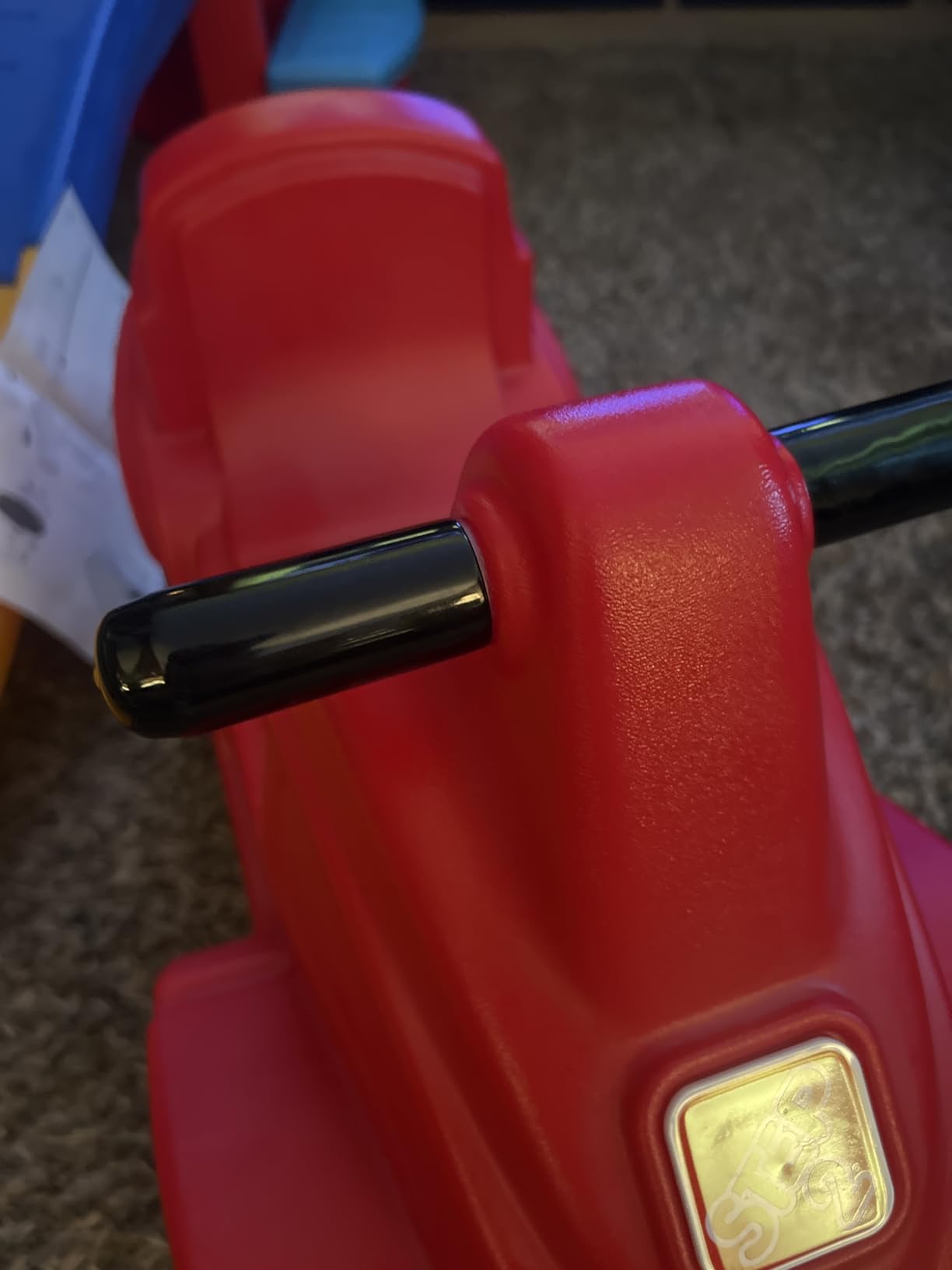
The safety design is thoughtful for this age. Recessed retainer wells hold the car in place until the child is ready to roll, and the track is low to the ground, so a two-year-old climbing up and dropping onto the car is the intended use rather than an accident. It works on a patio or a playroom floor as well as a lawn, and the plastic wipes clean with a damp cloth.
Space is the whole story here. The track measures 110 inches by 27 inches and needs a clear stretch roughly 9 feet long. The good news is that it comes apart for storage, so it can live in a garage between seasons. A separate expansion pack adds 4 feet of track, and it is not compatible with other extension packs, so plan the layout before you set it up.
When a full playset earns its space
This works when you have a flat, clear 9-foot stretch and a child who needs a reason to spend time outside. The climbing, balancing and pushing sequence is genuinely good gross-motor practice, and a 2 year old who has climbed the steps and launched the car will happily do it fifty times.
It also solves the boredom problem better than any single ride-on. When the car gets tiring, there is still the track to run.
When it is the wrong purchase
Skip it in a small yard, a rented flat, or any home where 9 feet of permanent clear space is not realistic. For most apartments it is simply too large. If your priority is a vehicle your child can ride for years and hand to a sibling, pick 1 is a better investment, and for indoor use in a playroom, a folding push car takes up a fraction of the footprint.
12. JMMD 6-in-1 Toddler Bike – Best for Travel and Storage
JMMD 6 in 1 Toddler Bike with Push Handle for Kids 18-60 Months, 12″ Foldable Balance Bike with Training Wheels, Pedals, Brakes, Kickstand, Push Tricycle Toddler Gift & Toys for Boy & Girl
Ages 18-60 months
Max weight 55 lb
6 convertible modes
12 inch rubber wheels
Pros
- Six modes from push trike to pedal bike with training wheels
- Folds flat with one press of a button under the frame
- Aluminum alloy frame is light and sturdy
- 12 inch puncture-proof rubber wheels
- Hand brake plus a 60 degree steering limiter
- 95 percent pre-assembled
Cons
- Some reports of push handle durability issues
- Pedals and hand brake can be stiff at first
- Heavier than a plain balance bike
- Crowded with pedals and training wheels attached
This is the most capable single bike in the roundup and the most demanding. Six modes take it from a parent-pushed tricycle through a toddler tricycle, a balance bike and a toddler bike to a pedal bike with training wheels, covering ages 18 to 60 months in one frame.
It holds a 4.7 star rating from roughly 1,880 reviews. The safety engineering is the standout: a hand brake for real stopping, a 60 degree steering limiter that prevents a panicked sudden turn, and a 135-degree rotating parent steering handle that lets an adult control speed and direction. The 12-inch puncture-proof rubber wheels are the most substantial tires in this roundup.
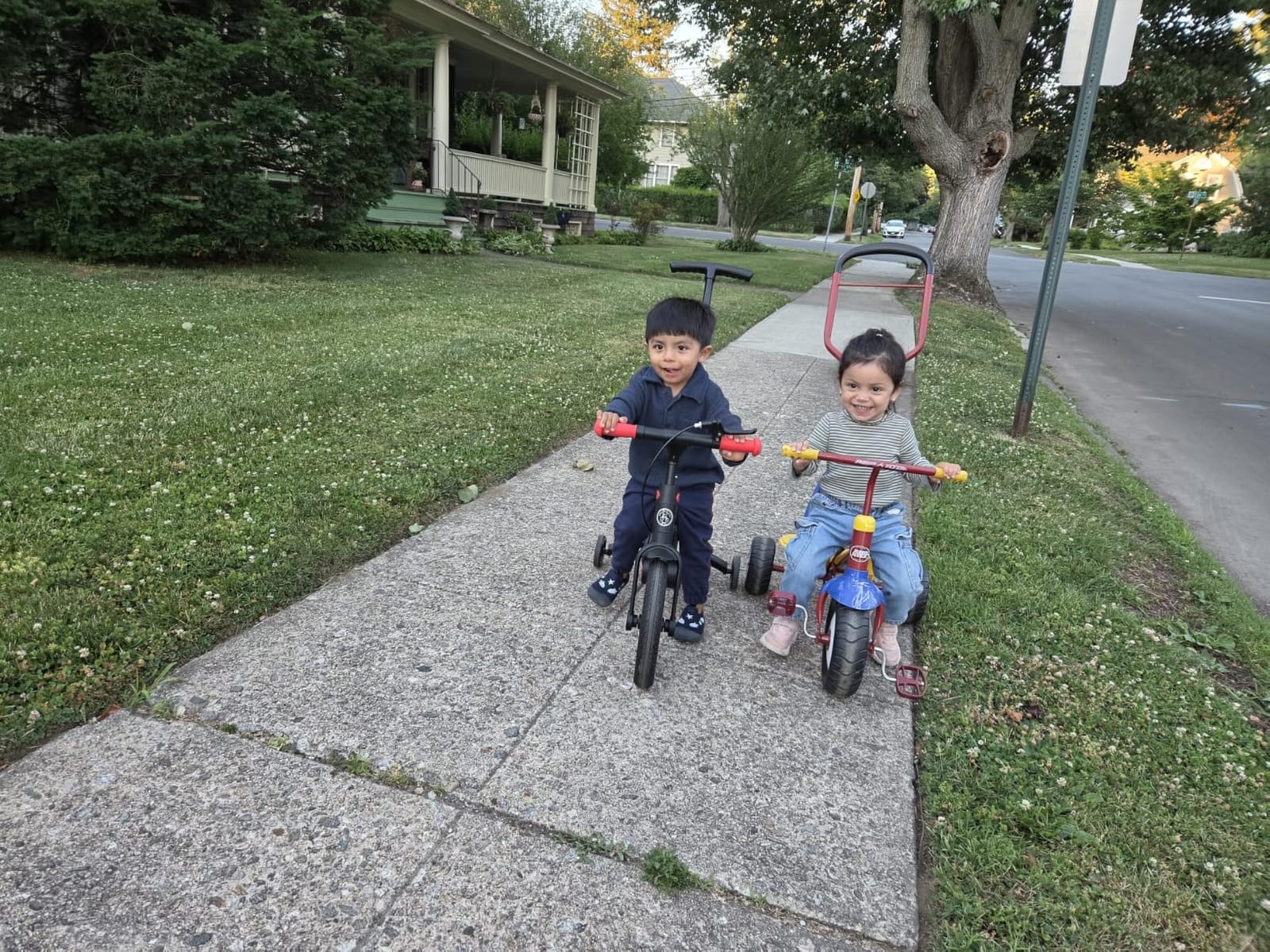
It also arrives 95 percent assembled, so you attach a handlebar, a seat, a push rod and the pedals, and it is ready. The frame is aluminum alloy rather than the carbon steel used on most competitors here, which is why it folds to a flat enough shape to load in a car.
The trade-offs are real. The push handle is a wear point, with some reports of durability problems over time. The hand brake and pedals are stiff for the first rides and need a few minutes of adult work before a two-year-old can use them. And the training wheels plus pedals make the folded package bulkier than a plain balance bike.
What one-press folding actually saves
One button under the frame collapses the whole thing into a flat panel. In a hallway cupboard, behind a sofa, or in the boot of a car, that is the difference between a bike that gets used at grandparents’ house twice a month and one that stays in a garage. Given that a 2 year old will use a good ride-on for a couple of years at most, portability extends the useful life more than any single feature.
It arrives 95 percent assembled, which matters for the same reason: the build is minutes, not an evening.
When a simpler bike is the smarter buy
Choose this if you want one frame for the whole early-childhood stage and you have somewhere to store it folded. Choose the SEREED balance bike in pick 9 if you only need the balance stage, want a quieter indoor ride, and would rather not deal with pedals, a brake and a training wheel assembly at two years old. The complexity is the price of the versatility.
How to Choose a Ride-On Toy for a 2 Year Old
Match the ride type to the developmental stage
There are four ride-on types, and picking the wrong one for the stage is the most common mistake parents make. A foot-to-floor ride-on is a low car or buggy your child pushes along with their feet; it suits a walker and needs no coordination beyond steering. A push-along ride-on adds a parent handle, so an adult controls the speed; it suits a child who can sit but not yet pedal. A pedal tricycle needs leg strength and reach, so it usually starts around age 2 and a half to three. A balance bike has no pedals at all and builds the balance that makes a pedal bike come later.
Convertible designs blur these lines, and that is exactly why the 3-in-1 and 5-in-1 toys rank well here. A toy that starts as a walker and ends as a ride-on avoids the gap where a child is ready for neither.
Motorised ride-ons are a separate category and a later one. If you are curious about battery-powered options, our guide to the best electric ride-on cars for kids covers where that stage actually starts, and why most of them are too much for a two-year-old to steer alone.
Prioritise a wide wheelbase and a low centre of gravity
Two-year-olds have a high centre of gravity relative to their legs. That is why the most common complaint about ride-ons is tipping backward when a child leans to look behind them or over a bump. A wide wheelbase spreads the weight and lowers the effective centre of gravity, and extended rear wheels add stability at the axle most likely to lift.
Look for a rear wheel track wider than the front, and treat a low frame as a feature rather than an accident. Any ride-on with a motor or a high seat needs an anti-rollover bar or a low backrest for the same reason.
Match the wheels to your floor
Indoors, wheel material decides whether the toy is usable. Hard plastic wheels scratch hardwood and sound like a dropped tray. Rubber or EVA foam wheels roll quietly, grip a smooth floor and leave no marks. Wide, balloon-style wheels also distribute weight better on a tiled floor with grout lines.
Outdoors, the priorities flip. Deep tread or airless never-flat tires handle grass and gravel without puncturing, and inflated rubber tires roll faster on a smooth driveway. The Radio Flyer Scoot 2 and the Radio Flyer Creativity Car are the quiet-floor picks; the KRIDDO trike and the SEREED light-up trike are the rough-ground picks.
Check the weight limit against real growth
The gap between ride-ons here is 35 to 55 pounds, and that matters more than most spec sheets admit. A 35 pound ceiling is reached around age three, which turns a good toy into a frustration quickly. A 50 or 55 pound limit buys you another year or more of use, and those extra months are the difference between a toy that is handed down and one that goes to a charity shop.
Height is the second limit and the one manufacturers rarely print. Measure the seat height with the child sitting, knees bent, and check that their feet reach the pedals or the floor with a slight bend. If they must straighten their legs to touch, they will outgrow the fit in weeks.
Uneven ground and sloped driveways
This is the question parent forums ask most, and it deserves a direct answer. Ride-on toys are engineered for flat, hard surfaces, and hills change that. On any slope, a child-powered ride-on gains or loses speed faster than an adult can react, and a wide-wheelbase tricycle with no brakes can roll backwards faster than a two-year-old can counter-steer.
On a sloped driveway, a pedal trike is workable if you supervise closely and if the trike has brakes. A foot-to-floor car is safer, because the child can stop pushing and the toy simply stops. A no-brakes balance bike on a slope is the worst option, since a child cannot stop at all. If your ground is genuinely hilly, the parent steering handle on the newyoo TR007 in pick 6 or the 6-in-1 in pick 12 gives you a hand that can actually slow the descent.
For uneven ground specifically, large-diameter wheels and airless tires are the answer. The KRIDDO balance bike and the SEREED light-up trike both use shock-absorbing EVA or never-flat tires that take cracked pavement and lawn edges without jolting a small rider.
Buying second-hand: what to check
Hand-me-down ride-ons are common and usually a good value, because the toy is often barely used and the plastic outlives the child. Check four things before you commit: the tires for cracks, bulges and bald tread; the seat and any belts for stretch or cracks; the fasteners, by pushing every joint and listening for creaks; and the battery compartment on any electric model, where a swollen or corroded cell is a reason to walk away.
Check that the model is not too big for your child. Ride-ons are almost never too small for a two-year-old, and a toy sized for a four-year-old will be frustrating rather than fun. Missing hardware is the most common reason a second-hand ride-on ends up in a skip, so ask for the original box and any spare fixings.
Assembly time and small-space storage
Assembly is the most common source of regret. Tool-free and spring-loaded models here build in 10 to 20 minutes; the Step2 push cars take an hour and a half or more with picture-only instructions, and one of them needs a wrench to detach the handle for storage. If you are assembling at 9pm with a two-year-old awake, that difference is real.
For storage, check the folded or dismantled dimensions before buying, not after. A push buggy is roughly 43 inches long even folded; a folding scooter is 22 inches; a one-press-folding bike collapses flat; and a 9-foot playset needs a garage rather than a cupboard. Measure your narrowest storage spot first, and a ride-on that has to live in a hallway will be used more often.
Frequently Asked Questions
What are some good ride-on toys for a 2-year-old?
The strongest options at this age are a pedal tricycle with a wide wheelbase, such as the Fisher-Price Harley-Davidson Tough Trike, and a foot-to-floor ride-on with a parent handle, such as the Step2 Whisper Ride II. A balance bike is the better choice if your child is confident standing but not yet pedalling, because it removes the drivetrain from the learning process. The most durable picks keep a weight limit of 50 pounds or more so the toy survives past the third birthday.
What is a good ride-on car for a 2-year-old?
For a two-year-old, a good ride-on car has a low seat, a wide wheelbase and a parent push handle, because two-year-olds are top-heavy and tip easily. The Step2 Whisper Ride II and the Step2 Push Around Buggy both fit that brief, with quiet wheels, a working horn, a seat belt and a folding handle for storage. Choose quiet rubber or foam wheels if the car will be used on hardwood or tile indoors.
Is a 12V electric ride-on appropriate for a 2 year old?
Most 12V electric ride-ons are built for children from about 3 years old and a weight limit around 55 pounds, and they are not designed for a two-year-old to control independently. At this age, a foot-to-floor ride-on or a pedal trike gives the same imaginative play with far less risk, and there is no battery to charge, no charging port to reach and no motor to service later. If you want the powered experience, our dedicated electric ride-on guide covers the models that fit older children.
Are tricycles safe for 2 year olds?
A tricycle is generally safe for a two-year-old on flat ground, provided the child can sit steadily, reach the pedals with a slight knee bend and steer. Look for a wide wheelbase and extended rear wheels, which reduce the chance of rolling over when a toddler leans into a turn. Many toddler tricycles have no brakes, so avoid sloped driveways and teach your child that pedalling backwards sends the trike backwards.
What weight limit should a ride-on toy for a 2 year old have?
Look for at least 40 pounds, and prefer 50 pounds or more if you can. A 2 year old is typically around 25 to 30 pounds and will reach 35 pounds somewhere around their third birthday, so a 35 pound ceiling ends the toy’s useful life sooner than most parents expect. The height of the seat and the pedal reach matter just as much as the number, so have your child sit in it before you commit.
What age are ride-on toys good for?
Ride-on toys are generally useful from about 12 months to 5 years, but the type has to match the stage. Push walkers and foot-to-floor cars work from 12 to 18 months, pedal trikes from about 2 to 5 years, and balance bikes from 18 months to 4 years. Convertible designs such as 3-in-1 and 6-in-1 models cover the widest range and are often the cheapest way to buy one toy that lasts the whole stage.
Final Verdict: Which Ride-On Should You Buy?
The default answer for most families buying the best ride-on toys for 2 year olds is the Fisher-Price Harley-Davidson Tough Trike. It has the highest review volume in the group, a 4.7 star rating built on tens of thousands of owners, a 55 pound weight limit and a wide frame that resists the backward tip that ruins so many ride-ons at this age.
Change the pick when your constraint is different. In a small apartment, the Radio Flyer Scoot 2 folds flat and weighs 5.5 pounds. On rough ground or a yard with grass, the SEREED light-up tricycle and the KRIDDO trike handle bumps better. If your child can walk but cannot yet pedal, the Radio Flyer Creativity Car works as a walker, a ride-on and a sensory toy in one. For a sloped driveway, pick something with a parent steering handle rather than a no-brakes balance bike.
Whatever you choose, check the seat height with your child sitting in it and measure your storage space first. Those two checks prevent most of the disappointment we hear about, and they take about two minutes. Last updated in October 2026.