
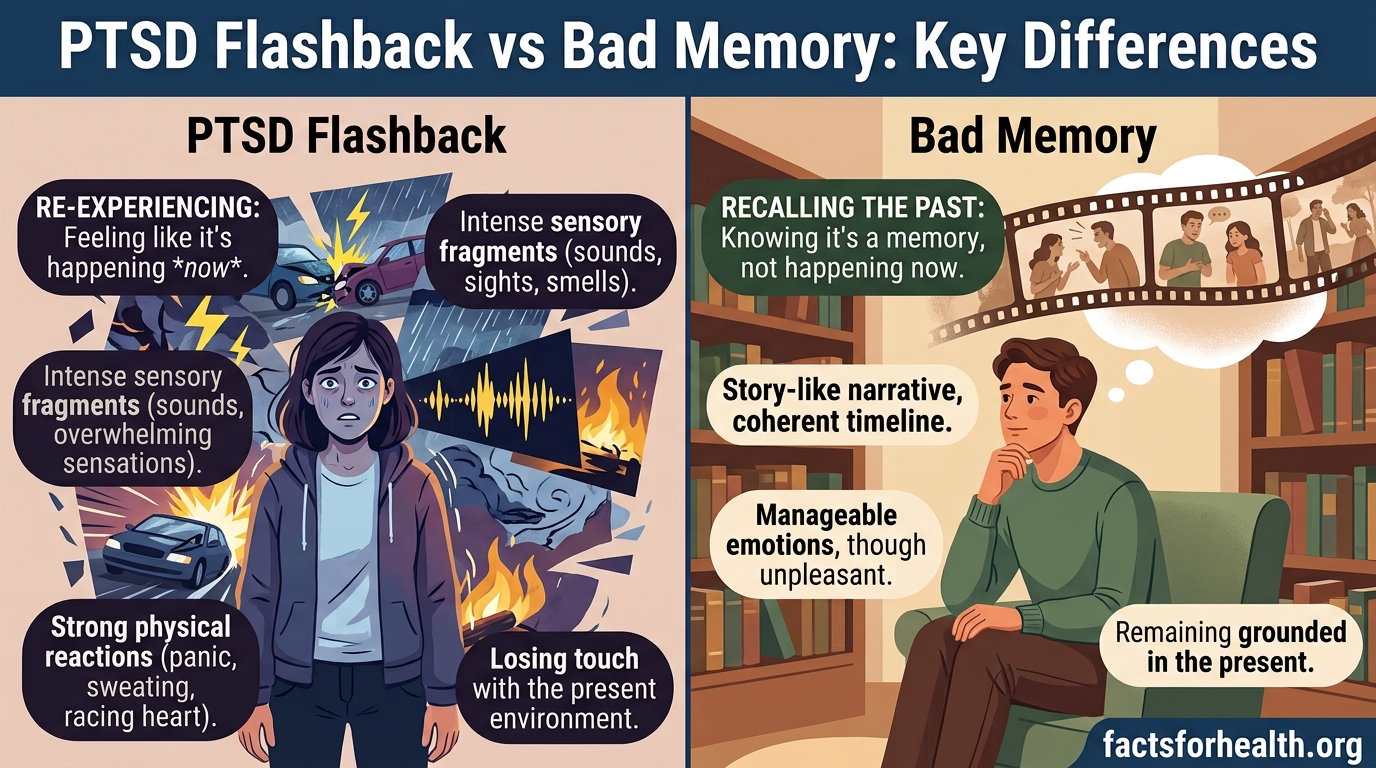
Have you ever been going about your day when suddenly a painful memory hits you so hard that for a moment, the world around you disappears? Maybe your heart started racing, your body tensed up, and you felt like you were right back in the worst moment of your life. Or maybe you just felt a wave of sadness, remembered something difficult, and moved on a few minutes later. Understanding the difference between a PTSD flashback and a bad memory can feel confusing, especially when the line between the two seems blurry.
Our team has spent months researching trauma responses, interviewing mental health professionals, and reading hundreds of firsthand accounts from people living with PTSD and complex PTSD (C-PTSD). What we found is that most resources skip over the “bad memory” side of the comparison entirely. They explain what flashbacks are in clinical detail but never pause to define what a regular bad memory actually looks like in contrast.
That gap leaves a lot of people wondering whether what they are experiencing is normal or whether they need professional help. Some people dismiss serious flashbacks as “just bad memories” and never get treatment. Others worry that every unpleasant memory is a sign of PTSD. Neither conclusion is accurate.
This guide breaks down exactly how these two experiences differ, what happens in your brain during each one, and how to tell which you are experiencing. Whether you are trying to understand your own reactions or support someone you love, you will find clear, practical answers here.
Table of Contents
The Difference Between a PTSD Flashback and a Bad Memory: Quick Answer
A PTSD flashback is an involuntary, vivid re-experiencing of a traumatic event where your brain and body respond as though the trauma is happening right now, often with a partial or complete loss of awareness of your present surroundings. A bad memory is an unwanted recollection of a negative experience that you observe from a distance, fully aware that it happened in the past and that you are safe in the present moment.
The simplest way to think about it: with a bad memory, you are watching a movie of something that happened to you. With a flashback, you are suddenly inside the movie, and the movie feels more real than the room you are sitting in.
One Reddit user in the r/CPTSD community captured this distinction perfectly: “With a memory you are an observer to the emotional response you had at the time. With a flashback, you are a participant in the emotional response as if it is happening again right now.”
That observer-versus-participant difference is the single most important distinction we will explore throughout this article. Everything else, from brain chemistry to coping strategies, flows from that core difference.
What Is a Bad Memory?
A bad memory is a normal, everyday recollection of something negative that happened to you. It could be a painful breakup, the day you lost a job, a time someone hurt your feelings, or even a genuinely traumatic event. The key characteristic is that you remember it as something from the past.
When a bad memory surfaces, you might feel sadness, anger, embarrassment, or anxiety. Those emotions are real and can be intense. But you maintain your connection to the present moment. You know where you are. You know what year it is. You know the memory is over.
Think about a time you remembered an embarrassing mistake from years ago and cringed. Your stomach might have dropped. You might have said “ugh” out loud. But you did not actually believe you were back in that moment, making that mistake again. That is a bad memory doing what bad memories do.
Bad memories can be intrusive, meaning they pop up without warning. A song on the radio might remind you of a difficult time. A smell might bring back a moment you would rather forget. These intrusions are part of how human memory works. They are not, on their own, a sign that anything is wrong.
The American Psychological Association recognizes that intrusive memories exist on a spectrum. On one end, you have ordinary unwanted recollections that most people experience. On the other end, you have the intense re-experiencing symptoms associated with PTSD. Bad memories sit at the milder end of that spectrum.
Here is what makes a bad memory distinct from a trauma response. A bad memory carries emotional weight, but you remain the observer of your own feelings. You can think about the memory, talk about it, push it away, or let it pass. You have agency over the experience. Your nervous system might react, but it does not take over.
People often ask us: “If I think about my trauma a lot and it makes me upset, does that mean I have flashbacks?” Not necessarily. Thinking about trauma frequently, feeling distressed when you do, and even avoiding certain topics are all common responses to difficult experiences. These become clinical concerns when they cross from remembering into reliving, which is where flashbacks enter the picture.
What Is a PTSD Flashback?
A PTSD flashback is a dissociative reaction in which a person temporarily loses connection with their present reality and experiences fragments of a traumatic event as if it is occurring in the current moment. The DSM-5-TR classifies flashbacks as a re-experiencing symptom of post-traumatic stress disorder, distinct from ordinary intrusive memories.
During a flashback, the boundary between past and present breaks down. The person may see, hear, smell, feel, or emotionally relive aspects of the trauma. Their body responds as though the threat is real and immediate. Heart rate spikes. Breathing changes. Muscles tense. The fight-or-flight response activates at full intensity.
One person described it on Reddit this way: “It’s not just a memory, it feels more real than reality. With emotional flashbacks my body enters fight or flight all of a sudden and I cannot figure out why.”
That feeling of “more real than reality” is what sets flashbacks apart from every other type of memory experience. The brain is not retrieving a filed, time-stamped memory. It is replaying raw, unprocessed sensory data that was never properly stored.
Flashbacks are also involuntary. You cannot simply decide to stop having one the way you might redirect your attention from a bad memory. The experience can last anywhere from a few seconds to several hours, and after it ends, the person often feels exhausted, disoriented, or emotionally flooded.
Types of Flashbacks: It Is Not Always Visual
One of the biggest misconceptions about flashbacks is that they must include vivid visual imagery, like the dramatic scenes portrayed in movies and television. In reality, flashbacks take several different forms, and many people who experience them never see a visual “movie” in their mind.
Visual flashbacks are what most people picture. The person sees images of the traumatic event, sometimes overlaid on their current environment and sometimes replacing it entirely. These can range from brief flashes of a face or scene to prolonged, immersive visual experiences.
Emotional flashbacks involve sudden, intense emotional states that match the feelings experienced during the original trauma, without any visual component. A person might suddenly feel overwhelming shame, terror, helplessness, or rage that seems to come from nowhere. As one r/CPTSD user explained: “Emotional flashbacks are different because they lack the visual and auditory effects of more typical flashbacks, which means it can be very hard to recognize them.”
Somatic flashbacks are body-based. The person physically re-experiences sensations from the trauma, such as pain, pressure, temperature changes, or physical sensations associated with the event. Research published in clinical literature has found that approximately 49 percent of people with PTSD experience pain flashbacks, where they physically feel pain connected to the traumatic event.
Olfactory flashbacks involve smell. A person suddenly smells something connected to the trauma, such as smoke, alcohol, a specific cologne, or a chemical, even when that scent is not present in the environment. Smell is processed in a part of the brain closely connected to memory, which makes scent-based flashbacks particularly vivid and disorienting.
Auditory flashbacks involve hearing sounds, voices, or words from the traumatic event. Someone might hear their name called in a specific tone, or hear a sound that was present during the trauma, even though no one else can hear it.
Understanding these different types matters enormously. Many people suffer for years without recognizing that their sudden emotional crashes or unexplained body sensations are flashbacks. They think flashbacks must be visual, and because they do not see anything, they assume they are just overreacting.
The forum data we reviewed confirms this pattern. People frequently express relief upon learning that what they call “emotional spirals” or “mystery body pain” are actually textbook flashback experiences. Validating the full spectrum of flashback types is one of the most important things any resource on this topic can do.
Are Flashbacks a Form of Dissociation?
Yes, flashbacks are widely recognized by clinicians as a form of dissociation. The DSM-5-TR specifically lists flashbacks under dissociative reactions in its description of PTSD re-experiencing symptoms. Dissociation refers to any disruption in the normal integration of consciousness, memory, identity, or perception.
During a flashback, the person’s awareness of their present environment becomes fragmented or temporarily lost. This is dissociation in action. The mind disconnects from the present and becomes partially or fully absorbed in the re-experienced trauma material.
The degree of dissociation varies. Some people maintain partial awareness of their surroundings during a flashback, feeling as though two realities are layered on top of each other. Others lose awareness almost entirely and have little or no memory of what happened during the episode.
This dissociative quality is a major differentiator from bad memories, where present-moment awareness stays fully intact.
Bad Memory vs PTSD Flashback: Side-by-Side Comparison
The list below breaks down how these two experiences differ across key dimensions. Use it as a quick reference when you are trying to understand what you or a loved one is going through.
- Sense of time: In a bad memory, you know it happened in the past. In a flashback, the past feels like it is happening now.
- Present awareness: A bad memory leaves you fully connected to your surroundings. A flashback causes partial or total disconnection from the present.
- Emotional intensity: Bad memories cause real emotions that you can observe and manage. Flashbacks cause overwhelming emotions that feel as intense as the original trauma.
- Body response: Bad memories might cause mild physical reactions like a sigh or brief tension. Flashbacks trigger full fight-or-flight activation, including racing heart, rapid breathing, sweating, and muscle tension.
- Voluntary control: You can usually redirect your attention away from a bad memory. Flashbacks cannot be simply willed away through willpower.
- Duration: Bad memories pass within seconds to a few minutes when redirected. Flashbacks can last from seconds to hours, with after-effects lingering for days.
- Sensory experience: Bad memories are primarily mental and emotional. Flashbacks can involve vivid sensory replays of sight, sound, smell, touch, or taste.
- Perspective: Bad memories place you as the observer of your own past. Flashbacks place you as a participant in the event, as if it is recurring.
- Aftereffects: After a bad memory, you return to baseline relatively quickly. After a flashback, people often feel exhausted, disoriented, emotionally raw, or physically drained.
- Frequency pattern: Bad memories may surface occasionally in response to reminders. Flashbacks tend to be recurring, pattern-driven, and triggered by stimuli the person may not consciously recognize.
One forum member described the difference with striking clarity: “A memory is less substantial. It probably has emotions connected with it, but you don’t feel them directly. A flashback is immediate. It takes over.”
That word, “immediate,” gets to the heart of the distinction. Bad memories feel like recall. Flashbacks feel like occurrence.
What Happens in the Brain: The Science of Flashbacks vs Memories
To understand why flashbacks feel so fundamentally different from bad memories, you need to understand how the brain processes traumatic experiences differently from ordinary ones.
The Amygdala: Your Brain’s Smoke Alarm
The amygdala is a small, almond-shaped structure deep in the brain that functions as a threat detection system. Think of it as a smoke alarm. When it detects danger, it triggers the body’s fight-or-flight response before you even have time to think about what is happening.
During a traumatic event, the amygdala becomes extremely active. It fires danger signals at maximum intensity, flooding the body with stress hormones like cortisol and adrenaline. This is useful in the moment. It keeps you alive. But in PTSD, the amygdala remains hypervigilant long after the danger has passed.
When a trigger appears in the present, the amygdala reacts as though the original threat has returned. It does not check with the logical parts of the brain first. It does not ask whether the danger is real right now. It just sounds the alarm, and the body responds.
With a bad memory, the amygdala may activate mildly. You might feel a jolt of unpleasant emotion. But the alarm is quiet, brief, and manageable. The prefrontal cortex, the brain’s reasoning center, stays online and tells you that you are safe. During a flashback, that reasoning center gets overwhelmed. The alarm drowns out the logic.
The Hippocampus: Your Brain’s Filing Cabinet
The hippocampus is responsible for processing memories and filing them with context: when they happened, where they happened, and the fact that they are over. It is the part of the brain that puts a time-stamp on experiences so they can be stored as past events.
During severe trauma, the hippocampus can become impaired by the flood of stress hormones. It fails to properly process and file the traumatic memory. Instead of being stored as a complete narrative with a clear “this happened in the past” label, the memory gets stored as fragmented sensory snapshots. Images, sounds, smells, physical sensations, and emotions are saved without context.
PTSD UK uses a helpful metaphor: imagine your brain’s filing system encountering a document it cannot categorize. Instead of filing it neatly in the “past events” drawer, it leaves it out on the desk, where it keeps popping up unpredictably.
This is why flashbacks feel so disorienting. The brain is not retrieving a properly filed memory. It is encountering raw, unprocessed sensory data that has no time-stamp attached. Without that “this is in the past” label, the brain interprets the sensory data as a current threat.
The Prefrontal Cortex: Your Brain’s Reality Check
The prefrontal cortex is the part of the brain responsible for logical thinking, decision-making, and distinguishing between past and present. It is the voice that says, “That was years ago. I am safe now.”
During a bad memory, the prefrontal cortex stays active and engaged. It helps you process the memory in context. During a flashback, the prefrontal cortex becomes less active, sometimes significantly so. The brain’s reality-checking system goes offline. Without it, there is nothing to counter the amygdala’s alarm or to remind you that the experience is from the past.
This is why telling someone to “snap out of it” during a flashback does not work. The part of the brain that could snap them out of it is temporarily out of commission. The person literally cannot access the logical reasoning needed to override the response.
The Window of Tolerance
Clinicians often use the concept of the “window of tolerance” to explain what happens during flashbacks versus bad memories. Your window of tolerance is the zone where you can function, process information, and manage emotions effectively.
When a bad memory surfaces, you might move toward the edge of your window of tolerance but generally stay within it. You feel uncomfortable but functional. When a flashback occurs, you are pushed completely outside your window of tolerance. Your nervous system becomes hyperaroused (fight or flight) or hypoaroused (freeze or collapse), and you lose access to your normal coping abilities.
Understanding the window of tolerance helps explain why the same person can handle a bad memory one day and be completely destabilized by a flashback the next. It is not about willpower or strength. It is about whether your nervous system stays within its capacity to self-regulate.
Common Triggers for Flashbacks
Triggers are stimuli that activate the brain’s threat detection system and initiate a flashback. They can be external (things in the environment) or internal (things happening inside your body or mind). One of the most frustrating aspects of triggers is that they often operate below conscious awareness. You may have a flashback without recognizing what set it off.
Sensory triggers are among the most common. A specific smell, sound, texture, taste, or visual cue connected to the trauma can instantly activate the amygdala. A particular song, the smell of a certain food, the texture of a fabric, or a quality of light can all serve as triggers.
Emotional triggers involve feeling a specific emotion that was present during the trauma. If you felt helpless during the original event, situations that evoke helplessness in the present can trigger a flashback. This is why emotional flashbacks often seem to come from nowhere. The trigger is an internal emotional state, not an external cue.
Relational triggers involve interactions with other people. A certain tone of voice, a particular facial expression, being told “no,” or feeling criticized can all trigger flashbacks if those dynamics were present during the trauma. Relationship conflict is a particularly powerful trigger for many survivors.
Contextual triggers involve situations or environments that resemble the trauma in some way. Anniversaries of the event, seasonal changes, holidays, specific locations, or even weather patterns can serve as triggers. Anniversary reactions, where symptoms intensify around the anniversary date of the trauma, are well-documented in PTSD research.
Physiological triggers involve body sensations. A racing heart, shortness of breath, fatigue, or physical pain can trigger a flashback if similar sensations were present during the trauma. This is particularly relevant for somatic flashbacks, where the body sensation is both the trigger and the flashback.
Keeping a trigger journal can help identify patterns. Write down what was happening before the flashback started: where you were, what you were doing, what you sensed, and what you were feeling. Over time, patterns often emerge that can help you anticipate and prepare for triggers.
When Bad Memories Escalate Into Flashbacks
One question we hear frequently is whether a bad memory can turn into a flashback. The answer is nuanced. A single bad memory does not transform into a flashback on its own. But the relationship between bad memories and flashbacks is more connected than it might appear.
In PTSD, the underlying mechanism is the improperly processed trauma memory sitting in the brain like an unfiled document. Bad memories related to the trauma and flashbacks both draw from this same source material. The difference is one of intensity and activation, not of type.
Think of it as a continuum. On one end, you have a mild intrusive memory that surfaces briefly and passes. Move along the continuum and you have more persistent intrusive memories that cause distress but maintain present awareness. Move further and you reach emotional flashbacks where the body and emotions react as though the trauma is recurring. At the far end, you have full dissociative flashbacks where present awareness is lost entirely.
Several factors can push someone along this continuum. Increased stress, lack of sleep, substance use, being in a trigger-rich environment, or experiencing additional life challenges can all lower your threshold. What was manageable as a bad memory on a calm, well-rested day might become a flashback on a day when your nervous system is already taxed.
This is why people sometimes report that their symptoms “got worse” over time. It is not that the trauma itself changed. It is that the nervous system’s capacity to keep the material at the “bad memory” level became compromised. Without treatment, the improperly processed memories continue to intrude more frequently and intensely.
One Reddit user described this progression: “I was diagnosed with PTSD roughly 3 to 4 years ago, but I could not really believe I had it until about 8 months ago when I was severely triggered and my whole life was turned upside down.” It can take years for someone to recognize that what they dismissed as bad memories were actually flashbacks all along.
How to Tell the Difference: A Self-Assessment Guide
If you are reading this trying to figure out whether what you are experiencing is a bad memory or a flashback, here are some questions to ask yourself. These are not diagnostic tools. Only a qualified mental health professional can diagnose PTSD. But they can help you understand your experiences and decide whether to seek an evaluation.
Ask yourself: When the memory surfaces, do I know where I am? If you can name your location, the date, and the people around you, you are likely experiencing a bad memory. If the present feels distant, fuzzy, or completely gone, that points toward a flashback.
Ask yourself: Can I redirect my attention if I try? With a bad memory, you can usually shift your focus to something else, even if it takes effort. With a flashback, your attention feels locked, and attempts to redirect often fail.
Ask yourself: How is my body responding? A bad memory might cause mild discomfort. A flashback triggers intense physical activation: racing heart, rapid breathing, sweating, trembling, muscle tension, or a feeling of being frozen.
Ask yourself: Does the experience feel like remembering or like happening? If it feels like recalling something that occurred, it is likely a memory. If it feels like the event is recurring, or if the emotions feel as intense and immediate as they were during the original event, that suggests a flashback.
Ask yourself: How do I feel afterward? After a bad memory, you might feel a bit down but generally return to normal quickly. After a flashback, people commonly feel exhausted, confused, emotionally raw, or physically drained for hours or even days.
Ask yourself: Do other people notice something is happening? Bad memories are usually invisible to others. Flashbacks are often observable. People around you may notice that you seem distant, unresponsive, pale, shaky, or “not yourself.”
Ask yourself: Is there a pattern? Bad memories surface somewhat randomly. Flashbacks tend to follow patterns, occurring in response to identifiable triggers or situations, even if you have not yet identified what those triggers are.
If several of your answers point toward flashbacks rather than bad memories, consider speaking with a trauma-informed therapist. Recognizing the pattern is the first step toward getting effective treatment.
What Flashbacks Look Like to an Outsider
One of the most searched questions related to this topic is what flashbacks look like to other people. Maybe you are trying to understand what your partner goes through, or maybe you have been told you “zone out” and want to know if that could be a flashback.
From the outside, flashbacks can look different depending on the person and the type of flashback. There is no single universal presentation.
Some people become visibly still and unresponsive during a flashback. They may stare at a fixed point, stop talking mid-sentence, or fail to respond when spoken to. Their face might go blank or take on an expression that does not match the current situation. To an observer, it can look like the person has suddenly checked out.
Others become visibly distressed. They might startle, gasp, cry, shake, or clutch their body. They might push people away, back into a corner, or try to leave the room abruptly. Their breathing may become rapid and shallow, and their skin may flush or go pale.
Some people appear angry or irritable during a flashback, especially if the trauma involved conflict or violation. They might snap at people, become defensive, or seem disproportionately upset about something minor. This is not a character flaw. It is the fight-or-flight response activating in a context that does not match its intensity.
Emotional flashbacks can be particularly hard to spot from the outside. The person might not display any obvious signs but may suddenly become withdrawn, anxious, clingy, or self-critical. They might say things like “I don’t know what’s wrong with me” or “I just feel off.” To an observer, it can look like a sudden mood change with no apparent cause.
One common real-world scenario that forum users describe is dissociative driving. A person might arrive at their destination and realize they have no memory of the drive. This type of dissociation can occur alongside flashback activity, and it is more common than most people realize.
If you observe someone having a flashback, the most helpful things you can do are stay calm, avoid touching them without permission, speak in a gentle and grounding voice, and remind them of where they are and that they are safe. Do not demand that they explain what is happening, and do not tell them to snap out of it. Simply being a steady, non-threatening presence is often the best support.
Coping Strategies for Flashbacks: Grounding Techniques
Grounding techniques are specific strategies designed to bring your awareness back to the present moment during or after a flashback. Because flashbacks involve a disconnection from the present, grounding works by directly engaging your senses and your body to reestablish that connection.
Unlike cognitive strategies that work well for bad memories, such as reframing or perspective-taking, grounding techniques work with the nervous system directly. This makes them effective even when the logical brain is temporarily offline.
The 5-4-3-2-1 Sensory Technique
This is one of the most widely recommended grounding exercises. Name five things you can see, four things you can physically feel, three things you can hear, two things you can smell, and one thing you can taste. The structured counting and sensory engagement help pull attention back to the present environment.
Temperature Grounding
Splashing cold water on your face, holding an ice cube, or running your hands under very cold water activates the mammalian dive reflex, which can rapidly calm an overactive nervous system. Temperature is a powerful grounding tool because it is nearly impossible to ignore.
Body-Based Grounding
Press your feet firmly into the floor. Feel the contact between your body and the surface supporting you. Clench and release your muscles deliberately, starting from your toes and working up. Notice the physical sensations of your body occupying space in the room.
Breathing Techniques
Slow, deep breathing signals to the nervous system that the threat has passed. Try box breathing: inhale for four counts, hold for four, exhale for four, hold for four. Or try extended exhale breathing: inhale for four counts, exhale for eight. Longer exhales activate the parasympathetic nervous system, which counteracts fight-or-flight.
The GROUND Protocol
Some therapists recommend a structured approach for managing active flashbacks. The steps include recognizing what is happening, orienting yourself to the present, observing your immediate environment, using sensory anchors, naming the date and location, and doing a final grounding check. The specific steps can vary by source, but the principle is the same: systematically walk your brain back to the present through deliberate action.
Orienting Statements
Say out loud: “My name is [your name]. I am [age] years old. Today is [date]. I am in [location]. I am safe. The trauma is over.” Hearing yourself state these facts out loud engages different neural pathways than thinking them silently, which can help the information penetrate even when the brain is flooded.
Grounding Objects
Carry a small object with a strong texture, scent, or visual quality that you can focus on during a flashback. A rough stone, a strong-smelling essential oil, a textured piece of fabric, or a photo of a safe place can all serve as physical anchors to the present.
Not every technique works for every person. Experiment with different approaches to find what works best for you. Many people find that combining techniques, such as cold water plus breathing plus orienting statements, is more effective than any single strategy alone.
Helping Others Understand: How to Explain Flashbacks
One of the most challenging aspects of living with flashbacks is explaining the experience to people who have never had one. Friends, family members, partners, and coworkers may struggle to understand why you react the way you do, especially if your flashbacks are not the dramatic visual type shown in movies.
Start with the observer-versus-participant distinction. Tell them: “When you remember something bad, you know it is a memory. When I have a flashback, my brain does not know it is a memory. My body reacts as though the danger is happening right now, and I cannot control that response.”
Use a physical analogy. Many people find it helpful to compare flashbacks to a phantom limb. Just as an amputee might feel pain in a limb that is no longer there, a person with PTSD feels danger from a threat that is no longer present. The sensation is real, even though the source is in the past.
Be specific about what you need during a flashback. Tell your trusted people whether you prefer to be touched or not touched, spoken to or given space, accompanied or left alone. Giving people clear instructions helps them feel useful rather than helpless, and it reduces the chance that well-meaning interventions will make things worse.
Explain that flashbacks are involuntary. People sometimes assume that if you wanted to, you could stop the flashback through willpower. Let them know that the part of the brain responsible for logical override is temporarily offline during a flashback, and that no amount of trying harder will fix it.
Finally, let people know what flashbacks are not. They are not panic attacks, though they share symptoms. They are not meltdowns or emotional overreactions. They are not a choice. They are a recognized neurological response to unprocessed trauma, and they respond to specific treatments.
Treatment Options for PTSD Flashbacks
The good news is that flashbacks respond well to evidence-based treatment. Unlike bad memories, which can often be managed through self-care and cognitive strategies, flashbacks typically require trauma-focused therapy to address the underlying processing failure.
EMDR (Eye Movement Desensitization and Reprocessing) is one of the most effective treatments for flashbacks. EMDR uses bilateral stimulation, typically through guided eye movements, to help the brain reprocess traumatic memories and file them properly. Research consistently shows that EMDR can significantly reduce flashback frequency and intensity.
Trauma-focused cognitive behavioral therapy (TF-CBT) helps people identify and change the thought patterns that maintain trauma responses. It includes exposure components that help the brain learn that memories of the trauma are not dangerous in the present. Prolonged exposure therapy, a specific type of CBT, has particularly strong evidence for PTSD.
Somatic experiencing works directly with the body’s nervous system to release stored trauma energy. This approach is especially helpful for somatic flashbacks, where physical sensations are a primary symptom. Sensorimotor psychotherapy is a related body-based approach that addresses how trauma is held in the body.
Medication can also play a role. SSRIs and other antidepressants are sometimes prescribed to help manage the hyperarousal and mood symptoms associated with PTSD. Medication is typically used alongside therapy rather than as a replacement for it.
When to Seek Professional Help
Consider reaching out to a mental health professional if you experience any of the following: flashbacks that occur regularly, flashbacks that interfere with your daily functioning, intrusive memories that have intensified over time, avoidance of situations due to fear of flashbacks, hypervigilance that prevents you from relaxing, or nightmares that disrupt your sleep.
You do not need to have all of these symptoms to benefit from treatment. Even occasional flashbacks that cause significant distress are worth addressing with a professional. The earlier you seek treatment, the more effective it tends to be.
Trauma-informed therapists are specifically trained to work with flashbacks and other PTSD symptoms. Look for a provider who is certified in EMDR, trained in trauma-focused CBT, or who explicitly lists trauma as their specialty. Not all therapists have trauma training, and working with someone who lacks that expertise can sometimes do more harm than good.
If you are in crisis, contact a crisis helpline immediately. In the United States, you can call or text 988 to reach the Suicide and Crisis Lifeline. In the UK, you can call Samaritans at 116 123. These services are free, confidential, and available 24 hours a day.
FAQs
How do you treat PTSD flashbacks?
PTSD flashbacks are most effectively treated with trauma-focused therapies, particularly EMDR, trauma-focused CBT, and prolonged exposure therapy. These approaches help the brain reprocess traumatic memories so they are stored properly and no longer trigger re-experiencing episodes. Somatic experiencing and body-based therapies can also help, especially for somatic flashbacks. In some cases, medication such as SSRIs is prescribed alongside therapy to manage symptoms. Grounding techniques provide additional day-to-day coping support.
Are flashbacks a form of dissociation?
Yes, flashbacks are recognized as a form of dissociation. The DSM-5-TR lists flashbacks under dissociative reactions in its PTSD diagnostic criteria. During a flashback, a person experiences a temporary disruption in their awareness of present reality, which is the defining characteristic of dissociation. The person may partially or fully lose connection with their current surroundings and become absorbed in re-experienced trauma material.
How to explain PTSD flashbacks to someone?
Start by explaining the observer-versus-participant distinction: with a normal memory you watch from a distance, but during a flashback your brain responds as though the event is happening now and you cannot control that response. Use a physical analogy like a phantom limb to help them understand that the sensation is real even though the source is in the past. Tell them specifically what you need during an episode, whether that is space, gentle grounding reminders, or simply their calm presence. Emphasize that flashbacks are involuntary neurological responses, not choices or overreactions.
Do you have to have flashbacks to have PTSD?
No, you do not have to experience flashbacks to be diagnosed with PTSD. The DSM-5-TR requires at least one re-experiencing symptom, which can include intrusive memories, distressing dreams or nightmares, or flashbacks. Someone who experiences frequent intrusive memories and nightmares but never has a full dissociative flashback can still meet the criteria for PTSD. Flashbacks are one possible symptom, not a mandatory one.
Conclusion
Understanding the difference between a PTSD flashback and a bad memory comes down to one core distinction: with a bad memory, you are the observer. With a flashback, you are the participant. Your brain and body respond as though the trauma is happening now, and your ability to recognize that it is in the past is temporarily compromised.
This distinction matters because it determines which strategies will help. Bad memories respond to cognitive approaches and self-care. Flashbacks require grounding techniques that work directly with the nervous system and, for lasting relief, trauma-focused therapy that addresses the underlying processing failure. If you recognize yourself in the descriptions of flashbacks in this article, reaching out to a trauma-informed therapist is the most important next step you can take.