
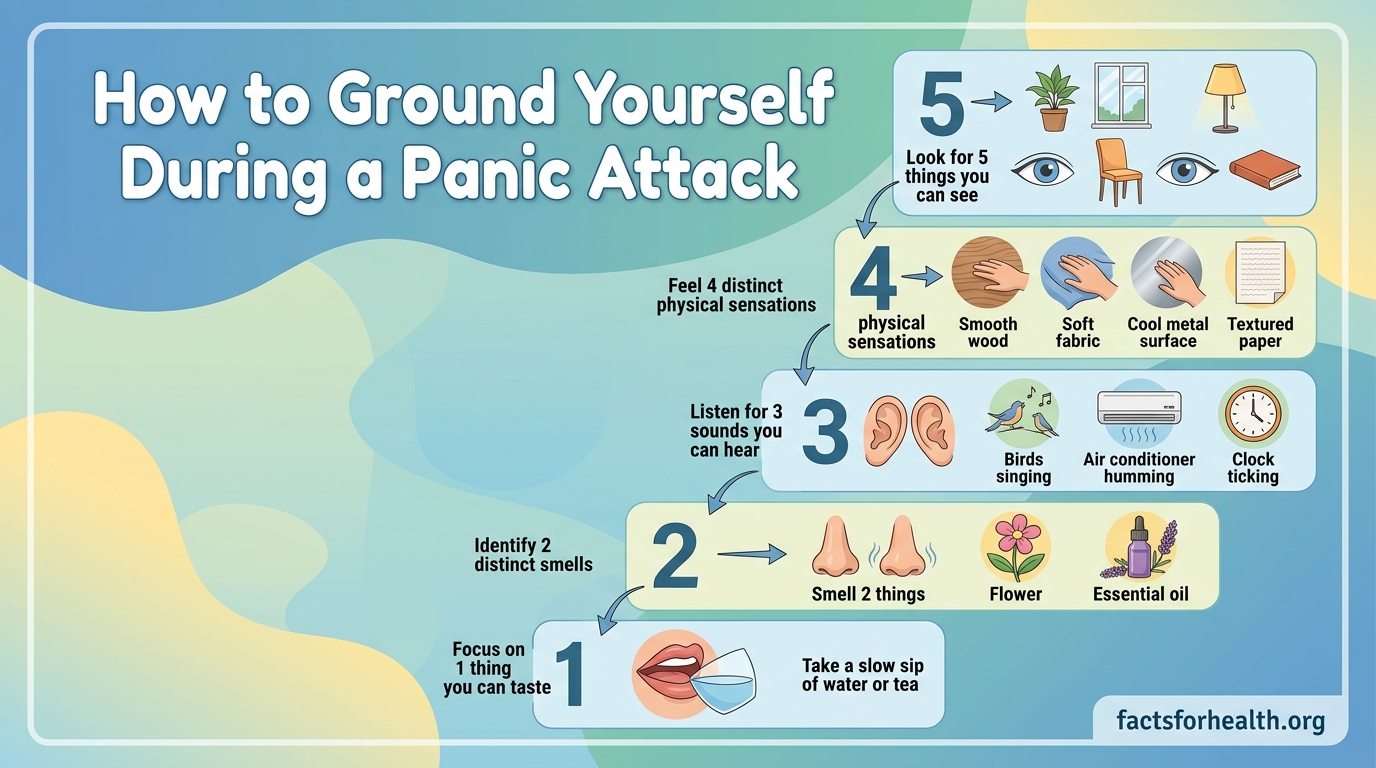
If you are reading this in the middle of a panic attack right now, here is what to do immediately. Look around and name five things you can see, four things you can touch, three things you can hear, two things you can smell, and one thing you can taste. Then slow your breathing by inhaling for four counts, holding for four, exhaling for four, and holding for four. You are safe. This will pass.
Learning how to ground yourself during a panic attack is one of the most practical skills you can build for managing anxiety. Grounding techniques are sensory and physical exercises that pull your attention out of the spiral of fear and back into the present moment. They work by interrupting the fight-or-flight response that hijacks your body during panic, giving your nervous system a signal that you are not actually in danger.
Our team has reviewed dozens of techniques discussed by therapists, medical sources, and real people who experience panic attacks. What follows is a clear, step-by-step guide covering the most effective grounding methods, when to use each one, and what to do when a technique does not seem to work.
We will cover the 5-4-3-2-1 method, box breathing, the 3-3-3 rule, the ice water hack, body scanning, anchoring statements, and more. Each technique includes instructions simple enough to remember when your mind is racing. You do not need any equipment, medication, or prior training to use these tools.
Table of Contents
Quick Answer: How to Ground Yourself During a Panic Attack
The fastest way to ground yourself during a panic attack is to use one of three categories of techniques: sensory grounding, physical grounding, or breathing exercises. Here are the most effective methods in each category.
Sensory grounding techniques:
- 5-4-3-2-1 method — Name five things you see, four you can touch, three you hear, two you smell, and one you taste.
- 3-3-3 rule — Name three things you see, three sounds you hear, and move three parts of your body.
- Sensory focus — Hold a cold object, smell something strong like peppermint, or suck on a mint to jolt your senses into the present.
Physical grounding techniques:
- Ice water hack — Splash cold water on your face or hold an ice cube to trigger the mammalian dive response, which slows your heart rate.
- Body scan — Slowly focus on each part of your body from toes to head, noticing sensations without judgment.
- Progressive muscle relaxation — Tense and release each muscle group to discharge built-up physical tension.
Breathing techniques:
- Box breathing — Inhale for four counts, hold for four, exhale for four, hold for four. Repeat four to six cycles.
- 4-7-8 breathing — Inhale for four counts, hold for seven, exhale slowly for eight. This activates the parasympathetic nervous system.
Pick one technique from the list above and try it right now. If it does not work within two minutes, switch to a different one. Not every technique works for every person or every attack, which is why having several options matters.
What Is a Grounding Technique?
A grounding technique is any exercise that redirects your attention away from anxious thoughts and back into your physical body or immediate environment. The goal is not to eliminate anxiety or pretend you are calm. The goal is to anchor yourself in the present moment so the panic has less power over your thinking.
Grounding works because panic attacks feed on themselves. A scary physical sensation triggers a fearful thought, which triggers more physical sensations, which triggers more fear. Grounding breaks this loop by forcing your brain to process real sensory information instead of imagined threats.
Therapists often divide grounding techniques into three categories. Sensory grounding uses your five senses. Physical grounding uses your body and movement. Mental grounding uses cognitive tasks like counting or categorizing. Most people find that a combination of approaches works best, and the right technique can change depending on the situation.
It is worth noting what grounding is not. Grounding is not a cure for panic disorder or a replacement for therapy. It is also not about suppressing emotions or telling yourself to calm down. In fact, trying to force yourself to calm down during a panic attack often makes things worse. Grounding is about creating enough space between you and the panic to ride out the wave safely.
People use grounding techniques for many situations beyond panic attacks. These methods also help with PTSD flashbacks, dissociation, generalized anxiety, emotional overwhelm, sensory overload, and even difficulty falling asleep. Once you learn these skills, they become portable tools you can carry into any stressful situation.
The Science Behind Grounding and Panic Attacks
To understand why grounding works, you need to understand what happens in your body during a panic attack. When your brain perceives a threat, even if that threat is internal rather than external, it activates the sympathetic nervous system. This is the fight-or-flight response, and it is the same survival system that would help you escape a physical predator.
The fight-or-flight response floods your body with stress chemicals like adrenaline and cortisol. Your heart rate spikes, your breathing becomes rapid and shallow, your muscles tense, and blood flows away from your digestive system and toward your limbs so you can fight or run. These changes are helpful if you are facing actual danger. They are miserable if the only threat is your own mind misfiring.
During a panic attack, your amygdala, the brain’s alarm center, sends danger signals even though no real threat exists. The prefrontal cortex, which handles logical thinking, goes partially offline. This is why you cannot simply think your way out of a panic attack. Your rational brain is not fully in charge at that moment.
Grounding techniques work by activating the parasympathetic nervous system, which is the body’s natural brake on the stress response. The parasympathetic system is sometimes called the rest-and-digest system because it calms the body down after a threat has passed. Grounding gives this system a jump start.
One key player is the vagus nerve, the longest cranial nerve in your body. The vagus nerve connects your brain to your heart, lungs, and digestive tract. When you stimulate the vagus nerve through slow breathing, cold exposure, or certain physical movements, it sends a signal to your brain that says the body is safe. This signal helps deactivate the fight-or-flight response.
The ice water technique works through a specific mechanism called the mammalian dive response. When cold water hits your face, your body assumes you have plunged into cold water and automatically slows your heart rate to conserve oxygen. This reflex is hardwired into your biology and works even when your mind is panicking. Research has shown that cold water facial immersion can reduce heart rate by 10 to 25 percent within seconds.
Breathing techniques work through a different mechanism. When you panic, you tend to breathe rapidly and shallowly, which blows off too much carbon dioxide and makes symptoms like dizziness and tingling worse. Slow, controlled breathing restores the proper balance of oxygen and carbon dioxide in your blood, which reduces physical symptoms and signals safety to your brain.
What Happens During a Panic Attack?
A panic attack is a sudden surge of intense fear or discomfort that peaks within minutes. It can happen without warning and without any obvious trigger. During an attack, your body reacts as though you are in mortal danger, even though you may be sitting safely at home or standing in line at the grocery store.
Common symptoms of a panic attack include:
- Racing or pounding heartbeat
- Shortness of breath or feeling like you are choking
- Chest pain or tightness
- Dizziness, lightheadedness, or feeling faint
- Tingling or numbness in your hands, feet, or face
- Sweating, chills, or hot flashes
- Trembling or shaking
- Nausea or stomach upset
- Feeling detached from reality or from yourself
- Fear of losing control, going crazy, or dying
These symptoms are terrifying, especially the first time you experience them. Many people end up in emergency rooms during their first panic attack because the chest pain and shortness of breath feel exactly like a heart attack. This fear is completely understandable, and it is one reason grounding techniques matter so much. Having a tool you trust can mean the difference between riding out the attack and spiraling further.
Panic attacks typically peak within 10 minutes and rarely last longer than 20 to 30 minutes total, although the aftereffects can linger for hours. Knowing that the attack has a time limit can itself be grounding. You are not going to feel this way forever. Your body cannot sustain that level of adrenaline indefinitely.
It is also normal to feel exhausted, shaky, or emotionally drained after a panic attack ends. Some people feel embarrassed or afraid of having another one. These reactions are common, and they do not mean anything is wrong with you. What matters is building a toolkit so the next time panic rises, you know exactly what to do.
The 5-4-3-2-1 Method: Sensory Grounding Step by Step
The 5-4-3-2-1 method is the most widely recommended grounding technique for panic attacks, and for good reason. It engages all five senses, requires no equipment, and is simple enough to remember even when your mind is racing. Therapists, anxiety support groups, and medical sources consistently rank it as a go-to tool.
Here is how to do the 5-4-3-2-1 method, step by step.
Step 1: Name five things you can see. Look around your environment and say the names of five objects out loud if possible. “I see a lamp. I see a window. I see a blue chair. I see a clock. I see a plant.” Saying the words out loud matters because it engages your speech and hearing, not just your vision. If you are in public and cannot speak, name them silently but be specific.
Step 2: Name four things you can touch. Focus on physical sensations. Feel the texture of your clothing, the temperature of the air, the firmness of the floor under your feet, or the smooth surface of a nearby object. Name each one. “I feel the fabric of my shirt. I feel the cold desk. I feel the carpet under my shoes. I feel my watch on my wrist.”
Step 3: Name three things you can hear. Close your eyes if it helps and listen. Identify three distinct sounds. They can be obvious, like traffic or music, or subtle, like the hum of a refrigerator or the rustle of leaves. “I hear a fan running. I hear a car outside. I hear my own breathing.”
Step 4: Name two things you can smell. This one can be tricky depending on where you are, but try. If you cannot smell anything, think of two smells you enjoy or try to find something nearby. Coffee, soap, perfume, food, fresh air, or even the smell of paper can work.
Step 5: Name one thing you can taste. Notice the current taste in your mouth, or take a sip of water, bite into a mint, or eat a small piece of food. Focus on the flavor fully for a few seconds.
By the time you finish all five steps, your brain has processed dozens of pieces of real sensory data. This is data that contradicts the panic narrative. Your environment is ordinary, your senses are functioning, and you are present. Many people find that the attack has significantly weakened or passed entirely by the time they reach step five.
One tip from people who use this technique regularly: practice it when you are calm. If you have already walked through the steps several times during low-stress moments, your brain will reach for the pattern automatically when panic hits. Think of it as building muscle memory for your mind.
The 3-3-3 Rule for Panic Attacks
The 3-3-3 rule is a shorter, faster grounding technique that many people prefer when a full 5-4-3-2-1 sequence feels like too much effort. It is one of the most searched grounding methods, and no competitor article gives it a dedicated section, so let us break it down fully.
The 3-3-3 rule works like this. First, name three things you can see around you. Second, name three sounds you can hear. Third, move three parts of your body, such as your ankle, your fingers, and your shoulders.
That is the entire technique. It takes about 30 seconds, and it combines sensory grounding with physical grounding in a compact format. The physical movement step is what sets the 3-3-3 rule apart from pure sensory exercises. Moving your body forces your brain to coordinate muscle activity, which requires attention that is then unavailable for panic loops.
Many people use the 3-3-3 rule as a first response when they feel panic starting to build. Because it is so quick, you can do it at your desk, in a meeting, on public transit, or while waiting in line without anyone noticing. If the 3-3-3 rule is not enough, you can immediately escalate to the 5-4-3-2-1 method or add a breathing technique.
Think of the 3-3-3 rule as your quick-draw tool. It is the first thing you reach for. If it does not fully stop the panic, you move to a heavier tool. Having this tiered approach prevents the common problem of freezing up because you cannot decide which technique to use.
Breathing Techniques to Stop a Panic Attack
Breathing is the most direct way to influence your nervous system. You cannot consciously slow your heart rate, but you can consciously control your breath, and your heart rate follows your breath. This is why every grounding guide includes breathing exercises.
Box Breathing (4-4-4-4)
Box breathing, also called square breathing, is used by Navy SEALs, first responders, and therapists to manage acute stress. The technique is simple. Inhale through your nose for a count of four. Hold your breath for a count of four. Exhale through your mouth for a count of four. Hold empty for a count of four. Repeat this cycle four to six times.
The structure is what makes box breathing effective. Each phase lasts the same amount of time, which gives your mind a clear pattern to follow. The holds between breaths are where the magic happens, because they train your body to tolerate the sensation of not breathing for a moment, which builds confidence that you are in control.
Box breathing is the most commonly cited technique in anxiety forums for one reason: it works during full-blown panic attacks when other methods fail. Reddit users in anxiety communities repeatedly name box breathing as their top tool. If you only learn one breathing technique, make it this one.
4-7-8 Breathing
The 4-7-8 method, developed by integrative medicine expert Dr. Andrew Weil, is a slightly more advanced technique. Inhale through your nose for four counts. Hold your breath for seven counts. Exhale through your mouth for eight counts, making a whooshing sound.
The long exhale is the key to this technique. When you exhale for longer than you inhale, you activate the parasympathetic nervous system more forcefully. The seven-count hold can feel challenging during a panic attack, so some people modify it to 4-4-8 or even 3-3-6 until they are comfortable with the full pattern.
4-7-8 breathing tends to work best for the recovery phase of a panic attack, when the peak has passed but you still feel shaky. It is also excellent for preventing panic if you feel one building. Use it before bed if anxiety keeps you awake, or before a stressful event like public speaking.
Lip Pursing and Extended Exhale
If structured counting feels too complicated during a panic attack, try this simpler approach. Breathe in through your nose, then exhale slowly through pursed lips as if you are blowing out a candle. Make each exhale last twice as long as your inhale. That is the entire technique.
This method works because pursed-lip breathing creates natural back-pressure in your airways, which keeps them open and prevents the airway constriction that can happen during hyperventilation. The extended exhale stimulates the vagus nerve and slows your heart rate without requiring you to count or follow a pattern.
Physical Grounding Techniques
Sometimes sensory and breathing techniques are not enough. When panic is intense and your mind refuses to cooperate, physical techniques can cut through the noise. These methods use your body to send an unmistakable safety signal to your brain.
The Ice Water Hack (Dive Response)
Splashing cold water on your face is one of the fastest physical interventions for a panic attack. Cold water on the face triggers the mammalian dive response, an evolutionary reflex that slows your heart rate when your face is submerged in cold water. Your body assumes you are diving and automatically shifts into conservation mode.
To use this technique, hold an ice pack against your cheeks and under your eyes for 15 to 30 seconds, or splash cold water on your face several times. If you are somewhere without water, hold an ice cube in your hand until it melts. The cold sensation is sharp enough to override the panic signals and force your brain to pay attention to the present moment.
Reddit users in anxiety communities consistently report that cold water is the single most effective immediate intervention during a panic attack. It is fast, it requires no skill, and the dive response is hardwired into your biology, so it works even when your conscious mind is overwhelmed.
A word of caution: if you have a heart condition, check with your doctor before using cold water techniques, as the dive response does affect heart rate. For most people, this technique is safe and remarkably effective.
Body Scan
A body scan involves slowly moving your attention through your body from your feet to your head, noticing physical sensations in each area. Start with your toes. What do they feel like? Are they warm, cold, tingling, relaxed? Move to your feet, then your ankles, then your calves, and so on.
The body scan works because it gives your mind a structured task that requires sustained attention. While you are focused on whether your left knee feels tense, you are not generating catastrophic thoughts. It also reconnects you to your physical body, which combats the dissociation and detachment that many people feel during panic.
A full body scan can take five to ten minutes, but you can do a quick version in under two minutes by focusing on just four zones: feet, stomach, shoulders, and jaw. These areas carry the most tension during stress, and consciously releasing them can noticeably reduce panic symptoms.
Progressive Muscle Relaxation
Progressive muscle relaxation involves deliberately tensing and then releasing each muscle group in your body. Start with your hands. Clench your fists as tightly as you can for five seconds, then release and notice the contrast. Move to your arms, then your shoulders, then your face, then your stomach, then your legs, then your feet.
This technique works by teaching your body the difference between tension and relaxation, which most people cannot feel when they are panicking. The contrast between tight and loose is a physical grounding experience that also discharges the adrenaline-driven muscle tension that fuels panic.
Movement and Exercise
Sometimes the best grounding technique is to move. Go for a brisk walk, do jumping jacks, run up a flight of stairs, or dance to a loud song. Physical activity burns off the adrenaline and cortisol that your body has released during the panic response, which naturally brings the attack to a close.
Movement also forces proprioception, your body’s sense of where it is in space. Every time you take a step or lift your arm, your brain receives sensory data about your position and movement. This data grounds you in your physical reality and interrupts the mental loop of panic.
Many people find that walking outdoors works better than any seated technique. The combination of fresh air, visual movement, and physical exercise addresses panic on multiple levels at once.
Deep Pressure and Weighted Blankets
Deep pressure stimulation, such as from a weighted blanket, a tight hug, or lying under something heavy, activates the parasympathetic nervous system through a different pathway than breathing or cold. Deep pressure triggers the release of serotonin and dopamine while reducing cortisol, which creates a calming effect.
Weighted blankets are mentioned frequently as a preventative tool and a recovery aid. They are less practical during a panic attack in public, but if you are at home, wrapping yourself in a weighted blanket or holding a heavy pillow against your chest can provide fast relief. Some people also use compression garments or tight clothing for a similar effect.
A strong self-hug works too. Cross your arms over your chest and place your hands on opposite shoulders, then apply firm pressure. This gives you deep pressure input without any equipment, and the self-soothing motion is itself calming.
Mental Grounding Techniques
Mental grounding techniques use cognitive tasks to redirect your thinking. They work by occupying your working memory with a structured activity, leaving less mental bandwidth available for panic. These techniques are especially useful in situations where physical movement is not possible, like during a meeting or on public transit.
Anchoring Statements
An anchoring statement is a brief, factual reminder of who you are and where you are. Say your name, your age, the current date, and your location. “My name is Sarah. I am 34 years old. Today is 2026. I am in my kitchen in Chicago. This is a panic attack, and it will pass.”
The power of anchoring statements comes from their specificity and their grounding in verifiable facts. Panic thrives on uncertainty and future-oriented fear. An anchoring statement yanks you back to the concrete, knowable present. It also labels what is happening, which reduces the secondary fear of the unknown.
Write your anchoring statement down and keep it in your wallet or phone. During a panic attack, your working memory is compromised, and having the words already written means you do not have to compose them under pressure.
Counting and Math
Simple mental math occupies your cognitive processing without being so difficult that it adds frustration. Count backward from 100 by sevens. Name all the U.S. states you can remember in alphabetical order. Pick a category, like fruits, and name one for every letter of the alphabet.
These tasks work because they require sustained, sequential thinking. You cannot generate catastrophic thoughts while also calculating what 93 minus 7 equals. The math does not need to be correct, and you do not need to finish the task. The act of trying is what interrupts the panic loop.
Memory Game
Pick a memory and reconstruct it in detail. Walk through your childhood home room by room and describe every piece of furniture. Recall the plot of your favorite movie in order. Recite the lyrics to a song you know by heart.
This technique works similarly to math and counting, but it taps into longer-term memory rather than working memory. For some people, retrieving cherished memories also provides an emotional anchor that counters the fear of the panic attack.
Visualization and Safe Place
Picture a place where you feel completely safe and calm. It can be a real location, like a beach you visited, or an imagined one, like a cozy cabin in the woods. Engage all five senses in the visualization. What do you see there? What do you hear? What does the air feel like?
Visualization is best used as a practice tool before panic hits and as a recovery technique after the peak. During the most intense part of a panic attack, visualization can be difficult because your brain is too flooded with stress chemicals to sustain an imagined scene. But in the build-up phase or the recovery phase, it can be deeply soothing.
Grounding in Public and Workplace Settings
One of the biggest challenges people report is using grounding techniques in environments where they feel watched or judged. Panic attacks at work, school, or in public add a layer of social anxiety on top of the panic itself. Forum users frequently mention that techniques which work at home feel impossible in these settings.
The good news is that most grounding techniques can be done discreetly. Box breathing is completely invisible. You can do it in a meeting, at your desk, or in a checkout line without anyone noticing. The 3-3-3 rule is also subtle, since it involves only looking around and making small movements.
If you feel a panic attack building at work, try the following sequence. First, excuse yourself to the restroom. The walk itself provides physical grounding. Once there, use the 3-3-3 rule, followed by box breathing, followed by cold water on your wrists or face. This combination addresses the panic from sensory, mental, and physical angles in under five minutes.
If you cannot leave your desk, try progressive muscle relaxation from the waist down. Tense and release your glutes, thighs, calves, and feet while continuing to sit normally. No one will notice, and the muscle engagement grounds you physically without drawing attention.
For students, fidget tools are worth mentioning. A small stone, a textured object, or a fidget ring in your pocket gives you something to touch during class when other techniques are impractical. Many people report that having a physical object provides faster relief than purely mental techniques because the tactile sensation is immediate and constant.
The key to grounding in public is having a pre-planned go-to technique. When panic hits, you do not want to waste precious seconds deciding what to do. Pick one technique that works for you in public settings and commit to using it first, every time. Forum users consistently say that having a default plan is what separates people who manage panic from people who feel helpless when it strikes.
When Grounding Techniques Are Not Enough
Let us be honest about something most articles do not address. Grounding techniques do not work every time, and that is not a failure on your part. Sometimes a panic attack is too intense, too sudden, or too entrenched for sensory exercises to break through. Acknowledging this reality is important because the alternative is feeling broken when a technique you were told would work does not.
If a grounding technique is not working, here is what to do. First, switch to a different category. If sensory grounding is failing, try physical. If breathing is not helping, try cold water. Sometimes a different mode of input is what your nervous system needs to reset.
Second, try stacking techniques. Combine the 3-3-3 rule with box breathing. Do a body scan while holding an ice cube. Layering techniques gives your brain more data to process and more signals that you are safe.
Third, accept the panic instead of fighting it. This sounds counterintuitive, but many experienced practitioners say that fighting a panic attack gives it more energy. Try saying to yourself, “I am having a panic attack. It is uncomfortable but not dangerous. I am going to let it run its course.” Paradoxically, dropping the resistance can shorten the attack significantly. This approach, sometimes called the R.I.D.E. technique (Recognize, Investigate, Detach, Express), treats panic like a wave to surf rather than a monster to fight.
Fourth, reach out to another person. Call or text someone you trust and tell them what is happening. The act of communicating forces your brain to organize thoughts into language, which engages the prefrontal cortex and partially restores logical thinking. Even hearing a calm voice can regulate your nervous system through social bonding mechanisms.
Finally, know when to seek professional help. If you are having panic attacks frequently, if they are getting worse, or if they are interfering with your daily life, talk to a doctor or therapist. Grounding techniques are coping tools, not treatments. For panic disorder, effective treatments include cognitive behavioral therapy (CBT), exposure therapy, and in some cases medication. There is no shame in combining self-help techniques with professional care.
If you are experiencing thoughts of self-harm or if your panic attacks are accompanied by severe depression, please reach out to a crisis line immediately. In the United States, you can call or text 988 to reach the Suicide and Crisis Lifeline. You do not have to handle this alone.
How to Practice Grounding Before a Panic Attack Hits
This is the section most articles skip, and it is arguably the most important. Grounding techniques work best when they are already familiar to your brain. If the first time you try the 5-4-3-2-1 method is during a panic attack, it probably will not work well. Your stressed brain has no pattern to fall back on.
The solution is to practice when you are calm. Pick two techniques and do one of them every day for a week. It takes less than three minutes. Do the 5-4-3-2-1 method while you drink your morning coffee. Practice box breathing during your commute. Run through the 3-3-3 rule while waiting in line.
The goal is automaticity. You want your brain to recognize the pattern so deeply that it reaches for it without conscious effort when panic starts. Think of it like a fire drill. You practice evacuating when there is no fire so that when there is one, your body knows what to do without panicking.
Another effective strategy is to build a panic attack action plan. Write down your top three techniques on a card and keep it in your wallet or save it on your phone. List them in order of what to try first, second, and third. During a panic attack, you can simply follow the plan without making decisions.
Many people also benefit from tracking their panic attacks in a journal. Note what was happening before the attack, which techniques you used, and what worked. Over time, patterns emerge. You might discover that cold water works best for morning panic but box breathing works better for evening episodes. This personalized data is more valuable than any generic advice.
Finally, address the root causes. Grounding techniques manage symptoms, but they do not address why you are having panic attacks in the first place. Chronic stress, trauma, caffeine, sleep deprivation, and major life changes can all contribute. If panic attacks are becoming a pattern, the most effective long-term strategy is to work on the underlying causes with a therapist or counselor.
FAQs
What is the 3 3 3 rule for panic attacks?
The 3-3-3 rule is a quick grounding technique where you name three things you can see, three sounds you can hear, and move three parts of your body. It takes about 30 seconds and combines sensory grounding with physical movement, making it effective for early-stage panic or for use in public settings where longer techniques are impractical.
What to do during a panic attack?
During a panic attack, use a grounding technique immediately. Try the 5-4-3-2-1 method (name five things you see, four you can touch, three you hear, two you smell, one you taste) or box breathing (inhale four counts, hold four, exhale four, hold four). Splash cold water on your face to trigger the dive response. Remind yourself that panic attacks peak within 10 minutes and will pass.
What is 5 4 3 2 1 sensory grounding?
The 5-4-3-2-1 method is a sensory grounding technique that walks you through all five senses. You name five things you can see, four things you can touch, three things you can hear, two things you can smell, and one thing you can taste. This engages your brain with real environmental data, interrupting the panic loop and anchoring you in the present moment.
How do I snap myself out of a panic attack?
The fastest way to snap out of a panic attack is to shock your nervous system with a strong physical stimulus. Splash cold water on your face to trigger the dive response, hold an ice cube in your hand, or do 20 jumping jacks to burn off adrenaline. Pair this with box breathing and an anchoring statement stating your name, location, and that this is a panic attack that will pass.
How long does it take for grounding to work during a panic attack?
Grounding techniques typically begin working within 30 seconds to 2 minutes. Physical techniques like cold water and movement tend to work fastest, often within seconds. Sensory techniques like the 5-4-3-2-1 method usually take 2 to 3 minutes to complete. If a technique has not helped after 2 minutes, switch to a different technique rather than continuing with one that is not working.
Can grounding techniques stop a panic attack completely?
Grounding techniques can significantly reduce the intensity and duration of a panic attack, and sometimes stop it entirely, especially if used early. However, no technique works every time for every person. Grounding is best understood as a tool to manage symptoms and ride out the attack more comfortably, not as a guaranteed off switch. Combining multiple techniques and practicing them beforehand improves effectiveness.
Conclusion
Learning how to ground yourself during a panic attack is a skill that improves with practice. The techniques in this guide, from the 5-4-3-2-1 method to box breathing to the ice water hack, are proven tools that real people use every day to manage panic. None of them requires special equipment, and all of them can be done anywhere.
Start by picking two techniques from this article and practicing them daily when you are calm. Build a written action plan with your top three methods so you never have to make decisions during a panic attack. If attacks are frequent or severe, talk to a healthcare professional about additional treatment options.
You are not alone in this. Panic attacks are common, they are treatable, and having the right tools makes a profound difference. The next time panic rises, you will know exactly what to do.