
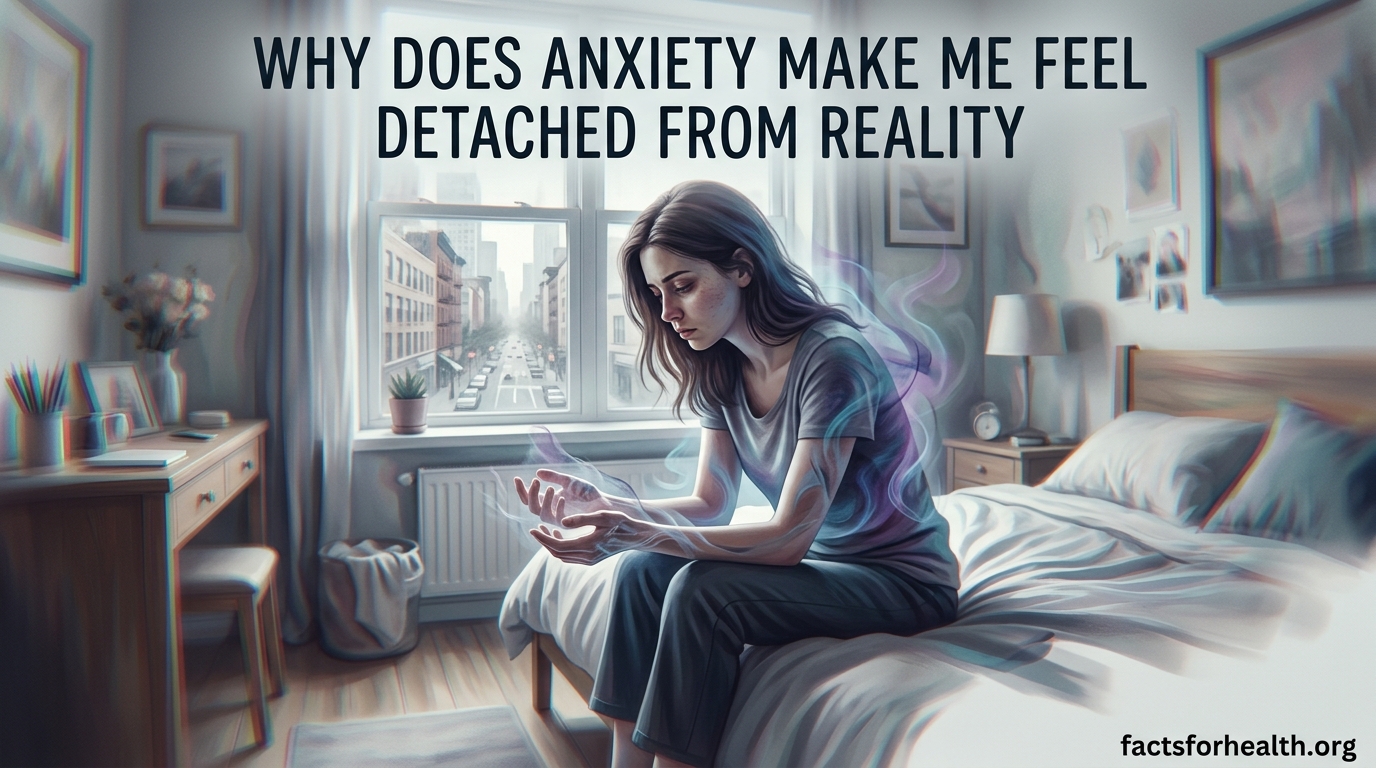
If you have ever felt like the world around you is a movie set, like you are watching yourself from behind glass, or like nothing around you is quite real, you are not alone. This is one of the most common and most frightening symptoms of anxiety. The question “why does anxiety make me feel detached from reality?” is something thousands of people search for every single day, and the answer is both scientifically understood and deeply reassuring.
Anxiety can make you feel detached from reality through a protective dissociative response called derealization (when your surroundings feel unreal) and depersonalization (when you feel disconnected from yourself). When anxiety reaches high levels, your brain activates a defense mechanism that creates psychological distance from overwhelming sensations, making everything feel dreamlike, foggy, or surreal.
Here is the most important thing to know right now: feeling detached from reality does not mean you are going crazy, developing psychosis, or losing your mind. It means your nervous system is overwhelmed and has temporarily shifted into a protective mode. You still know who you are, you still know what is real, and this feeling can and does go away.
In this guide, our team breaks down exactly what happens in your brain when anxiety triggers detachment, what the experience feels like based on real accounts, and the specific steps you can take to break the cycle and feel like yourself again.
Table of Contents
What Is Depersonalization and Derealization?
Depersonalization and derealization are two related but distinct dissociative experiences. Together, they fall under the umbrella of dissociation, which is a broader term for any experience where your brain creates a sense of disconnection from yourself, your body, your emotions, or your surroundings.
Depersonalization is the feeling of being detached from your own body or mind. People describe it as feeling like they are watching themselves from the outside, like they are operating on autopilot, or like their body does not belong to them. You might feel emotionally numb, like your thoughts are not really yours, or like you are an observer in your own life rather than a participant.
Derealization is the feeling that your surroundings are not real. The world may look foggy, dreamlike, visually distorted, or behind a glass wall. Colors might seem faded, sounds might feel muffled or too loud, and familiar places can suddenly look strange or unfamiliar. You know intellectually that the world is real, but it does not feel real.
When these experiences happen frequently or persistently enough to cause distress and interfere with daily life, they may be classified as depersonalization-derealization disorder, or DPDR. The DSM-5 recognizes DPDR as a formal dissociative disorder. However, many people experience transient episodes of depersonalization or derealization during periods of intense anxiety, panic attacks, or chronic stress without meeting the full criteria for the disorder.
Understanding the difference between depersonalization and derealization matters because it helps you put words to what you are experiencing. Many people who feel detached from reality struggle to describe it, and simply having the right vocabulary can reduce the fear significantly.
Depersonalization vs Derealization at a Glance
Depersonalization affects your sense of self. You might feel like you are outside your body, like your limbs do not belong to you, or like you are watching a character on screen who happens to share your name. Emotional numbness is common.
Derealization affects your sense of the world. Your environment may look artificial, like a stage set or a video game. People may seem like actors. The ground under your feet might not feel solid. Time can feel distorted, moving too fast or too slow.
Most people who experience anxiety-related detachment experience both to some degree, though one may be more dominant than the other.
The Anxiety-Detachment Connection: Why Your Brain Does This
To understand why does anxiety make me feel detached from reality, we need to look at what happens in your brain and nervous system when anxiety spikes. The answer comes down to biology, not psychology gone wrong.
When you experience anxiety, your brain perceives a threat. It does not matter whether the threat is a physical danger, a stressful deadline, or an intrusive thought. Your amygdala, the brain’s alarm system, activates the fight-or-flight response. This triggers your hypothalamic-pituitary-adrenal (HPA) axis, which floods your body with stress hormones including cortisol and adrenaline.
In the short term, this stress response is adaptive. It sharpens your focus, increases your heart rate, and prepares your body to deal with danger. But when anxiety is chronic or reaches extreme levels, something different happens. Your nervous system becomes overloaded. It has been firing on all cylinders for too long, and the emotional processing centers of your brain essentially start to shut down to protect you from being overwhelmed.
This is where dissociation comes in. Think of it like a circuit breaker in your home. When too much current flows through the system, the breaker trips to prevent a fire. Dissociation is your brain’s circuit breaker. When emotional or sensory input becomes too intense to process, your brain creates psychological distance, numbing the experience so you can keep functioning.
The Neurochemical Picture
Research suggests that serotonin imbalances play a role in dissociative experiences. Serotonin is a neurotransmitter that helps regulate mood, perception, and your sense of well-being. When anxiety disrupts your serotonin system, your perception of reality can shift. This is one reason why selective serotonin reuptake inhibitors (SSRIs) are sometimes prescribed for people experiencing persistent depersonalization or derealization.
Cortisol, the primary stress hormone, also contributes. Chronically elevated cortisol levels keep your HPA axis stuck in overdrive, which perpetuates the dissociative state. The longer your nervous system stays in threat-detection mode, the more entrenched the feeling of detachment can become.
Other neurotransmitters, including glutamate and endogenous opioids, are also believed to be involved in dissociation. The exact neurochemistry is still being studied, but the core message is clear: dissociation is a measurable, biological response to stress and anxiety. It is not imagined, it is not a character flaw, and it is not a sign of weakness.
The Fear-Detachment Feedback Loop
One of the most frustrating things about anxiety-related detachment is that it tends to feed on itself. This creates what mental health professionals call the fear-detachment feedback loop, and understanding it is the first step to breaking free.
The cycle works like this. First, you experience a moment of dissociation, maybe during a stressful period or a panic attack. Your surroundings suddenly feel unreal or you feel disconnected from your body. This sensation is alarming, especially if you do not understand what is happening. Your brain interprets the dissociation itself as a threat.
Because your brain now perceives a new threat, it triggers more anxiety. More anxiety means more cortisol, more nervous system activation, and a stronger dissociative response. The derealization intensifies. You become more frightened, which produces more anxiety, which deepens the dissociation. The loop tightens with each revolution.
This is why simply trying to “snap out of it” rarely works. The effort to force yourself back to reality often increases your anxiety about not feeling real, which paradoxically deepens the detachment. People on anxiety support forums describe this vividly. They say things like, “The harder I try to feel real, the more unreal everything feels.”
The key to breaking the loop is counterintuitive. Instead of fighting the feeling, you learn to accept it as a temporary stress response. When you stop treating dissociation as a catastrophic threat, your anxiety decreases, your cortisol levels drop, and the dissociative response naturally fades. This principle, called acceptance, is central to many evidence-based treatments for DPDR.
What Does It Actually Feel Like?
If you are wondering whether what you are experiencing is anxiety-related detachment, hearing how others describe it can help. People who have never felt it often struggle to put the experience into words. Those who have tend to use similar metaphors and descriptions.
One of the most common descriptions is the dream feeling. People say it feels like they are in a dream they cannot wake up from. Everything looks normal on the surface, but there is a persistent sense that something is off, that the world is a projection or a simulation rather than solid reality.
The glass wall metaphor comes up again and again in forum discussions. People describe feeling like there is an invisible barrier between them and the rest of the world. They can see and hear everything around them, but it feels distant, muffled, separated. One Reddit user wrote, “I know I am here, but I do not feel here.”
The movie or autopilot feeling is also widely reported. People describe watching themselves go through the motions of daily life, talking, working, interacting, but feeling like a passenger rather than the driver. It is as if they are watching a character who looks like them and shares their memories but is not truly them.
Visual and sensory distortions are common. Colors may look washed out or too vivid. Objects may look the wrong size or distance. Familiar rooms can suddenly feel alien. Some people describe looking in the mirror and not recognizing the face looking back, even though they know intellectually it is their own.
Emotional numbness often accompanies these perceptual changes. People report feeling unable to connect emotionally with loved ones, even though they know they care about them deeply. Events that should feel joyful or sad feel flat and distant. This emotional blunting is one of the most distressing aspects for many people, but it is also one of the most common symptoms.
Common Causes and Triggers
Anxiety-related detachment does not usually happen in a vacuum. Specific triggers can bring on or worsen episodes of depersonalization and derealization. Knowing your triggers is an important part of managing the experience.
Panic attacks and panic disorder are among the most common triggers. During a panic attack, anxiety levels spike so rapidly and intensely that dissociation kicks in as a protective response. For some people, the derealization experienced during a panic attack becomes the thing they fear most, which creates a cycle of panic about dissociation itself.
Chronic stress and burnout can gradually push your nervous system into a state of overload. Unlike panic attacks, which are acute, chronic stress builds over weeks or months. You may not even realize how stressed you are until the dissociation starts. Burnout from work, caregiving responsibilities, or prolonged life difficulties can all be underlying causes.
Sleep deprivation is a major and often overlooked trigger. Your brain needs adequate sleep to regulate neurotransmitters and process sensory information. Chronic poor sleep can weaken your brain’s ability to maintain a stable sense of reality, making dissociation much more likely.
Trauma and PTSD are closely linked to dissociation. Childhood trauma, in particular, is a significant risk factor for developing dissociative symptoms. The brain may have learned dissociation as a coping mechanism during overwhelming early experiences, and this pattern can reactivate during periods of stress later in life.
Substance use can trigger or worsen derealization. Cannabis is one of the most commonly reported substances associated with dissociative episodes, but alcohol, hallucinogens, and even excessive caffeine can contribute. Withdrawal from certain substances can also produce dissociation.
Other mental health conditions frequently co-occur with dissociation. Generalized anxiety disorder (GAD), obsessive-compulsive disorder (OCD), depression, and post-traumatic stress disorder (PTSD) all have high rates of comorbid dissociative symptoms. Treating the underlying condition often resolves the detachment.
Why Is Anxiety-Related Detachment Worse in the Morning?
Many people report that derealization is at its worst when they first wake up. This is a common pattern, and there are several reasons for it. During the night, your cortisol levels naturally rise in the early morning hours as part of your body’s preparation for waking. This is called the cortisol awakening response. For people with anxiety, this natural cortisol spike can push an already sensitized nervous system over the edge into dissociation.
Poor sleep quality also plays a role. If your sleep was fragmented, insufficient, or filled with anxiety-driven dreams, your brain starts the day already depleted. Without adequate restorative sleep, your brain’s reality-processing systems are not fully online, making the morning feel particularly unreal.
The transition from sleep to waking is also a shift in consciousness that can trigger a lingering sense of unreality. Most people shake this off within minutes, but for someone with an anxiety-sensitized nervous system, the grogginess and perceptual shift can persist for hours.
DPDR vs Psychosis: You Are Not Losing Your Mind
This is the section many people need to read most. If you are experiencing depersonalization or derealization and your biggest fear is that you are developing psychosis, schizophrenia, or some form of permanent mental illness, let us address this directly.
DPDR and psychosis are fundamentally different experiences. The most important distinction is something clinicians call preserved insight. When you experience anxiety-related dissociation, you know that what you are feeling is not normal. You know the world is real even though it does not feel real. You are aware that your perception is off. This awareness, this insight, is the hallmark of dissociation, not psychosis.
In psychosis, a person loses contact with reality in a way that they believe is real. They may have delusions they are convinced are true, or hallucinations they cannot distinguish from reality. They typically do not recognize that their experience is unusual, which is why psychosis often goes untreated until someone else intervenes.
If you are worried that you might be going crazy, that very worry is strong evidence that you are not. People experiencing psychosis do not typically wonder whether they are losing touch with reality. The fact that you are searching for answers, reading articles, and trying to understand your experience shows that your connection to reality is intact.
This distinction matters enormously because it directly affects the feedback loop we discussed earlier. When you understand that dissociation is a known anxiety symptom and not the beginning of a psychotic break, the fear decreases. When the fear decreases, the anxiety decreases. When the anxiety decreases, the dissociation fades.
How to Break the Cycle: Grounding Techniques That Work
Grounding techniques are practical exercises that help anchor your awareness back in the present moment and your physical body. They work by engaging your senses and redirecting your brain’s attention away from the dissociative experience and toward concrete, immediate sensory input. Here are the most effective methods, with step-by-step instructions.
The 5-4-3-2-1 Sensory Grounding Method
This is the most widely recommended grounding technique for dissociation, and for good reason. It engages all five senses and forces your brain to process concrete sensory information. Here is how to do it.
Step 1: Look around and name five things you can see. Say them out loud if possible. “I see a coffee mug. I see a blue wall. I see a tree outside the window.” Be specific. Notice colors, shapes, and textures.
Step 2: Name four things you can physically feel. Focus on the sensation of your feet on the floor. The fabric of your clothes against your skin. The temperature of the air. The weight of your body in the chair.
Step 3: Identify three things you can hear. The hum of a refrigerator. Traffic outside. Your own breathing. Try to find sounds you normally tune out.
Step 4: Notice two things you can smell. If nothing is immediately apparent, try sniffing something with a strong scent like coffee, soap, or essential oil. Scent is one of the most powerful senses for grounding because it connects directly to the brain’s emotional centers.
Step 5: Focus on one thing you can taste. Take a sip of water, eat a mint, or simply notice the taste in your mouth. The act of eating or drinking mindfully can be especially grounding.
The goal is not to instantly cure the dissociation. The goal is to bring your attention back to your body and your immediate environment, even briefly. With practice, these moments of grounding become longer and more natural.
Paced Breathing
Dissociation is linked to nervous system overactivation, and breathing is one of the few bodily functions you can consciously control to calm that system. Paced breathing activates your parasympathetic nervous system, which is responsible for rest and recovery.
Try box breathing. Inhale slowly through your nose for a count of four. Hold the breath for a count of four. Exhale slowly through your mouth for a count of four. Hold the empty breath for a count of four. Repeat this cycle for at least two minutes.
Alternatively, try the 4-7-8 method. Inhale for four counts, hold for seven, and exhale slowly for eight. The longer exhale signals to your nervous system that you are safe, which helps reduce the anxiety driving the dissociation.
Sensory Anchors
A sensory anchor is a physical object you carry with you that you can use to ground yourself whenever dissociation strikes. It could be a smooth stone, a textured piece of fabric, a piece of jewelry, or a keychain. When you feel detached, hold the object and focus all your attention on its texture, weight, and temperature.
The advantage of a sensory anchor is that it is always available. You do not need to remember a technique or count through steps. You simply reach into your pocket and focus on something real and tangible.
Temperature Shifts
Strong sensory input can jolt your nervous system out of a dissociative state. Splashing cold water on your face, holding an ice cube, or taking a cool shower activates the mammalian dive reflex, which slows your heart rate and redirects blood flow to your brain. This can interrupt the dissociative cycle quickly.
Body Movement
Dissociation often comes with a sense of physical stillness or disconnection from your body. Movement helps reestablish that connection. Try doing ten jumping jacks, going for a brisk walk, stretching your arms above your head, or simply pressing your feet firmly into the ground and feeling the resistance.
Acceptance Over Resistance
Perhaps the most important technique is also the most counterintuitive. Instead of fighting the feeling of detachment, practice allowing it. Remind yourself: “This is a stress response. It is uncomfortable but not dangerous. It will pass.” The less you fear the dissociation, the faster it tends to dissolve.
Forum users who have recovered from DPDR consistently report the same thing. Trying to force the feeling away made it worse. Learning to coexist with it, to stop panicking about it, is what ultimately allowed it to fade. As one Reddit user put it, “The moment I stopped caring whether I felt real, I started feeling real again.”
When to Seek Professional Help
While occasional, brief episodes of dissociation during periods of high anxiety are common and not inherently dangerous, there are times when professional support is warranted. Knowing when to reach out is an important part of taking care of your mental health.
Consider seeking help from a mental health professional if dissociative episodes are occurring frequently, lasting for extended periods, or interfering with your ability to function at work, school, or in relationships. If the feelings are causing significant distress or depression, or if you find yourself avoiding situations because you fear dissociation, these are signs that professional support could help.
Several evidence-based treatments have proven effective for anxiety-related dissociation. Cognitive behavioral therapy (CBT) helps you identify and change the thought patterns that fuel anxiety and the fear of dissociation. Dialectical behavior therapy (DBT) teaches specific skills for grounding, emotional regulation, and distress tolerance. Eye movement desensitization and reprocessing (EMDR) is particularly helpful when dissociation is linked to past trauma.
Medication may also play a role. SSRIs are commonly prescribed to address underlying anxiety or depression that may be driving the dissociative symptoms. Anti-anxiety medications may be used in the short term to reduce acute anxiety. Medication is typically most effective when combined with therapy rather than used alone.
If you ever have thoughts of self-harm or suicide, reach out for immediate help. Contact a crisis line, go to an emergency room, or call someone you trust. Dissociation itself is not dangerous, but the distress it causes can sometimes contribute to depression, and your safety always comes first.
FAQs
Can anxiety make you feel detached from reality?
Yes. Anxiety is one of the most common causes of feeling detached from reality. When anxiety levels are high, the brain can activate a dissociative response as a protective mechanism, causing depersonalization (feeling detached from yourself) or derealization (feeling that your surroundings are unreal). This is a recognized, well-documented anxiety symptom and is not a sign of psychosis or permanent mental illness.
How long can anxiety derealization last?
Anxiety-induced derealization can last anywhere from a few minutes during a panic attack to several days or weeks during periods of prolonged stress. Brief episodes that resolve once anxiety decreases are very common. For some people, symptoms can persist for months if the underlying anxiety goes untreated, but this does not mean the condition is permanent. With appropriate treatment and anxiety management, derealization typically resolves.
How to get out of anxiety derealization?
To break out of anxiety derealization, try grounding techniques like the 5-4-3-2-1 sensory method (identify 5 things you see, 4 you feel, 3 you hear, 2 you smell, 1 you taste), practice paced breathing such as box breathing, use sensory anchors like a textured object, or try temperature shifts like splashing cold water on your face. Most importantly, practice accepting the feeling rather than fighting it, since the fear of derealization is what often keeps it going.
How long does it take to recover from anxiety?
Recovery from anxiety varies widely depending on the individual, the severity of symptoms, and the treatment approach. Some people see significant improvement within a few weeks of starting therapy or medication. For others, full recovery may take several months to a year. With evidence-based treatments like CBT, DBT, or medication management, most people experience substantial improvement in their anxiety symptoms, including dissociative episodes.
What does DPDR feel like?
DPDR typically feels like being disconnected from yourself, your body, or your surroundings. People describe feeling like they are watching themselves from outside their body, operating on autopilot, or looking at the world through glass or fog. Surroundings may look dreamlike, artificial, or visually distorted. Emotional numbness is common, as is a sense that nothing feels quite real even though you know intellectually that it is.
How to snap back out of derealization?
To snap back from derealization, engage your senses with strong physical input. Try the 5-4-3-2-1 grounding method, splash cold water on your face, hold an ice cube, do ten jumping jacks, or practice box breathing (inhale 4 counts, hold 4, exhale 4, hold 4). Remind yourself that what you are experiencing is a harmless stress response, not a sign of danger. Reducing your fear of the symptom is often more effective than trying to force it away.
Is DPDR permanent?
No, DPDR is not permanent. Depersonalization-derealization disorder and anxiety-related dissociation are treatable conditions. Many people recover fully with appropriate treatment including therapy (CBT, DBT), medication when needed, and stress management techniques. Even without formal treatment, episodes often resolve on their own once the underlying anxiety or stress is addressed. The feeling of permanence is itself a symptom of anxiety, not a reflection of reality.
Why is anxiety worse in the morning?
Anxiety is often worse in the morning due to the cortisol awakening response, a natural spike in cortisol that occurs shortly after waking. For people with anxiety disorders, this cortisol surge can push an already sensitized nervous system into overdrive, triggering symptoms like derealization, racing thoughts, or physical anxiety symptoms. Poor sleep quality, anxiety-driven dreams, and the grogginess of transitioning from sleep to wakefulness can also contribute to morning anxiety and dissociation.
Moving Forward: You Can Feel Real Again
If you came to this article searching for answers about why anxiety makes you feel detached from reality, we want you to leave with a few key takeaways. The detachment you are experiencing is real, it is a recognized anxiety symptom, and it has a clear biological explanation rooted in your nervous system’s protective response to stress.
You are not going crazy. The fact that you are aware of the feeling, distressed by it, and searching for answers is itself proof that your connection to reality is intact. People experiencing psychosis do not typically recognize that their perception has changed. Your insight, your awareness that something feels off, is the defining feature of dissociation, not of losing your mind.
The fear-detachment feedback loop is what keeps the experience going. When you fear the dissociation, you generate more anxiety, which deepens the dissociation. Breaking the loop starts with changing your relationship to the symptom. Acceptance, grounding techniques, and reducing your fear of the experience are your most powerful tools.
Professional help is available and effective. CBT, DBT, EMDR, and medication management have all proven successful in treating anxiety-related dissociation. If the feelings are persistent, distressing, or interfering with your life, reaching out to a mental health professional is a sign of strength, not weakness.
Most importantly, recovery is not just possible, it is the expected outcome. Thousands of people have experienced exactly what you are feeling and have gone on to live full, present, connected lives. Understanding why anxiety makes you feel detached from reality is the first step. Taking action, whether through self-help strategies or professional support, is the next.
You will feel like yourself again.