
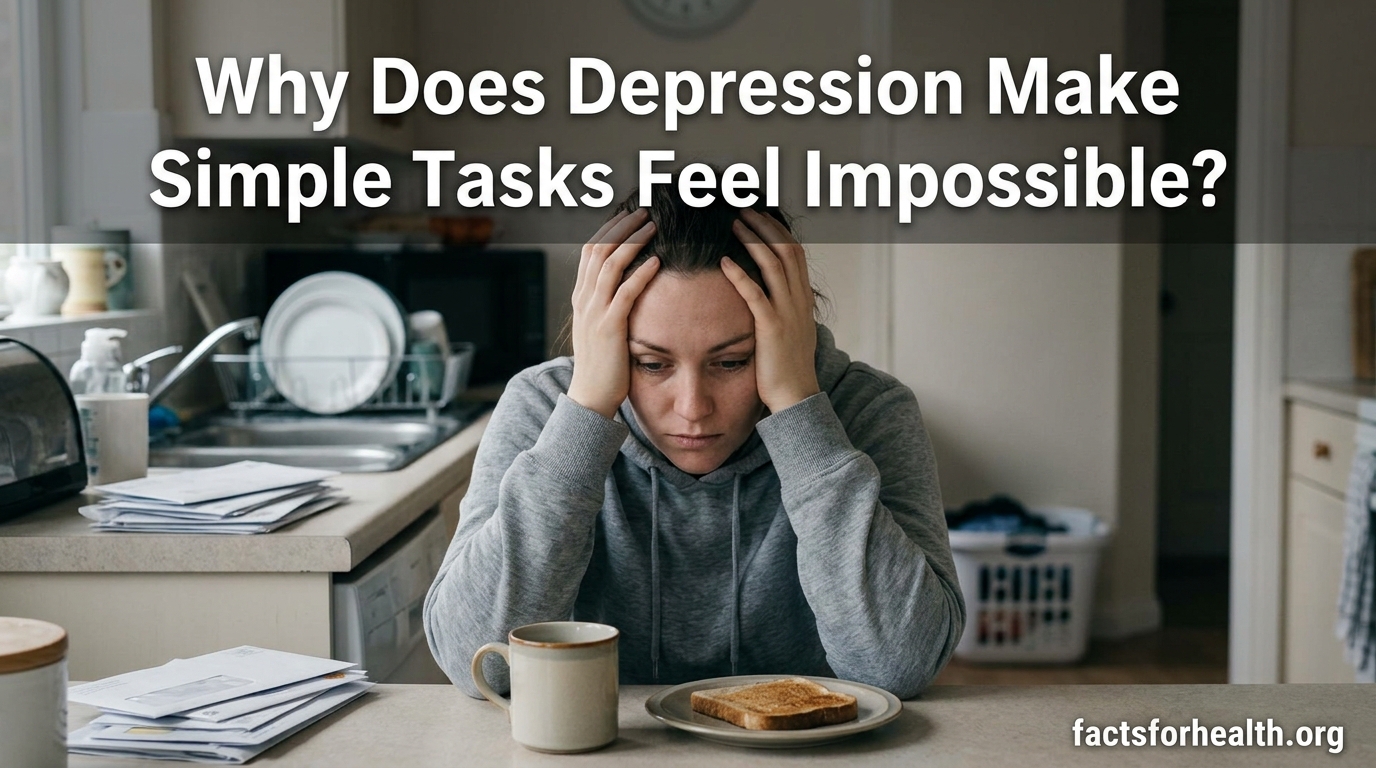
You know that feeling when brushing your teeth sounds like climbing a mountain? Or when a sink full of dishes might as well be a construction project? If you have ever stared at a laundry basket for an hour, unable to start, you are not alone. Millions of people experiencing depression face this exact wall every single day.
Here is the most important thing to understand first: this is not laziness. It is not a character flaw. It is not a failure of willpower. Understanding why does depression make simple tasks feel impossible requires looking at what is actually happening inside the brain. The answer involves disrupted brain chemistry, a compromised reward system, and genuine cognitive impairment that makes everyday activities feel like they require superhuman effort.
In this article, we will break down the science behind this experience, explore the specific symptoms that create this barrier, explain the cycle that makes it worse over time, and share practical coping strategies that real people use to get through it.
Table of Contents
The Short Answer
Depression makes simple tasks feel impossible by depleting the neurotransmitters your brain needs for motivation and reward processing. When dopamine levels drop, activities that should feel satisfying instead feel pointless or overwhelmingly effortful. Combined with physical fatigue, cognitive dysfunction, and a disrupted sense of self-worth, the brain essentially loses access to the fuel required to initiate and complete even basic self-care tasks.
Think of it this way. A healthy brain hands you a small reward every time you accomplish something, even something tiny like making your bed. Depression shuts down that reward system. So the task costs the same amount of energy but delivers zero satisfaction. Over time, your brain learns that effort leads to nothing, and it stops even trying to send the signal to start.
Why Does Depression Make Simple Tasks Feel Impossible?
The answer to this question sits at the intersection of neuroscience, psychology, and lived experience. Let us break down the key mechanisms at play.
Dopamine and the Broken Reward System
Dopamine is often called the “feel-good” neurotransmitter, but that description misses something important. Dopamine is actually the “do-something” chemical. It is what your brain releases before and during a task to motivate you to act. It is the reason you feel a spark of initiative when you decide to tackle your inbox or finally fold that laundry.
Depression reduces dopamine activity in the brain’s reward pathways. Research shows that people with major depressive disorder have significantly blunted dopamine responses compared to healthy individuals. This means the internal spark that says “go ahead, start the task” is barely firing. Without it, even a five-minute chore can feel like it requires pushing through wet concrete.
One person on a depression support forum described it perfectly: “Even tasks that take less than five minutes feel huge. My brain just does not send the start signal.” That is dopamine depletion in action. The intention to act exists, but the neurochemical fuel to convert intention into movement is missing.
Executive Dysfunction and the Prefrontal Cortex
The prefrontal cortex is the command center of your brain. It handles planning, prioritizing, initiating tasks, switching between activities, and regulating attention. These functions are collectively known as executive function. When they break down, the result is called executive dysfunction.
Depression directly impairs prefrontal cortex activity. Brain imaging studies show reduced blood flow and neural activation in this region during depressive episodes. What this means practically is that your brain struggles to break a task into steps, decide what to do first, or shift from thinking about a task to actually doing it.
This is why a depressed person might know they need to shower, want to shower, and still be unable to shower for hours or days. The knowledge and the desire are intact. The executive function bridge between wanting and doing has collapsed.
Someone on Reddit captured this experience: “I know what I need to do. I want to do it. I just cannot make my body and brain cooperate to actually start.” That gap between intention and action is the hallmark of depression-related executive dysfunction.
Energy Depletion Is Real, Not Imagined
Depression fatigue is not the same as being tired after a long day. It is a pervasive, bone-deep exhaustion that does not respond to rest or sleep. People with depression often describe feeling like their limbs are filled with lead or like they are moving through water.
This fatigue has biological roots. Depression is associated with dysregulation of the hypothalamic-pituitary-adrenal (HPA) axis, which controls your stress response and energy regulation. Chronic activation of this system leads to genuine physical depletion. Your body is running on empty at a cellular level.
Additionally, depression often disrupts sleep quality. Even if someone sleeps for ten hours, they may wake up exhausted because their brain is not cycling through the restorative sleep stages properly. So the energy tank never gets refilled, and every task draws from an already depleted reserve.
Depression vs ADHD: Different Roots, Similar Struggles
People sometimes confuse depression-related task difficulty with ADHD because both involve executive dysfunction. But the underlying mechanisms differ in important ways.
With ADHD, the brain’s reward system underreacts to routine tasks, making them feel boring and hard to sustain attention on. The person can often start tasks when sufficiently stimulated or interested. With depression, the reward system is suppressed across the board. Nothing feels interesting or rewarding, and the issue is compounded by fatigue, hopelessness, and anhedonia.
As one psychiatric resource puts it: “Unlike ADHD, where difficulties in task motivation are caused by a different reward system, depression shuts down your body.” Both conditions can coexist, which can make diagnosis and treatment more complex. If you suspect you might be dealing with both, a mental health professional can help untangle which symptoms belong to which condition.
The Symptoms Behind the Struggle
Several core depression symptoms work together to make task completion feel insurmountable. Understanding each one helps explain why the experience is so overwhelming.
Anhedonia: When Nothing Feels Worth Doing
Anhedonia is the clinical term for the inability to feel pleasure or interest in activities you once enjoyed. It is one of the most debilitating symptoms of depression, and it directly undermines task motivation.
Why would you bother doing the dishes if your brain cannot generate any sense of satisfaction from having a clean kitchen? Why take a shower if you cannot feel refreshed afterward? Anhedonia strips away the payoff that normally makes effort worthwhile. The task still costs energy, but the reward that used to make it feel worth doing has vanished.
This is profoundly disorienting. People often interpret it as proof that they do not care about their lives anymore. In reality, it is a symptom, not a statement about what matters to you. The caring is still there underneath. The brain’s ability to translate that caring into felt motivation is what is broken.
Depression Fatigue: More Than Just Tiredness
We touched on this above, but it deserves deeper attention because fatigue is one of the most common and most misunderstood depression symptoms. Studies estimate that over 90 percent of people with major depressive disorder experience significant fatigue.
This is not laziness. This is not a lack of discipline. It is a measurable biological state. Depression alters how your body produces and uses energy at the cellular level. Mitochondrial dysfunction, hormonal imbalances, and chronic inflammation all contribute to a genuine physical energy deficit.
When someone with depression says they are too tired to take a shower, they are describing a real physiological experience. The energy required is genuinely not available. Telling them to “push through” is like telling someone with a broken leg to just walk it off.
Brain Fog and Cognitive Dysfunction
Brain fog in depression is not a vague complaint. It reflects measurable cognitive impairments in attention, memory, processing speed, and executive function. Neuropsychological testing shows that people with depression perform worse on tasks requiring concentration, working memory, and cognitive flexibility.
What this feels like day to day: you walk into a room and forget why. You read the same paragraph three times without absorbing it. You stand in front of the refrigerator unable to decide what to eat. You start a task and lose the thread halfway through.
As someone shared on a mental health forum: “Cognitive difficulties compound physical fatigue. Mental fog makes decisions feel impossible.” When every small decision requires ten times the mental effort it normally would, the cumulative effect is exhausting. By noon, your brain may be as spent as your body.
Decision Fatigue: When Choosing Feels Like Lifting Weights
Decision fatigue is the phenomenon where the quality of your decisions deteriorates after a long session of decision making. For someone with depression, decision fatigue kicks in much earlier and hits much harder because the cognitive resources available are already depleted.
Simple choices feel paralyzing. What to wear, what to eat, whether to respond to a text, which task to tackle first. Each decision draws from the same limited pool of executive function. When that pool is already running on fumes, even trivial choices can trigger a freeze response.
This is why many people with depression benefit from reducing decisions. Wearing the same outfit, eating the same meals, following a rigid routine. These are not signs of giving up. They are adaptive strategies for conserving the cognitive energy that depression has already gutted.
The Avoidance Cycle: How Doing Less Makes Everything Harder
Here is where depression gets truly cruel. The difficulty completing tasks creates a feedback loop that makes the difficulty worse over time. Understanding this cycle is key to breaking it.
It works like this: A task feels too hard, so you avoid it. The task piles up, which makes it feel even more overwhelming. You feel guilty and ashamed for not doing it. That guilt and shame drain even more of your already limited energy. Now the task feels even harder, and you avoid it more.
One forum user described this vividly: “Not doing tasks leads to shame, which makes doing them even harder. Then I feel worse about myself, and the cycle just tightens.” This is the avoidance cycle in action, and it is one of the most common patterns reported by people struggling with depression.
Then there is the “later” trap. You tell yourself you will do it later. Later becomes tomorrow. Tomorrow becomes next week. The pile grows. The shame grows. The energy shrinks. As another person put it: “Depression creates a cycle where less activity leads to less capacity, which leads to even less activity.”
This cycle also feeds isolation. A messy home makes you not want to invite people over. Avoiding social contact deepens the depression. Deeper depression means even less energy for cleaning. The spiral tightens from multiple directions at once.
Physical health consequences pile on too. Neglected hygiene can lead to dental problems, skin infections, and weakened immune function. Skipped meals or poor nutrition worsens the biological deficits driving the depression. The body and mind drag each other down in a mutually reinforcing decline.
Breaking this cycle is not about suddenly doing everything. It is about interrupting the pattern with the smallest possible action.
Practical Coping Strategies That Actually Help
The strategies below are not about pushing harder. They are about working with your brain instead of against it. Each one is designed to reduce the cognitive and energetic cost of getting things done.
1. Shrink the task until it feels almost embarrassingly small. Instead of “clean the kitchen,” your task is “wash one plate.” Instead of “take a shower,” your task is “turn on the water.” The goal is to make the first step so tiny that it does not trigger the overwhelm response. Once you start, momentum often carries you further. As one forum user noted: “The hardest part is getting started. Once moving, it is easier to stay moving.”
2. Use the two-minute rule. If a task takes less than two minutes, do it immediately without thinking about it. Reply to that text. Put that cup in the sink. Put on socks. These tiny wins build small dopamine releases that can help restart your stalled reward system. They also prevent the pile-up that feeds the avoidance cycle.
3. Try body doubling. Body doubling means having another person present, either in person or virtually, while you do a task. You do not need to talk or interact. Just having another person there provides external structure and accountability that many people with depression find genuinely helpful. A friend on FaceTime, a coworker on a video call, or even a body doubling app can work.
4. Stack new habits onto existing ones. If you already manage to brush your teeth most days, put your medication next to the toothbrush. If you always make coffee in the morning, use that two-minute window to wipe down one counter. Habit stacking reduces the decision-making load because you are piggybacking on a routine that already exists.
5. Practice radical self-compassion. This is not optional fluff. Self-criticism is part of the avoidance cycle, and it makes everything worse. When you speak to yourself the way you would speak to a friend who is sick, you reduce the shame that drains your energy. A partial task counts. Brushing your teeth but not showering counts. Eating a granola bar instead of cooking a meal counts.
6. Reduce daily decisions. Pick one breakfast and eat it every day. Lay out clothes the night before, or wear the same comfortable outfit on low-energy days. Create a basic routine and follow it even when you do not feel like it. Routines reduce cognitive load, which frees up executive function for the tasks that actually need it.
7. Let light in. Exposure to natural light, especially in the morning, helps regulate circadian rhythms and can mildly boost mood and energy. Open the curtains. Sit near a window. Step outside for two minutes. This is not a cure, but it is a low-cost intervention that costs almost no executive function.
When to Seek Professional Help
Coping strategies are valuable, but they are not a substitute for treatment. Depression is a medical condition that often requires professional support to manage effectively. If task avoidance is severe enough that you are neglecting basic needs like eating, drinking water, or taking prescribed medications, it is time to reach out.
Other signs that indicate professional help is needed include inability to maintain personal hygiene for days at a time, withdrawing from all social contact, thoughts of self-harm or suicide, inability to work or attend school, and symptoms that persist for more than two weeks without improvement.
Therapy, particularly cognitive behavioral therapy (CBT) and behavioral activation, has strong evidence for treating depression-related task avoidance. Medication can help rebalance the neurotransmitter systems we discussed earlier. Many people benefit from a combination of both. If you are in crisis, you can call or text 988 in the United States to reach the Suicide and Crisis Lifeline, available 24 hours a day.
FAQs
How to get out of a depression funk?
Start with the smallest possible action. Pick one tiny task, like drinking a glass of water or stepping outside for two minutes. Do not try to fix everything at once. Reduce decisions by following a simple routine, let in natural light, and consider body doubling with a friend. If the funk lasts more than two weeks, reach out to a mental health professional.
What are 5 coping skills for depression?
Five effective coping skills include: micro-tasking (breaking tasks into tiny steps), the two-minute rule for quick tasks, body doubling with another person, habit stacking onto existing routines, and radical self-compassion to interrupt the shame cycle. Light exposure and gentle movement can also help boost energy and mood.
Why do I struggle so much with simple tasks?
Depression reduces dopamine and impairs the prefrontal cortex, making it biologically harder to initiate and complete tasks. Executive dysfunction, anhedonia, fatigue, and brain fog all work together to create a genuine barrier to action. This is a medical symptom, not laziness. Your brain is working with reduced neurochemical fuel for motivation and reward.
How to break the depression cycle of not doing anything?
Interrupt the avoidance cycle with one tiny action. Shrink a task until it feels almost too small to count, then do just that one step. Celebrate partial completion. Reduce self-criticism, which drains energy. Build a simple routine to cut decision fatigue. Each small action generates momentum that makes the next one slightly easier. Professional support like CBT or behavioral activation can help restructure these patterns over time.
You Are Not Broken, Your Brain Is Fighting an Illness
If you take one thing from this article, let it be this: the reason simple tasks feel impossible is not because you are weak, lazy, or broken. It is because depression disrupts the exact brain systems responsible for motivation, energy, and task initiation. You are experiencing a medical symptom, not a personal failure.
The science is clear on why does depression make simple tasks feel impossible. Dopamine depletion, executive dysfunction, anhedonia, and the avoidance cycle all work together to create a genuine biological barrier to action. Understanding these mechanisms can help reduce the shame that makes everything harder.
Start impossibly small. Wash one dish. Drink one glass of water. Text one person. These are not trivial victories. They are the first steps in interrupting a cycle that depression has built. And if you cannot do even that today, that is okay too. Tomorrow is another chance, and reaching out for professional help is always a valid next step.