
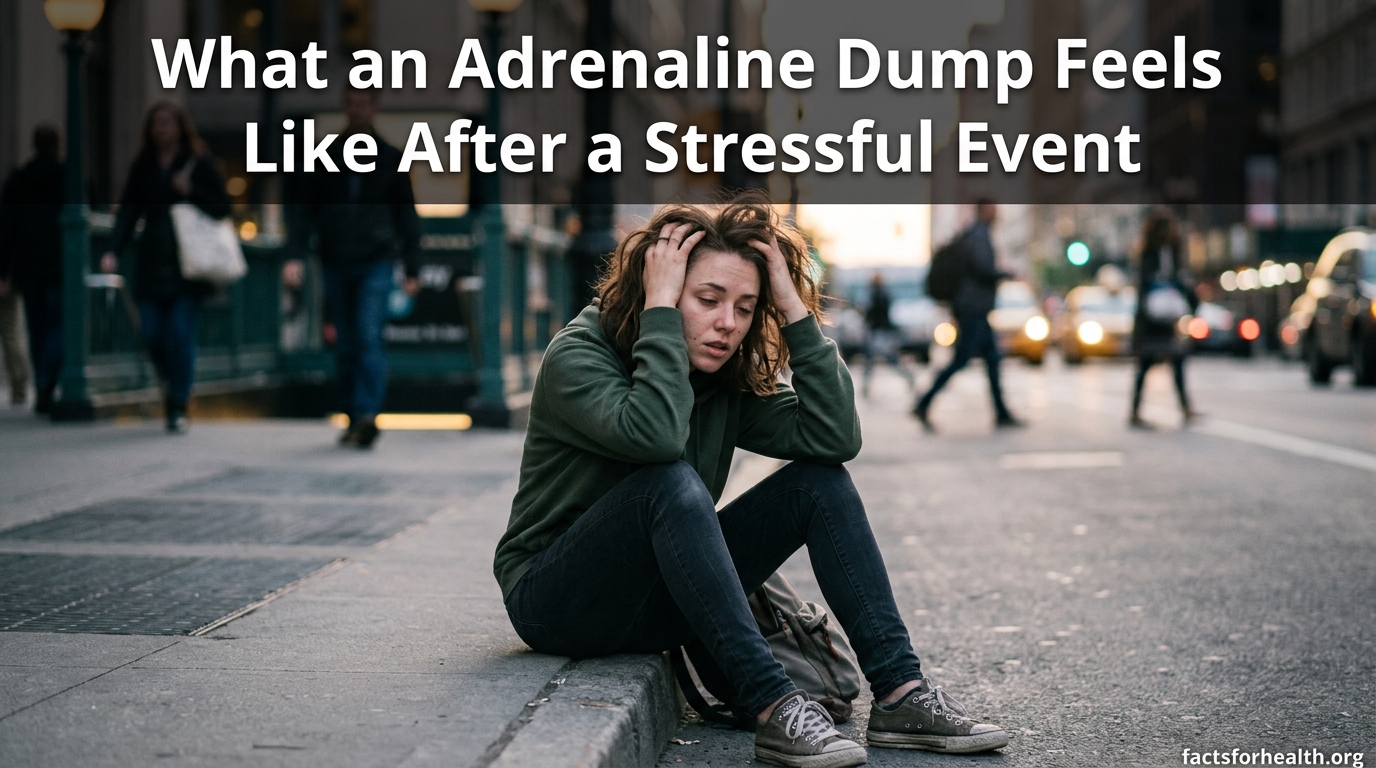
You walk out of the meeting, the hospital waiting room, or the near-miss on the highway. The danger is over. But your body has not gotten the memo. Your heart is slamming against your ribs. Your hands will not stop shaking. You feel a strange buzzing under your skin, like electricity running through every nerve. This is the moment most people first wonder what an adrenaline dump feels like after a stressful event, and why it hits hardest when the threat has already passed.
If you are reading this, you may have just experienced one. You may be sitting in your car, still trembling, trying to figure out if what you felt was normal. It was. The shaking, the racing heart, the sudden exhaustion, the fog rolling in, the nausea, the cold hands. These are all textbook adrenaline dump symptoms, and understanding them is the first step toward recovering from them.
In this guide, I will walk you through exactly what an adrenaline dump feels like at every stage, what is happening inside your body when it happens, why the crash afterward can feel worse than the event itself, and the specific techniques that help calm your nervous system down. I have pulled descriptions from people who experience adrenaline dumps regularly (nurses, first responders, people with POTS and PTSD) so you can recognize your own experience in their words and know you are not alone in this.
Table of Contents
What Is an Adrenaline Dump?
An adrenaline dump is a sudden, massive release of adrenaline (also called epinephrine) from your adrenal glands during the body’s fight-or-flight response. It happens in milliseconds. The moment your brain perceives danger, stress, or even intense excitement, two small glands sitting on top of your kidneys flood your bloodstream with a hormone designed to make you faster, stronger, and more alert than you have ever been.
The term “dump” is accurate. This is not a slow drip. It is a torrent. Your body releases a concentrated surge of adrenaline that changes your heart rate, breathing, blood flow, muscle tension, and mental focus all at once. The purpose is survival: your body is preparing you to fight a threat or run from it.
Here is the catch. Your body cannot tell the difference between a physical threat (a car swerving into your lane) and a psychological one (a brutal performance review). The adrenaline dump hits the same way regardless. And once it is in your bloodstream, you cannot simply think your way out of it. Adrenaline does not respond to logic. It runs its course, and that course can take anywhere from 20 minutes to several hours.
Adrenaline is often confused with cortisol, but they serve different roles. Adrenaline is the fast-acting first responder, hitting within seconds and driving the immediate physical symptoms. Cortisol is the slower secondary stress hormone, released minutes later to sustain the stress response over a longer period. Adrenaline is the sprint. Cortisol is the marathon. The adrenaline dump is what you feel first, and the crash that follows is your body winding down from that sprint.
What Happens in Your Body During an Adrenaline Dump
To understand what an adrenaline dump feels like, it helps to know what is actually happening inside your body. The process starts in a tiny region of your brain called the amygdala, which acts as your internal threat detector.
When the amygdala perceives danger, it sends a distress signal to the hypothalamus, the command center of your stress response. The hypothalamus then activates two separate but overlapping pathways: the SAM system and the HPA axis.
The SAM System: The First Wave
The sympathetic-adrenal medullary (SAM) system is your body’s fastest stress pathway. Within milliseconds of perceiving a threat, the hypothalamus sends signals through the sympathetic nervous system directly to the adrenal medulla, the inner core of your adrenal glands.
The adrenal medulla responds instantly by dumping adrenaline and noradrenaline into your bloodstream. This is the adrenaline dump. It happens so fast that you feel the physical effects before you have even finished processing what triggered them.
Adrenaline works by binding to receptors on your cells and triggering a chemical cascade involving cyclic adenosine monophosphate (cAMP). This cascade forces your body into overdrive. Here is what adrenaline does to specific organs and systems:
- Heart: Adrenaline makes your heart beat faster and harder, increasing cardiac output to push more blood to your muscles.
- Lungs: Your airways dilate and your breathing rate increases to take in more oxygen.
- Blood vessels: Blood vessels constrict in your skin and digestive system (redirecting blood to muscles), which is why your hands go cold and pale.
- Liver: Adrenaline triggers the release of stored glucose into your bloodstream, giving your muscles an instant energy supply.
- Eyes: Your pupils dilate to let in more light, and your peripheral vision narrows into tunnel focus on the threat.
- Muscles: Muscle tension increases dramatically, preparing for explosive movement.
- Brain: Mental focus sharpens and reaction times speed up, but complex thinking takes a backseat.
The HPA Axis: The Second Wave
While the SAM system handles the immediate crisis, the hypothalamic-pituitary-adrenal (HPA) axis kicks in about 30 seconds later as the backup system. The hypothalamus releases corticotropin-releasing hormone (CRH), which tells the pituitary gland to release adrenocorticotropic hormone (ACTH), which then signals the adrenal cortex to produce cortisol.
Cortisol keeps the stress response going. It maintains elevated blood sugar, suppresses non-essential functions like digestion and reproduction, and regulates inflammation. If the SAM system is the fire alarm, the HPA axis is the sprinkler system that keeps running after the alarm goes off.
This two-system design is brilliant for genuine survival threats. The problem is that most modern stressors are not life-or-death. When you get an adrenaline dump from an argument with your boss or a near-miss in traffic, your body prepares for a physical fight that never comes. All that adrenaline and cortisol have nowhere to go, and your body has to metabolize it the hard way. That buildup and eventual breakdown is what creates the symptoms and the crash you feel afterward.
What an Adrenaline Dump Feels Like
This is the section you probably came here for. Let me describe what an adrenaline dump feels like after a stressful event, sensation by sensation, using both clinical descriptions and the words of people who have lived through them.
The Heart: Racing, Pounding, Skipping
The first thing most people notice is their heart. It does not just beat faster. It pounds. You can feel it in your chest, your throat, sometimes even your ears. Heart palpitations are one of the most universal adrenaline dump symptoms, and they can be terrifying if you do not know what is causing them.
Your heart rate can jump from 70 beats per minute to 140 or higher in seconds. For people with POTS (postural orthostatic tachycardia syndrome), this jump can be even more dramatic. The sensation is not subtle. It feels like your heart is trying to escape your ribcage.
One person in the r/POTS community described it this way: “I get a heaviness feeling in my chest, pain usually in my left arm, dizziness, my stomach hurts so bad I double over. It genuinely feels like I am going to die.” That level of intensity is common during a full adrenaline dump, and the fear it creates can actually amplify the symptoms further.
The Shaking: Full-Body Tremors
The shaking is what sends most people searching for answers. It is not a subtle tremble. It is full-body, uncontrollable shaking that can last 20 minutes to an hour after the stressor has passed. Your hands shake so badly you cannot hold a glass of water. Your legs feel like jelly. Your jaw may even chatter.
This happens because adrenaline floods your muscles with tension and glucose, preparing them for explosive action. When that action never comes, the muscles have no way to release the stored energy. The result is involuntary tremoring as your body tries to burn off the excess.
A Reddit user in r/POTS captured it perfectly: “I felt super flushed, my vision tunneled, my hands went numb, and I instantly started having full body tremors. I could not stop shaking even though the situation was over.” This is the classic adrenaline dump signature: the event ends, but the body is still at battle stations.
The Skin: Flushing, Sweating, Cold Hands
Adrenaline does strange things to your skin. Many people experience sudden flushing, a hot, red wave that spreads across their face, neck, and chest. At the same time, their hands and feet go ice cold and pale as blood vessels constrict to redirect blood to the major muscle groups.
You may start sweating profusely, even if the room is cool. This is your body trying to cool itself down in anticipation of intense physical exertion. Goosebumps may ripple across your arms and legs as the tiny muscles at the base of each hair follicle contract.
One person described it as “a buzzing feeling throughout my body, my extremities get extremely cold, and my body shakes.” That buzzing or vibrating sensation under the skin is frequently mentioned in forums and is one of the most distinctive signs that you are experiencing an adrenaline dump rather than general anxiety.
The Stomach: Nausea, Butterflies, Pain
Your digestive system shuts down during an adrenaline dump. Blood is redirected away from your gut and toward your muscles, which can cause sudden nausea, stomach cramping, or that hollow “butterflies” sensation in your abdomen.
For some people, the stomach symptoms are the most prominent part of the experience. “I was trying to put some laundry away when I was hit by this intense wave of just weakness and tremors and shakiness and nausea and heat,” shared one person in the POTS community. That sudden, overwhelming nausea is a direct result of adrenaline hitting your digestive system.
You may also experience dry mouth as saliva production decreases. Some people feel a metallic taste or a lump in their throat. These are all normal adrenaline dump symptoms, even though they can feel alarming in the moment.
During the adrenaline dump itself, your mind goes into overdrive. Thoughts race. You become hyper-aware of every sound, every movement, every detail of your environment. This hyper-vigilance is your brain scanning for additional threats.
You may feel “amped up” or “on edge,” as if you could run through a wall. Some people describe a sense of unreal clarity, where time seems to slow down and everything appears sharp and vivid. This is adrenaline enhancing your cognitive processing speed.
But when the adrenaline starts to wear off, the mental clarity collapses. Brain fog rolls in. You may struggle to form sentences, remember simple things, or concentrate on anything. This cognitive crash is one of the most frustrating parts of the experience, especially if you need to function at work or in a social setting.
As one person in the r/Anxiety community put it: “I just wake up and feel anxiety symptoms, physical and even mental, out of nowhere. No trigger, no particular fear, no thought, no event causes this.” When adrenaline dumps happen without an obvious trigger, the mental confusion is even more disorienting.
The Emotional Aftermath
After the physical symptoms peak, the emotional fallout begins. Many people feel irritable, tearful, or emotionally raw. Mood swings are common. You might go from feeling shaky and scared to angry to completely flat within a short span.
This emotional volatility is partly chemical. Your brain is processing the sudden depletion of adrenaline and dopamine, and the shift can leave you feeling emotionally hungover. It is not a character flaw. It is neurochemistry.
Common Causes and Triggers
Adrenaline dumps can be triggered by almost anything your brain interprets as a threat, challenge, or high-stakes situation. Understanding your triggers is one of the most powerful tools for managing adrenaline dumps, because once you can predict them, you can prepare for them.
Acute Stressful Events
The most obvious triggers are acute, single-event stressors. These include:
- Near-miss car accidents or sudden swerves
- Medical emergencies (your own or a loved one’s)
- Confrontations or arguments that escalate quickly
- Receiving frightening news
- Witnessing an accident or act of violence
- Public speaking or high-stakes presentations
- Job interviews or performance reviews
- Sports competitions or athletic performances
What all these share is an element of suddenness. The amygdala responds most intensely to threats that appear quickly and unpredictably. A problem you have been worrying about for weeks produces a slower cortisol response. A threat that materializes in seconds triggers a full adrenaline dump.
Chronic Stress and Burnout
When you are under sustained stress, your baseline adrenaline and cortisol levels stay elevated. This means your nervous system is already primed, and even minor stressors can trigger a disproportionately large adrenaline dump.
People experiencing burnout often report adrenaline dumps from triggers that would barely register on a calm day. A phone ringing, an email notification, a colleague stopping by your desk. The nervous system has become so sensitized that it treats everyday events as threats.
Medical Conditions: POTS, Dysautonomia, PTSD
For some people, adrenaline dumps are not triggered by external events at all. They are a symptom of an underlying condition that affects the autonomic nervous system.
POTS (postural orthostatic tachycardia syndrome) is one of the most common. People with POTS experience inappropriate adrenaline surges when they stand up, after eating, or even at rest. Their bodies release adrenaline without any psychological trigger, which is deeply confusing and distressing.
PTSD works differently but produces similar results. The amygdala becomes hyper-reactive after trauma, triggering adrenaline dumps in response to reminders of the traumatic event, loud noises, or seemingly nothing at all. The body has learned to treat the world as dangerous, and the alarm system fires constantly.
Adrenaline dysautonomia is a broader term for autonomic nervous system dysfunction that produces recurrent adrenaline surges. People with this condition often describe being dismissed by doctors who attribute their symptoms to anxiety, when the root cause is a nervous system that misfires.
Adrenaline Dumps at Night
Nighttime adrenaline dumps are a specific and particularly distressing form of this experience. You fall asleep normally, then jolt awake an hour or two later with your heart racing, drenched in sweat, and completely unable to calm down.
This happens for several reasons. As you fall asleep, your blood pressure and heart rate drop. In people with sensitized nervous systems, this drop can trigger a compensatory adrenaline surge. Blood sugar crashes during the night can also trigger adrenaline release as your body tries to raise glucose levels. And for people with PTSD, nightmares or the vulnerability of sleep itself can activate the threat response.
Nighttime adrenaline dumps feed a vicious cycle. The adrenaline disrupts your sleep, poor sleep makes your nervous system more reactive the next day, and the increased reactivity makes nighttime dumps more likely. Breaking this cycle requires specific sleep hygiene strategies and, in some cases, medical support.
The Adrenaline Rush vs the Crash: A Timeline
One of the most searched questions about this topic is how long an adrenaline dump lasts and what happens in the hours that follow. The experience unfolds in distinct phases, and understanding the timeline can help you gauge where you are and what to expect next.
Phase 1: The Surge (0-30 Seconds)
The adrenaline dump begins the instant your amygdala detects a threat. Within milliseconds, the SAM system activates and adrenaline floods your bloodstream. You feel the surge almost immediately: heart rate spikes, breathing quickens, muscles tense, and your senses sharpen.
This is the shortest phase but the most intense. Your body is at maximum readiness. If the threat is physical and you fight or flee, the adrenaline gets used up through movement. If the threat is psychological and you sit still, the adrenaline has nowhere to go.
Phase 2: The Plateau (30 Seconds to 20 Minutes)
After the initial surge, adrenaline levels remain elevated. Your heart rate stays high. Your muscles stay tense. Your mind stays in hyper-vigilant scanning mode. This is the phase where most people notice the shaking, the sweating, and the racing thoughts.
During this plateau, you may feel “amped up” or unable to sit still. One forum user described “extreme physical restlessness, the need to move, and extreme irritability when lying down.” Your body is literally begging you to take physical action, and being forced to sit still can make the discomfort worse.
For most people, this plateau phase lasts 15 to 20 minutes. That is roughly how long it takes your body to begin metabolizing the circulating adrenaline. If the stressor continues (an ongoing argument, a prolonged emergency), the plateau can extend significantly as new adrenaline is released to replace what is being broken down.
Phase 3: The Crash (20 Minutes to Several Hours)
This is the phase that sends people searching for answers. As adrenaline levels finally begin to drop, the crash begins. And for many people, the crash feels worse than the surge.
The symptoms of the adrenaline crash are almost the mirror opposite of the rush. Where you had racing energy, you now feel bone-deep exhaustion. Where your mind was sharp, you now have brain fog. Where you felt wired, you now feel hollow and shaky.
Here is a side-by-side comparison of what the rush feels like versus what the crash feels like:
- Heart rate: Rush = racing and pounding; Crash = still elevated but irregular, sometimes with palpitations
- Energy: Rush = surging, electric, restless; Crash = exhausted, heavy limbs, barely able to move
- Mental state: Rush = hyper-alert, racing thoughts; Crash = brain fog, difficulty concentrating, confusion
- Muscles: Rush = tense and trembling; Crash = weak, sore, jelly-like
- Mood: Rush = fearful, hyped, edgy; Crash = flat, irritable, tearful, or emotionally numb
- Body temperature: Rush = flushed and sweating; Crash = chilled, sometimes shivering
- Stomach: Rush = nausea, butterflies; Crash = hungry or completely appetite-less, lingering nausea
The crash can last anywhere from one hour to an entire day, depending on the intensity of the adrenaline dump and your overall health. One person in the r/dysautonomia community shared: “I had a 3-hour-long adrenaline dump and the next morning felt really weak, nauseous, and had bad brain fog.” That next-day hangover effect is extremely common and is often the part that interferes most with daily functioning.
Phase 4: Recovery (Hours to Days)
Full recovery from a significant adrenaline dump can take 24 to 48 hours. During this window, you may feel more tired than usual, more emotionally sensitive, and more susceptible to another dump. Your nervous system is in a refractory period, recovering from the chemical rollercoaster.
This is why self-care after an adrenaline dump matters so much. Rest, hydration, gentle movement, and avoiding additional stressors can shorten the recovery window significantly. Pushing through and ignoring the crash tends to prolong it.
Adrenaline Dump vs Panic Attack: How to Tell the Difference
This is one of the most common questions people ask after experiencing an adrenaline dump, and the confusion is understandable. The physical symptoms overlap heavily. Both involve a racing heart, shaking, sweating, dizziness, and a sense of impending doom. But they are different experiences with different causes.
An adrenaline dump is a physiological event triggered by your body’s stress response. It can happen in response to a real external stressor (a car accident, a confrontation, a medical emergency) or as part of a medical condition (POTS, dysautonomia, PTSD). The trigger may be physical, psychological, or internal, but the root cause is a hormonal surge.
A panic attack is a sudden episode of intense fear or discomfort that peaks within minutes. It can occur with or without an obvious trigger. While adrenaline is involved in panic attacks, the defining feature is the psychological experience of terror and the fear of losing control, dying, or going crazy.
Here is how to tell them apart:
- Trigger: Adrenaline dump usually follows an identifiable stressor; panic attack can strike out of nowhere
- Onset: Adrenaline dump builds as the stressor unfolds; panic attack peaks within 10 minutes of starting
- Duration: Adrenaline dump symptoms last 20 minutes to several hours; panic attack typically peaks and subsides within 20 to 30 minutes
- Mental state: Adrenaline dump produces hyper-vigilance and physical symptoms; panic attack produces overwhelming fear and catastrophic thinking
- Aftermath: Both produce exhaustion, but the adrenaline crash tends to involve more physical weakness and brain fog, while the post-panic state tends to involve emotional depletion
The overlap is real. An adrenaline dump can trigger a panic attack, and a panic attack involves an adrenaline surge. Some people experience both simultaneously. If you are unsure which one you are experiencing, focus on managing the physical symptoms first. The recovery techniques work for both.
How to Calm Down After an Adrenaline Dump: In-the-Moment Techniques
When you are in the middle of an adrenaline dump, logic is not your friend. Your prefrontal cortex (the rational thinking part of your brain) is partially offline. What works is using your body to signal safety to your nervous system. Here is a step-by-step checklist for calming down in the moment.
The 6-Step Adrenaline Recovery Checklist
Step 1: Name what is happening. Tell yourself out loud: “This is an adrenaline dump. My body is responding to stress. This will pass.” Multiple forum users report that simply naming the experience provides immediate psychological relief. It shifts you from being inside the fear to observing it.
Step 2: Control your breathing. Your breathing is the fastest route to your parasympathetic nervous system, the rest-and-digest network that counters adrenaline. Slow, deep breathing activates the vagus nerve, which signals your heart to slow down. Start with box breathing (instructions below) or simply extend your exhales to be longer than your inhales.
Step 3: Get cold. Cold exposure is one of the most consistently recommended techniques in forum communities. Splash cold water on your face, hold an ice pack against your cheeks, or take a cold shower. Cold activates the mammalian dive reflex, which immediately lowers your heart rate and shifts your nervous system into parasympathetic mode. As one r/PTSD user put it: “An icy cold shower sometimes gets me straight out of it.”
Step 4: Ground yourself. Use the 5-4-3-2-1 technique to pull your attention out of your racing thoughts and into your physical environment. Name 5 things you can see, 4 things you can feel, 3 things you can hear, 2 things you can smell, and 1 thing you can taste. This sensory anchoring reduces hyper-vigilance by giving your brain concrete data to process.
Step 5: Release the physical tension. Your muscles are holding enormous tension from the adrenaline surge. Progressive muscle relaxation can help release it. Tense each muscle group for 5 seconds, then release. Start with your fists, then arms, then shoulders, then face, then legs. The contrast between tension and release helps your body recognize that the threat has passed.
Step 6: Move gently. Light movement helps metabolize circulating adrenaline. Walk slowly, do some gentle stretching, or pace around the room. Avoid intense exercise, which can keep your heart rate elevated and prolong the stress response. The goal is to burn off the adrenaline without triggering another surge.
Box Breathing Instructions
Box breathing is used by Navy SEALs, emergency responders, and anxiety specialists because it is simple and effective. Here is how to do it:
- Inhale through your nose for 4 seconds
- Hold your breath for 4 seconds
- Exhale through your mouth for 4 seconds
- Hold your breath for 4 seconds
- Repeat for at least 4 cycles (about 64 seconds total)
The key is keeping each phase equal in length. This rhythmic pattern slows your heart rate through a mechanism called respiratory sinus arrhythmia, where your heart rate naturally speeds up on the inhale and slows down on the exhale. By extending the cycles, you amplify the calming effect.
The 4-7-8 Breathing Technique
If box breathing does not work for you, try 4-7-8 breathing, which emphasizes long exhales to maximize vagus nerve activation:
- Inhale through your nose for 4 seconds
- Hold your breath for 7 seconds
- Exhale completely through your mouth for 8 seconds
- Repeat for 4 cycles
The extended exhale is what makes this technique powerful. A longer exhale than inhale is the single most reliable breathing pattern for activating the parasympathetic nervous system. If you only remember one thing from this section, remember to make your exhale longer than your inhale.
Comparing Breathing Techniques
Different breathing techniques work better for different people and situations. Here is a quick comparison to help you choose:
- Box breathing (4-4-4-4): Best for maintaining calm under pressure; easy to remember; good for public situations
- 4-7-8 breathing: Best for acute anxiety and falling asleep; stronger vagal activation; requires more breath-holding capacity
- Paced breathing (5-6 breaths per minute): Best for long-term nervous system regulation; used in biofeedback training; requires practice to maintain the rhythm
- Extended exhale (inhale 3, exhale 6): Best quick fix when you cannot remember a specific pattern; can be done anywhere without anyone noticing
Long-Term Strategies to Reduce Adrenaline Dumps
In-the-moment techniques help you survive an adrenaline dump, but if you are experiencing them frequently, you need long-term strategies to reduce their frequency and intensity. These approaches work by training your nervous system to be less reactive over time.
Trigger Mapping
For one week, write down every time you experience an adrenaline dump. Note the time, the situation, what happened right before, how long it lasted, and what helped. Patterns will emerge. You may discover that your dumps cluster around certain people, times of day, blood sugar dips, or sleep-deprived days.
Once you identify patterns, you can prepare. If mornings are your trigger time, you can build a slower wake-up routine. If hunger triggers dumps, you can eat smaller, more frequent meals. If lack of sleep is the culprit, prioritizing sleep becomes your primary treatment.
Build Nervous System Resilience
Your parasympathetic nervous system is like a muscle. The more you activate it, the stronger it gets. Daily practices that strengthen vagal tone make your body less likely to spiral into a full adrenaline dump when stressed.
Effective daily practices include 10 minutes of paced breathing, cold exposure (ending your shower with 30 seconds of cold water), gentle yoga, and mindfulness meditation. None of these need to be elaborate. Consistency matters far more than duration. Five minutes every day will rewire your nervous system more effectively than an hour once a week.
Regulate Blood Sugar and Caffeine
Blood sugar crashes trigger adrenaline release. If you skip meals or eat high-sugar foods that cause rapid spikes and crashes, you are setting the stage for adrenaline dumps. Eat protein-rich meals at regular intervals and keep emergency snacks available.
Caffeine is a direct trigger for many people. It stimulates the adrenal glands and can push an already-sensitized nervous system over the edge. If you are experiencing frequent dumps, try cutting caffeine for two weeks and see if the frequency drops. Many people in forum communities report dramatic improvement from this single change.
Address Underlying Conditions
If your adrenaline dumps are frequent, severe, or occur without an obvious trigger, talk to a doctor about underlying conditions. POTS, dysautonomia, thyroid disorders, and anxiety disorders can all cause recurrent adrenaline surges.
Medication can be part of the solution. Beta-blockers like propranolol are frequently mentioned in forum communities as effective for reducing the physical symptoms of adrenaline dumps. They block adrenaline receptors, preventing the heart from racing and the body from shaking. These require a prescription and medical supervision, but for many people, they make a significant difference.
When to See a Doctor
Most adrenaline dumps are normal physiological responses to stress. They are uncomfortable but not dangerous in isolation. However, certain signs warrant medical evaluation:
- Adrenaline dumps that occur multiple times per day without identifiable triggers
- Chest pain that persists after the adrenaline dump has resolved
- Fainting or loss of consciousness during an episode
- Heart rates consistently above 120 beats per minute at rest
- Adrenaline dumps that wake you from sleep multiple times per week
- Symptoms that interfere with your ability to work, drive, or maintain relationships
- Blood pressure spikes accompanied by severe headache and sweating
In rare cases, frequent adrenaline surges can be caused by a pheochromocytoma, a benign tumor on the adrenal gland that produces excess adrenaline. This is uncommon, but it is one reason doctors take recurrent, unexplained adrenaline dumps seriously. Blood tests, 24-hour urine tests, and imaging can rule it out.
If you have been dismissed by a doctor who attributed your symptoms solely to anxiety, consider seeking a second opinion from a cardiologist or a dysautonomia specialist. Your symptoms are real, and effective treatments exist.
FAQs
What does post-adrenaline dump feel like?
After an adrenaline dump, most people experience a crash characterized by deep exhaustion, brain fog, muscle weakness, irritability, and sometimes lingering nausea or shakiness. You may feel emotionally drained, mentally cloudy, and physically heavy, as if your body has run a marathon it never trained for. This post-adrenaline crash can last anywhere from one hour to a full day.
How long does an adrenaline dump last?
An adrenaline dump typically lasts 20 minutes to one hour from the initial surge to the beginning of the crash. The acute symptoms (racing heart, shaking, sweating) usually peak within the first 5 to 10 minutes and gradually subside over the next 20 to 30 minutes. The post-adrenaline crash that follows can last several hours, and full recovery may take 24 to 48 hours.
How long does adrenaline last after stress?
Adrenaline itself has a half-life of about 2 to 3 minutes in the bloodstream, meaning your body breaks it down quickly. However, the effects of an adrenaline surge can last up to an hour because the hormone continues circulating and binding to receptors. If the stressful situation is ongoing, your body may release additional adrenaline, extending the response. Cortisol, the secondary stress hormone, remains elevated for much longer.
How to recover after an adrenaline dump?
To recover from an adrenaline dump, start by controlling your breathing with box breathing or extended exhales. Splash cold water on your face to activate the calming dive reflex. Use the 5-4-3-2-1 grounding technique to reduce hyper-vigilance. Do light movement like walking or stretching to help metabolize the adrenaline. Rest, hydrate, and eat something with protein to stabilize blood sugar. Avoid caffeine and intense exercise until symptoms fully resolve.
What do adrenal dumps feel like?
Adrenal dumps feel like a sudden wave of physical intensity: your heart pounds and races, your body shakes with uncontrollable tremors, your hands go cold and numb, your skin flushes and sweats, your stomach turns with nausea, and your vision may narrow into tunnel focus. You feel a buzzing or vibrating sensation under your skin and an overwhelming urge to move. Afterward, you crash into exhaustion, brain fog, and emotional flatness.
What does your body feel like after an adrenaline rush?
After an adrenaline rush, your body feels drained and heavy. Common sensations include jelly-like muscles, deep fatigue, trembling hands, cold skin, a slow-to-recover elevated heart rate, brain fog, headache, nausea, and a hollow or wired-tired feeling where you are exhausted but cannot fully relax. Some people feel irritable or emotionally raw for hours afterward.
Is an adrenaline dump dangerous?
A single adrenaline dump after a genuinely stressful event is not dangerous. It is a normal physiological response. However, frequent or chronic adrenaline dumps can contribute to high blood pressure, weakened immune function, sleep disruption, and cardiovascular strain over time. If you experience adrenaline dumps multiple times per day, at rest, or without an obvious trigger, consult a doctor to rule out underlying conditions.
Why do adrenaline dumps happen for no reason?
Adrenaline dumps without an obvious trigger often stem from a sensitized nervous system, underlying conditions like POTS or dysautonomia, PTSD, chronic stress, blood sugar crashes, caffeine sensitivity, or hormonal fluctuations. The nervous system becomes primed to fire the fight-or-flight response at inappropriate times. Identifying patterns through trigger mapping and working with a healthcare provider can help determine the specific cause.
Conclusion
Understanding what an adrenaline dump feels like after a stressful event transforms a terrifying, confusing experience into something recognizable and manageable. The racing heart, the shaking, the cold hands, the buzzing skin, the crashing exhaustion. These are all signs that your body’s ancient survival system did exactly what it was designed to do, even if the timing felt wrong.
The shaking will stop. The fog will lift. Your nervous system knows how to come back to baseline, and the techniques in this guide can accelerate that process. Breathe slowly, get cold, ground yourself, move gently, and give yourself permission to rest during the crash. If adrenaline dumps are disrupting your life, talk to a healthcare provider. You do not have to just live with them.