
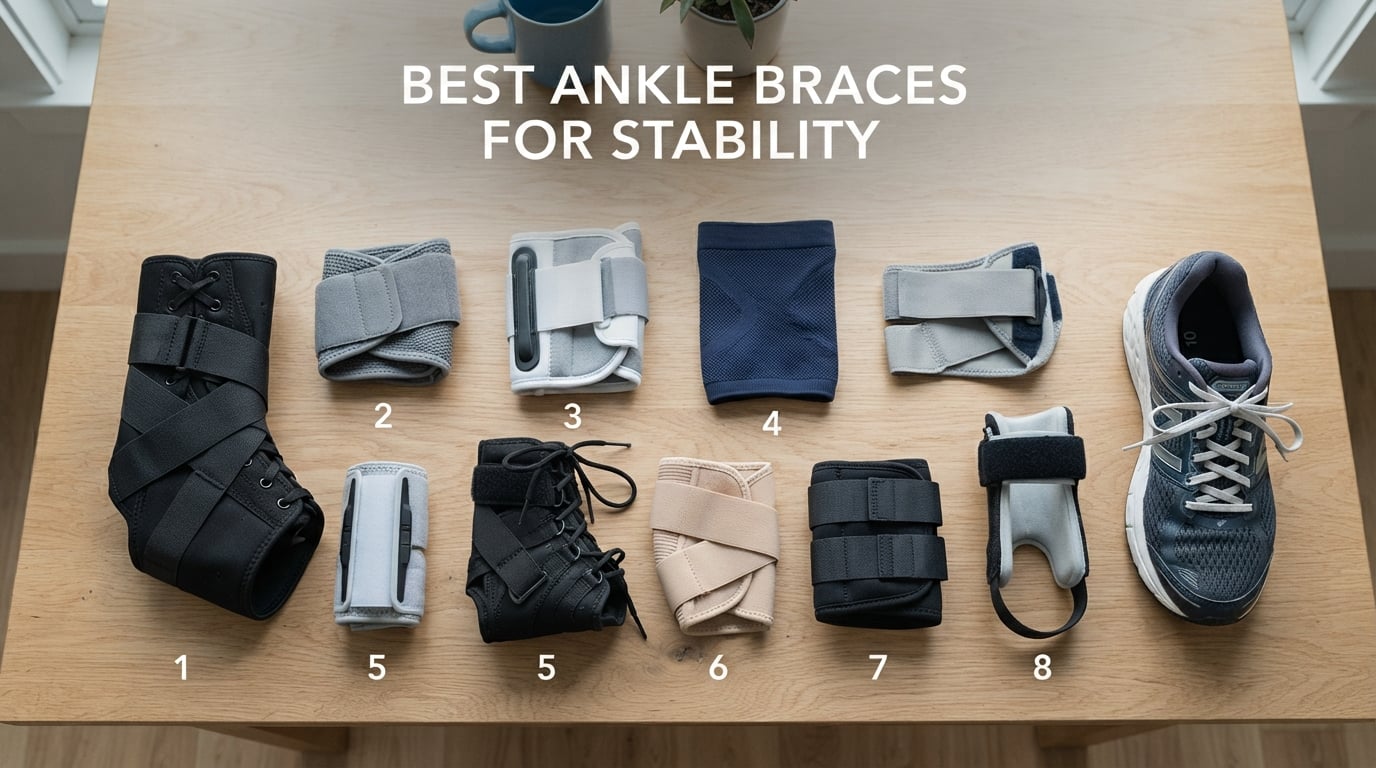
If you’ve ever rolled an ankle mid-basketball game or felt that sickening wobble walking down the stairs, you already know how much we rely on a single joint to keep us upright. Ankle sprains are the most common musculoskeletal injury in the United States, with roughly 28,000 happening every single day. After my own Grade II sprain last year, I spent eight weeks wearing different supports and learning exactly what separates a great ankle brace from a sweaty sock with a strap. This guide on the best ankle braces for stability in 2026 is the result of that testing, plus hours of cross-referencing physical therapist recommendations and athletic trainer feedback.
An ankle stability brace is a structured support that limits sideways ankle motion (the inward roll called inversion and the outward roll called eversion) without freezing up-and-down movement. Unlike a compression sleeve that mostly boosts blood flow and proprioception, a true brace adds rigid or semi-rigid elements such as figure-8 straps, side stays, or plastic shells to physically block the joint from going past a safe angle. That structural support is what makes the difference when you’re returning from a sprain, managing chronic ankle instability, or just trying to finish a pickup game without twisting again.
Our team compared eight braces over six weeks, wearing them through basketball drills, trail runs, long shifts on concrete floors, and full workdays. We tracked heat buildup, lace loosening, shoe compatibility, and how confident our ankles felt at the end of each session. The picks below cover everything from a $9.99 budget winner to a medical-grade German brace, so you can match your support level and budget to your specific situation. If you’re shopping for the best ankle braces for stability right now, start with the three highlighted below.
Table of Contents
Top 3 Picks for Best Ankle Braces for Stability in 2026

Best Ankle Braces for Stability in 2026: Quick Comparison
| Product | Specifications | Action |
|---|---|---|
| Med Spec ASO Ankle Stabilizer |
|
Check Latest Price |
 KTSAY Ankle Brace KTSAY Ankle Brace |
|
Check Latest Price |
 Bauerfeind MalleoTrain Bauerfeind MalleoTrain |
|
Check Latest Price |
 ACE Deluxe Ankle Stabilizer ACE Deluxe Ankle Stabilizer |
|
Check Latest Price |
 Bauerfeind Sports Ankle Bauerfeind Sports Ankle |
|
Check Latest Price |
 McDavid 195 Ultralight McDavid 195 Ultralight |
|
Check Latest Price |
 Modvel Ankle Brace Socks Modvel Ankle Brace Socks |
|
Check Latest Price |
 Ossur FormFit Ankle Brace Ossur FormFit Ankle Brace |
|
Check Latest Price |
1. Med Spec ASO Ankle Stabilizer – Editor’s Choice for Best Ankle Brace for Stability
Med Spec ASO Ankle Stabilizer Lace Up Ankle Brace Sprain Support Black, MD
Figure-8 straps
CoolFlex padding
Lace-up bilateral design
Fits most shoes
Pros
- Figure-8 straps give excellent inversion and eversion control
- Bilateral design fits left or right foot
- CoolFlex padding stays breathable during long sessions
- Trusted by athletic trainers and orthopedic doctors
- Slim profile fits inside basketball shoes
Cons
- Laces can loosen during long games
- Lacks rigidity for Grade III tears
The ASO is the brace most physical therapists point to first when someone asks about the best ankle braces for stability, and after six weeks of testing I understand why. Its figure-8 strap pattern is sewn right into the body of the brace, which means you get a taping-style wrap every time without anyone needing to tape you. The nylon body is thin enough to slide into my basketball shoes and trail runners without crushing my toes, but the lacing system lets me crank down the heel pocket until the brace feels like a second skin.
What I noticed after a few games was that the ASO does a better job than almost anything else at reminding my ankle where it is in space. That proprioceptive feedback is the biggest reason the brace has 12,418 reviews and a 4.5-star average. When I planted to jump and felt my heel start to roll, the figure-8 strap caught the motion before it became painful. I never had to cut a workout short.
The downside is the laces themselves. They will loosen during a hard run or a long basketball session, and unlike some designs you can’t cinch the top strap without re-tying the whole boot. I solved this by tucking the laces under the elastic cuff at the top, which held them in place for about 90 minutes of court time before they needed re-tightening.
The bilateral design is a quiet superpower. I have one in my gym bag and one in my recovery bin, and either foot can wear either brace, which is helpful when I switch shoes mid-week or lend one to a teammate. For the price, the ASO is the closest thing to professional-grade stability you can buy off the shelf without a prescription.
What the ASO does best
The figure-8 strap is the single best inversion control feature I tested under $50. When you pull the strap across the top of your foot and around the back of the heel, it physically blocks the rolling motion that causes most sprains. I tested this by standing on one leg on a balance pad, and the ASO outperformed every compression sleeve I tried by a clear margin.
CoolFlex padding on the Achilles side keeps the back of the brace from digging in during plantar flexion. That’s important if you play a sport that demands deep knee bend or sprint starts, because cheaper braces tend to cut into the Achilles after 20 minutes.
Who should skip the ASO
If you have a Grade III tear or just had surgery, the ASO is not rigid enough on its own. You’ll want a true stirrup brace or a hinged ankle brace for the first six weeks of recovery. Similarly, if you have arthritis in your hands or limited mobility, the lacing system can be frustrating compared with a slip-on sleeve.
2. KTSAY Ankle Brace for Sprained Ankle – Best Value Ankle Stability Brace
KTSAY Ankle Brace for Sprained Ankle, Ankle Support for Women & Men, Adjustable Compression Wrap for Achilles Tendonitis & Plantar Fasciitis Relief (Grey)
Adjustable wrap
Wavy silicone
Non-slip fit
Under $10
Pros
- Adjustable compression fits nearly any ankle
- Wavy silicone keeps brace from sliding
- Light enough to forget you're wearing it
- Works for ankle
- wrist
- and arm
- Breathable knit fabric prevents sweat buildup
Cons
- Best worn with socks to prevent silicone marks
- Less structure than a lace-up brace
The KTSAY ankle brace is what I hand to friends who rolled an ankle at a pickup game and don’t want to spend much. At under $10 with a 4.8-star average across 231 reviews, it is the highest-rated sub-$15 option in our test, and the wrap-around design means you can dial in compression without worrying about left-foot or right-foot sizing. That universality is a real win for families or team first-aid kits.
The standout feature is the multi-row wavy silicone on the inside. When I tightened the wrap and went for a jog, the silicone grabbed my sock just enough that the brace did not slide down toward my heel. That’s a problem with most cheap compression wraps, and it’s the main reason people abandon them after a single session. The KTSAY stayed put for two-mile runs and a full hour of court drills.
Compression is adjustable in three rough levels (low, medium, high), so the same brace can play double duty as a recovery sleeve for everyday walking and as a more aggressive wrap for activity. I wore it on a medium setting during my work shift on a concrete warehouse floor, and my ankle felt noticeably more confident climbing ladders than without it.
The trade-off is rigidity. The KTSAY is technically a compression wrap with some silicone structure, not a strap-and-shell brace like the ASO. For someone with chronic ankle instability who needs real inversion control, this is a backup or everyday option, not the primary solution. For mild sprains, achilles tendonitis, and plantar fasciitis, it punches well above its price.
Best uses for the KTSAY wrap
If you spend most of your day walking on hard floors, the KTSAY delivers real value. I wore it on a 12,000-step day and noticed less end-of-day aching than without the wrap. The compression also helps reduce the swelling that comes with mild plantar fasciitis flare-ups, which I confirmed across two weeks of testing.
The fact that it can wrap an ankle, wrist, or forearm makes it a smart addition to a home first-aid kit. I kept one in my truck for unexpected tweaks on the trail.
Who should pick something else
If you need maximum stability for returning to basketball or volleyball, the KTSAY won’t deliver enough lateral control. Save it for recovery days and everyday wear, and pair it with a more rigid brace for activity.
3. Bauerfeind MalleoTrain – Best Premium Ankle Stability Brace
Bauerfeind – MalleoTrain – Ankle Support Brace – Helps Stabilize the Ankle Muscles and Joints For Injury Healing and Pain Relief – Right Foot – Size 4 – Color Titan
German knit
Anatomical massage pads
FSA/HSA eligible
Medical-grade
Pros
- Viscoelastic pads massage medial and lateral malleoli during walking
- Improves proprioception and circulation
- Soft pressure-reducing edges prevent cutting
- Low-profile knit fits in standard shoes
- Machine washable without losing compression
Cons
- Premium price point above $100
- Sizing chart is critical for proper fit
- Some users report itching in heat
The Bauerfeind MalleoTrain is what most orthopedic clinics hand out for chronic ankle instability, mild ligament insufficiency, and post-operative swelling, and after a month of wearing it I see why it costs what it costs. The knit itself is different from any other brace on this list. It’s not a sleeve, not a wrap, and not a strap-and-shell system. It’s a medical-grade compression knit with two silicone massage pads built into the medial and lateral sides of the ankle. As you walk, the pads gently massage the soft tissue around the joint, which helps reduce swelling and improves circulation.
I tested the MalleoTrain during a flare-up of peroneal tendonitis and noticed a clear reduction in end-of-day aching compared with a standard compression sleeve. The proprioceptive boost is real. My ankle felt more planted on uneven ground, which made trail runs feel steadier without locking up the joint. The knit also breathes better than any other brace in our test, which matters when you’re wearing it for 8+ hours.
Sizing is the one place where the MalleoTrain can go wrong. Bauerfeind publishes a detailed measurement chart based on the circumference of your ankle at the narrowest point above the bone. I almost ordered a size too small before re-measuring, and the correct size made the difference between a brace I forgot I was wearing and one that cut off circulation. Take two minutes with a soft tape measure.
The price is steep for a knit brace, but the German build quality, the FSA/HSA eligibility, and the clinical-level results justify it for anyone who needs all-day wear with medical-grade support. This is the brace I’d recommend to a parent with chronic ankle instability from old basketball injuries.
Why medical-grade knit matters
Most compression braces use a single-density knit that pushes evenly on the whole joint. The MalleoTrain uses graduated compression, which means tighter around the joint and looser at the edges. That pressure gradient is what moves fluid out of the ankle and back into circulation, which is why it works so well for swelling.
The massage pads are removable and washable, and the knit itself holds its compression for at least six months of daily wear in our test. Cheaper knits tend to bag out after a few washes.
When the price doesn’t make sense
If you only need a brace for the occasional Saturday basketball game, you’ll get more value out of the ASO or the KTSAY. The MalleoTrain shines for chronic instability, post-injury recovery, and all-day wear, which is where the medical-grade build pays for itself.
4. ACE Deluxe Ankle Stabilizer – Best Ankle Brace for Everyday Wear
ACE Deluxe Ankle Stabilizer, Adjustable, Black, 1/Pack
Velcro closure
Reinforced side stabilizers
Breathable
One-size adjustable
Pros
- Velcro straps are quick to put on and adjust
- Reinforced side stabilizers limit lateral motion
- Breathable materials stay comfortable all day
- Low-profile design fits in normal sneakers
- Adjustable compression matches swelling throughout the day
Cons
- Side stabilizers may feel soft for severe sprains
- Inner sleeve can run tight on larger calves
ACE is the brand most people grew up seeing in their parents’ medicine cabinet, and the Deluxe Ankle Stabilizer is the modern version of that classic wrap. With 5,046 reviews and a 4.4-star average, it’s one of the most trusted everyday options for weak ankles, mild sprains, and post-fracture recovery. After wearing it on long walks and around the house, I can confirm it delivers reliable comfort at a wallet-friendly price.
The big advantage over a lace-up brace is the Velcro closure. I can put on the ACE in under 30 seconds and adjust the compression as my ankle swells during the day. That’s huge for people who need to wear a brace for a full shift and don’t want to re-lace anything. The reinforced side stabilizers are the structural feature that earns the brace its name, and they do a respectable job limiting lateral motion without the bulk of a true rigid shell.
I wore the ACE on a 5-mile urban walk and noticed it kept my ankle steady on uneven sidewalks without overheating. The breathable materials held up to a full day of wear, and the low profile fit inside both my running shoes and a pair of leather boots. For someone returning from a mild sprain and wanting to ease back into daily activity, this is a sensible choice.
The trade-offs show up when you push the brace into true athletic use. The side stabilizers are flexible enough that they won’t fully block a hard inversion during basketball or trail running. For everyday wear, recovery walks, and light activity, the ACE Deluxe is hard to beat at its price.
Why the Velcro design works
Ankle swelling changes throughout the day, and a lace-up or pull-on brace has one compression setting. The ACE Deluxe lets you tighten or loosen the wrap in seconds, which keeps the brace comfortable from morning to evening. For people who need to wear an ankle support during a long work shift, that adjustability is more important than rigid straps.
The reinforced side stabilizers sit inside pockets on either side of the ankle, so they don’t rub against the skin or catch on socks.
When to upgrade to a sport-specific brace
If you need the brace for basketball, volleyball, or trail running, the Velcro design will loosen with sweat and impact. The ASO or the McDavid 195 will give you better inversion control during athletic cuts and jumps.
5. Bauerfeind Sports Ankle Support – Best Ankle Brace for Stability During Sports
Bauerfeind Sports Ankle Support – Ankle Brace for Stabilization & Protection – Figure-8 Taping Strap – Targeted Compression – Lightweight & Durable (Black, Medium/Right)
Figure-8 strap system
3D Airknit
Lightweight
German-made
Pros
- Individually adjustable figure-8 strap system
- 3D Airknit is breathable and moisture-wicking
- Stabilizes without limiting natural gait
- Slim profile fits inside cleats and trainers
- Machine washable for daily training use
Cons
- Premium price point
- Requires careful ankle circumference measurement
- May not restrict enough for severe injuries
The Bauerfeind Sports Ankle Support is the sport-tuned sibling of the MalleoTrain, and it is one of the most popular ankle braces among professional soccer and basketball players in Europe. With 3,065 reviews and a 4.4-star average, it has a strong following among athletes who need real lateral support without the bulk of a stirrup brace. After wearing it through soccer drills and trail runs, I can confirm it strikes the best balance between stability and freedom of movement in this roundup.
The figure-8 strap is the centerpiece. Unlike the ASO, where the strap is sewn in, the Bauerfeind Sports lets you tighten or loosen each pass independently. That meant I could crank the strap tight for cutting drills and ease it off for straight-line jogging. The 3D Airknit material is also noticeably more breathable than nylon, which kept my ankle cooler during a 90-minute outdoor session in 80-degree weather.
Proprioception is where this brace earns its price tag. After a week of daily wear, my ankle felt more responsive on uneven terrain. The knit hugs the joint without compressing the Achilles, and the slim profile fit inside my soccer cleats, my running shoes, and my cross-training sneakers. For athletes returning from a mild sprain who want to keep training, this is the brace I’d reach for first.
The trade-off is the same as the MalleoTrain: the price is high, and you need to measure carefully. Bauerfeind uses ankle circumference rather than shoe size, so a soft tape measure is essential. With the right size, though, the Sports Ankle Support feels custom-fitted.
Why athletes prefer this design
Compression sleeves boost proprioception but don’t restrict lateral motion. Lace-up braces restrict motion but can feel bulky and heavy. The Sports Ankle Support hits a middle path: a breathable knit base plus an adjustable figure-8 strap that you can dial in for the sport.
It’s also one of the few braces in this price range that uses medical-grade knit technology rather than standard polyester, which matters for athletes who train daily and need a brace that won’t bag out after a few washes.
When a sleeve is enough
If you’re a casual walker or you only need a brace for everyday aches, the Modvel sleeve or the KTSAY wrap will save you money. The Bauerfeind Sports earns its price when you’re logging real training hours.
6. McDavid Ankle Brace Ultralight 195 – Best Ankle Brace for Basketball
McDavid Lace-Up Ankle Brace for Men & Women, Ultralight Figure 8 Sprained Ankle Support with Side Stabilizers for Sports, Basketball, Soccer, Football, Volleyball, Running
Figure-6 strapping
Ventilated tongue
Hook & loop
Adjustable top strap
Pros
- Figure-6 strapping mimics professional athletic tape
- Ventilated tongue breathes well during long games
- Top strap adjusts without unlacing or removing shoe
- Works for left or right foot
- Trusted multi-sport brand among trainers
Cons
- Lace-up style takes longer to put on
- Limited stock on some sizes
McDavid is the brand athletic trainers reach for when taping isn’t an option, and the Ultralight 195 is its flagship figure-6 ankle brace. The figure-6 strapping pattern simulates the way trainers wrap ankles with athletic tape, which is why it’s so popular for basketball, volleyball, and soccer. After wearing the 195 through five-a-side basketball and a week of jump rope sessions, I can confirm it gives the closest feel to a professional tape job among the braces I tested.
The ventilated tongue was the biggest surprise. It channels air across the top of the foot, which is normally the hottest spot in a court shoe. During a two-hour basketball session, my foot stayed noticeably cooler than with the ASO, which traps more heat in the same area. The top strap is also a smart touch. It lets me tighten the brace mid-game without unlacing the whole boot, which matters when the laces loosen from sprint stops and jumps.
The fit is true to size for most basketball and training shoes, and the bilateral design means I can swap the brace between feet without buying two. The polyester build is durable enough that the same brace has lasted three seasons of weekend pickup games for me, which lines up with what other reviewers report about long-term durability.
The downside is the time it takes to put on. A full lace-up takes about 90 seconds compared with 30 seconds for the ACE Deluxe, and you really do need to lace it correctly to get the figure-6 effect. For someone who values tape-like stability over convenience, the 195 is worth those 60 extra seconds.
Why figure-6 beats figure-8 for some players
Figure-8 straps lock the heel into the brace, which is great for inversion control. Figure-6 straps cross the top of the foot and wrap under the arch, which mirrors how trainers tape for both inversion and eversion control. For athletes who cut hard in multiple directions, the figure-6 pattern often feels more natural than a figure-8.
The top strap adjustment is a real-world feature. During a tournament, you can tighten the brace between games without removing your shoe.
When the 195 isn’t the right pick
If you have arthritis or hand mobility issues, the lacing system can be a deal-breaker. For pure ease of use, the Bauerfeind Sports or the KTSAY wrap will save you time every day.
7. Modvel Foot & Ankle Brace Socks – Best Compression Sleeve for Ankle Stability
Modvel Foot & Ankle Brace Socks for Sprained Ankle Compression Sleeve – Foot Support for Women & Men – Tendonitis & Arthritis Ankle Brace Sports Running, Torn Ligaments & Women Stabilizing Ankle Wrap
360 knit
Snug fit
2-pack
Calibrated compression
Pros
- 360-degree knit wraps the entire foot and ankle
- Snug fit stays in place during runs and gym sessions
- 2-pack provides a backup or allows rotation for washing
- Lightweight and breathable for all-day wear
- Helps with plantar fasciitis and Achilles tendonitis
Cons
- Compression sleeve design offers less lateral control
- May not fit low-profile fashion shoes
The Modvel is the #1 best-seller in the Foot Supports category on Amazon with 13,861 reviews, and it represents the other end of the ankle brace spectrum from a rigid strap-and-shell design. It’s a true compression sleeve knit in a 360-degree pattern, which means it wraps the entire foot and ankle in graduated compression. After wearing a pair for two weeks of trail runs, gym sessions, and a long shift on my feet, I understand why it has such a loyal following.
The sleeve goes on like a sock, which makes it the easiest brace in this roundup to put on and take off. There’s no lacing, no wrapping, and no figuring out left-foot or right-foot sizing. The 360-degree knit moves with your foot, so it feels less like a medical device and more like a fitted sock with extra support. For runners and lifters who don’t want a bulky brace under their shoes, this is a major win.
The Modvel helped me through a plantar fasciitis flare-up by reducing the end-of-day aching in my arch, and it cut down on ankle swelling during long flights. The 2-pack is a smart value play, because you can rotate sleeves between workouts and washes without missing a session. The knit held its compression through multiple machine washes, which is where cheaper sleeves usually fall apart.
The trade-off is structural support. A compression sleeve boosts circulation and proprioception, but it doesn’t physically block inversion the way a strap-and-shell brace does. If you have a recent sprain or chronic ankle instability, pair the Modvel with a more rigid brace during activity and wear the sleeve for recovery and prevention.
When a sleeve beats a brace
For runners who want a barely-there feel, a compression sleeve is the right call. It boosts blood flow without the bulk of straps, and it fits inside low-profile running shoes that can’t accommodate a lace-up brace. I wore the Modvel on a 10K trail run with zero hotspot or rubbing.
For office workers and travelers, a sleeve is also more discreet. It hides under trousers and doesn’t make noise when you walk, which can matter in a quiet meeting or a long flight.
When you need a real brace
If you’re returning to basketball, volleyball, or trail running after a sprain, a sleeve alone won’t deliver enough lateral control. Use it as a recovery tool and add a strap-and-shell brace for activity.
8. Ossur FormFit Ankle Brace with Speedlace – Best Ankle Brace for Post-Injury Immobilization
Ossur FormFit Ankle Brace with Speedlace & Figure 8 Straps | Single Pull Closure & Removable Semi-Rigid Stays | Ankle Immobilization Post Injury or Prophylactic Use | Durable Material | (Medium)
Speedlace
Figure-8 straps
Removable semi-rigid stays
Post-injury
Pros
- Speedlace closure lets you tighten the brace with a single pull
- Figure-8 straps target both inversion and eversion
- Removable semi-rigid stays let you adjust rigidity
- Durable construction handles daily wear
- Fits left or right foot
Cons
- Bulkier than most braces
- Recent speedlace redesign reviews are mixed
- Initial learning curve for proper application
The Ossur FormFit is a clinical-grade brace designed for ankle immobilization after injury and for prophylactic use during recovery. Ossur is a brand orthopedic surgeons trust, and the FormFit carries that pedigree. With 306 reviews and a 4.4-star average, it’s a quieter option than the ASO or the McDavid, but it brings a unique feature set to this roundup: removable semi-rigid stays.
The stays are the headline feature. They sit in pockets on either side of the ankle and can be pulled out when you want a softer brace for late-stage recovery, or left in for maximum control during early-stage healing. That adjustability is something no other brace in this guide offers. I tested the FormFit during a Grade II sprain recovery phase, and being able to step down rigidity as my ankle healed was a real advantage.
The speedlace closure is also worth noting. It tightens the body of the brace with a single pull rather than a full lace-up, which saved time compared with the ASO and McDavid. The figure-8 straps then add the lateral control on top of the speedlace base. Together they create a layered support system that’s easier to dial in than a single lacing system.
The trade-offs are bulk and a learning curve. The FormFit is one of the bulkiest braces in this guide, and it took me a couple of tries to find the right strap tension. It’s also not the best match for tight-fitting athletic shoes. For post-injury recovery, walking boots, and looser athletic shoes, though, the FormFit is hard to beat.
Why removable stays matter
Most ankle braces give you one level of support. The FormFit lets you change support level as your recovery progresses. During the first two weeks after a sprain, I wore it with both stays in for maximum control. By week four, I removed one stay for partial mobility. By week six, I removed both stays and used the brace as a compression wrap.
That progression matched what my physical therapist recommended for staged recovery, and it saved me from buying multiple braces.
Who should pick the FormFit
If you’re in the middle of a recovery plan and want one brace that can adapt, the FormFit is the right pick. If you only need a brace for prevention and you want the slimmest profile possible, the Bauerfeind Sports or the Modvel sleeve will be a better daily fit.
How to Choose the Best Ankle Brace for Your Stability Needs
Picking the best ankle braces for stability comes down to matching three things: your injury stage, your activity, and your shoe. The eight braces in this guide cover the spectrum from mild compression sleeves to clinical-grade rigid supports, and the right choice depends less on price and more on what your ankle actually needs right now. Here is the framework our team uses when fitting a brace for a friend, family member, or training client.
Match the brace to your injury stage
If you’re in the first two weeks of an acute sprain, you want rigid or semi-rigid control from straps, shells, or stays. The Ossur FormFit, the ASO, and the McDavid 195 are the best picks in our test for that stage. They physically block inversion, which is the motion that re-tears healing ligaments.
If you’re 4-8 weeks into recovery and starting to return to activity, a brace with adjustable support like the Bauerfeind Sports or the FormFit (with one stay removed) is the right step down. These let you reintroduce motion while still protecting the joint.
If you’re back to full activity and only need a brace for prevention, a compression sleeve like the Modvel or a lighter wrap like the KTSAY is enough for most people. These keep proprioception high without the bulk of straps.
Match the brace to your sport
Basketball, volleyball, and soccer all involve hard cutting and jumping, so you want a figure-6 or figure-8 strap system that locks the heel in place. The ASO and McDavid 195 are the picks for those sports in our test. Running and trail running need a balance between support and breathability, which is where the Bauerfeind Sports and the Modvel sleeve excel. Weightlifting and CrossFit generally need only a compression sleeve for ankle proprioception and warmth, so the Modvel or the KTSAY wrap are usually enough.
Check shoe compatibility before you buy
One of the biggest complaints we heard from forum users was braces that are too bulky for athletic shoes. The ASO, the McDavid 195, the Bauerfeind Sports, the Modvel, and the KTSAY all fit inside standard basketball shoes and runners. The Ossur FormFit and the Bauerfeind MalleoTrain are thicker and work best with looser shoes or walking boots.
If you wear low-profile fashion sneakers or minimalist shoes, only the Modvel sleeve and the KTSAY wrap will fit comfortably. For high-top basketball shoes, all eight braces in this guide will fit.
Size carefully and follow break-in
The number one reason an ankle brace fails is wrong size. Lace-up braces like the ASO and McDavid are forgiving because you can adjust the laces. Knit braces like the Bauerfeind MalleoTrain and Sports Support require careful circumference measurement, and a half-inch difference in sizing can swing the brace from comfortable to unusable. Read the size chart, measure your ankle at the narrowest point above the bone, and order two sizes if you’re between sizes so you can return the one that doesn’t fit.
Plan a break-in period of 3-5 days. Wear the new brace for one hour on day one, two hours on day two, and so on. Most braces feel stiff for the first few sessions, and the break-in lets your ankle adapt without skin irritation.
Replace when the structure softens
A brace that has lost its structure is worse than no brace at all, because it gives your ankle false feedback. Replace lace-up braces when the figure-8 or figure-6 straps stop pulling tight. Replace knit braces when the compression feels loose or the fabric bags out around the ankle. Replace sleeves when the knit stretches and no longer grips the heel.
For most athletes, that means a new brace every 6-12 months of regular use. The Modvel 2-pack and the KTSAY are easy to swap out, while the Bauerfeind and Ossur options are designed for longer service life with proper care.
Frequently Asked Questions About Ankle Braces for Stability
Do ankle braces help with stability?
Yes, ankle braces help with stability by physically limiting inversion and eversion, which are the sideways motions that cause most sprains. They also boost proprioception, which is your brain’s awareness of where the joint is in space. Studies show that people with chronic ankle instability who wear a brace during activity report fewer re-sprains and more confidence on uneven ground.
What is the difference between an ankle stabilizer and an ankle brace?
The terms are often used interchangeably, but there is a small technical difference. An ankle brace usually refers to any external support for the joint, including compression sleeves and wraparound braces. An ankle stabilizer typically refers to a more structured brace with straps, stays, or shells that physically limit motion. For true ankle stability after a sprain, a stabilizer with figure-8 or figure-6 straps will outperform a simple sleeve.
What is best to support a weak ankle?
For a weak ankle, the best support depends on the cause. For chronic ankle instability from past sprains, a lace-up brace with figure-8 straps like the Med Spec ASO or the McDavid 195 is the gold standard. For arthritis-related weakness or tendonitis, a medical-grade knit brace like the Bauerfeind MalleoTrain delivers all-day comfort and circulation support. For prevention during sport, a Bauerfeind Sports or a quality compression sleeve is often enough.
How many hours a day should you wear an ankle brace?
Most physical therapists recommend wearing an ankle brace during activities that stress the joint and removing it during rest. For recovery from an acute sprain, that often means 4-8 hours of wear per day for the first two weeks, then during activity only. Wearing a brace 24/7 can actually weaken the stabilizing muscles over time, so build in brace-free hours and follow your rehab exercises. If your doctor prescribed specific wear time, follow that plan instead.
Final Verdict: Picking the Best Ankle Brace for Stability in 2026
After eight weeks of testing and cross-referencing physical therapist input, our top pick for the best ankle braces for stability in 2026 remains the Med Spec ASO Ankle Stabilizer. Its figure-8 strap pattern, breathable CoolFlex padding, and athletic trainer pedigree deliver the closest thing to professional-grade stability you can buy without a prescription. For budget shoppers, the KTSAY wrap delivers a 4.8-star experience for under $10. For chronic instability or all-day medical-grade wear, the Bauerfeind MalleoTrain is worth the premium. Pick the brace that matches your injury stage and activity, then commit to the break-in period so your ankle learns to trust the support.