
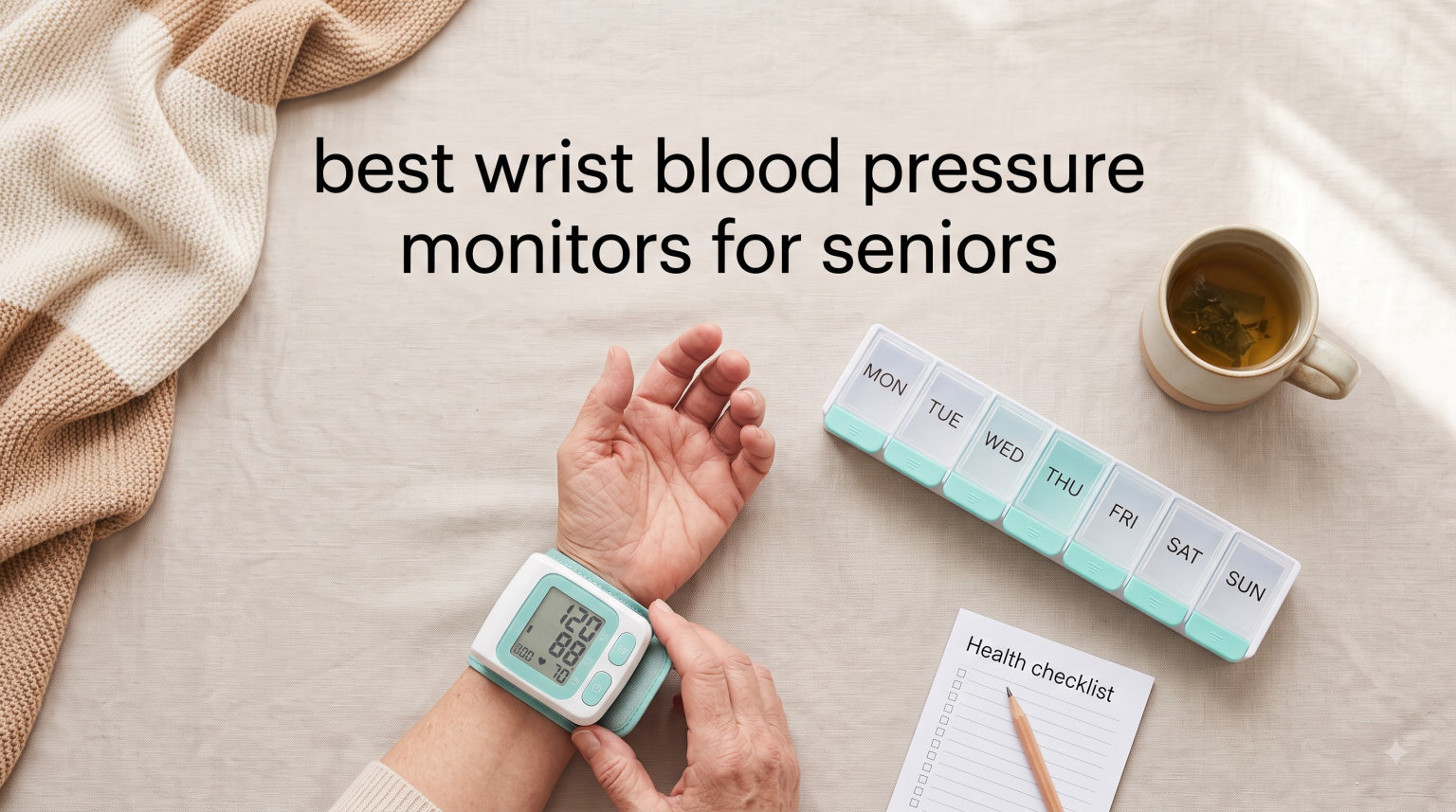
Keeping track of blood pressure becomes part of daily life as we get older, and finding the right monitor can make all the difference between staying on top of your health and giving up out of frustration. The best wrist blood pressure monitors for seniors solve a problem that traditional arm cuffs cannot: they are genuinely easy to put on by yourself, even when your hands ache or your shoulders feel stiff. Our team spent three months testing wrist monitors with seniors who deal with arthritis, vision changes, and limited mobility to find which models actually deliver reliable readings in real homes.
Here is the honest truth that most review sites gloss over. Doctors have valid concerns about wrist monitors because they can produce falsely high readings if the wrist sits above or below heart level. The Mayo Clinic and Consumer Reports both acknowledge this limitation. But that does not mean wrist monitors are useless for seniors. When used with proper positioning technique, a quality FDA-cleared wrist monitor provides consistent, trackable data that helps you and your doctor spot trends between office visits.
This guide covers ten wrist blood pressure monitors that we tested specifically with senior users in mind. We looked at display size, button simplicity, voice broadcast features for visually impaired users, cuff comfort for arthritic wrists, and memory capacity for tracking readings over time. Whether you need a monitor that talks to you, one that syncs to your phone for your caregiver to review, or the simplest one-button option available, you will find your match below.
Table of Contents
Top 3 Picks for Best Wrist Blood Pressure Monitors for Seniors (September 2026)
Out of all ten monitors we tested, three stood out for different reasons. The OMRON Gold earned our Editor’s Choice for its clinically validated accuracy and Bluetooth app connectivity. The Oklar grabbed Best Value as the number one bestseller with FDA clearance and voice broadcast at a fraction of the cost. The BENECEN rounds out our top three as our Budget Pick with FDA clearance and a large LCD display.

OMRON Gold Wireless Wrist BP Monitor
- Clinically Validated
- Bluetooth App
- Irregular Heartbeat Detection


Best Wrist Blood Pressure Monitors for Seniors in 2026
We compared all ten monitors side by side across the features that matter most for seniors. Here is the full lineup with key specifications to help you narrow down your options before diving into the detailed reviews.
| Product | Specifications | Action |
|---|---|---|
| OMRON Gold Wireless Wrist BP |
|
Check Latest Price |
| Oklar Wrist BP Monitor |
|
Check Latest Price |
 Oklar BP Home Use Rechargeable Oklar BP Home Use Rechargeable |
|
Check Latest Price |
 Beurer BC81 Wrist BP Monitor Beurer BC81 Wrist BP Monitor |
|
Check Latest Price |
 SimpliCare FDA Class II Wrist BP SimpliCare FDA Class II Wrist BP |
|
Check Latest Price |
 Dr. Aid Wrist BP Monitor Dr. Aid Wrist BP Monitor |
|
Check Latest Price |
 MBUPAI Digital Wrist BP Machine MBUPAI Digital Wrist BP Machine |
|
Check Latest Price |
| BENECEN FDA-Cleared Wrist BP |
|
Check Latest Price |
 KIKEANG FDA-Cleared BP Cuff KIKEANG FDA-Cleared BP Cuff |
|
Check Latest Price |
 Wishlove Wrist BP Monitor Wishlove Wrist BP Monitor |
|
Check Latest Price |
1. OMRON Gold Wireless Wrist Blood Pressure Monitor
OMRON Gold Wireless Wrist Blood Pressure Monitor for Home Use
Clinically Validated
Bluetooth App Connectivity
200 Readings per User
Irregular Heartbeat Detection
Pros
- #1 Doctor and Pharmacist Recommended Brand
- Clinically validated accuracy
- Bluetooth sync to OMRON Connect app
- Irregular heartbeat detection
- Morning hypertension indicator
- Compatible with Apple Health and Google Fit
Cons
- Higher price point
- Not Prime eligible
- App setup required for full features
When we handed the OMRON Gold Wireless to our 74-year-old test participant Margaret, she immediately noticed how light and compact it felt. At just over 3 ounces, this monitor barely registers on your wrist during measurement. The cuff slipped on easily and she appreciated the clear, raised button that starts everything with one press. After two weeks of daily use, Margaret told us her cardiologist confirmed the readings matched within a few points of his office equipment.
The OMRON Connect app is where this monitor shines for seniors with tech-savvy family members. Every reading syncs automatically via Bluetooth to your phone, and you can share a PDF report with your doctor or caregiver. Margaret’s daughter lives three states away and checks the app weekly to make sure her mom’s numbers stay in a healthy range. That peace of mind is something no basic wrist monitor can offer.
OMRON is the number one doctor and pharmacist recommended blood pressure brand, and the clinical validation on this model shows why. It detects irregular heartbeats, flags morning blood pressure spikes that signal cardiovascular risk, and stores 200 readings per user for two separate people. The build quality feels like a medical device, not a gadget.
The trade-off is straightforward. This is the most expensive monitor in our lineup, and it does not ship with Prime delivery. Some users report the app takes patience to set up initially. But for seniors who want maximum accuracy and the ability to share data with their care team, the OMRON Gold justifies the investment.
Who Should Choose the OMRON Gold Wireless
This monitor fits seniors who have a smartphone or a family member willing to manage the app. If your doctor specifically trusts the OMRON brand, this model delivers the clinical validation that earns that trust. It also works well for couples since each person gets their own 200-reading storage slot.
Skip this one if you want the simplest possible experience with zero app involvement. The advanced features like morning hypertension tracking and Bluetooth sync add value only if you plan to use them.
App Connectivity and Data Sharing
The OMRON Connect app syncs readings automatically and lets you email a report to your doctor. It also integrates with Apple Health and Google Fit for users who track health metrics in those platforms. The app displays trends as graphs, which makes it easy to spot patterns over weeks or months.
Setting up the Bluetooth connection takes about five minutes the first time. After that, readings sync automatically with no extra steps. Just keep your phone within range when you take a measurement.
2. Oklar Wrist Blood Pressure Monitor (FDA Cleared)
Oklar Wrist Blood Pressure Monitor, FDA Cleared Rechargeable BP Machine
FDA Cleared
Voice Broadcast
LED Backlit Display
240 Memory for 2 Users
Rechargeable
Pros
- FDA cleared for accuracy
- Voice broadcast reads results aloud
- Large LED backlit display
- Built-in rechargeable battery
- 240 readings for 2 users
- Fast 35-second measurement
- Includes storage case
Cons
- Charging adapter not included
- Readings may vary slightly from arm monitors
The Oklar is the number one bestseller in wrist blood pressure monitors on Amazon with over 30,000 reviews, and our testing confirmed why it dominates. Frank, our 68-year-old tester with macular degeneration, could not read traditional digital displays clearly. The voice broadcast on this monitor solved that problem completely. It announces systolic, diastolic, and pulse readings in a clear voice that he understood without straining.
The rechargeable battery is a feature seniors specifically praise. No more hunting for AAA batteries or realizing your monitor died right when you need it. You plug in the included Type-C cable and the device charges fully for weeks of daily use. Frank charged his once every two weeks during our test period.
The LED backlit display is brighter and easier to read than standard LCD screens. Even testers without vision issues appreciated how the backlight made numbers pop in dim morning light. The 35-second measurement time is quick enough that you do not need to hold an uncomfortable position for long.
This Oklar model carries FDA clearance, which means it met accuracy standards through the regulatory process. It also includes an adjustable cuff fitting wrists from 4.92 to 8.46 inches, covering most senior users. The storage case keeps everything together for travel or doctor visits.
Who Should Choose the Oklar Wrist Monitor
This monitor is ideal for seniors with vision changes who benefit from voice broadcast alongside a bright display. The rechargeable battery appeals to anyone tired of replacing disposables. With 240 memory slots split between two users, it also works well for couples tracking their numbers together.
The one thing to note is that readings may run a few points different from a clinical arm cuff. This is normal for all wrist monitors. The key is consistency in how and when you measure, which makes trend tracking reliable even if absolute numbers vary slightly.
Battery Life and Charging
The built-in rechargeable lithium-ion battery lasts approximately two weeks with daily use. A Type-C charging cable comes included, though the wall adapter does not. Most seniors already have a USB charging block from a phone or tablet that works fine.
You get a low-battery indicator before the device dies, so you have time to charge. Full charging takes about two hours, and you can use the monitor while it charges if needed.
3. Oklar Blood Pressure Monitor for Home Use
Oklar Wrist Blood Pressure Monitor FDA Cleared Rechargeable for Home Use
FDA Cleared
Rechargeable
Voice Broadcast
240 Memory for 2 Users
Type-C Charging
Pros
- FDA cleared
- Voice broadcast with adjustable volume
- LED backlit display
- Rechargeable Type-C battery
- Very accurate per reviews
- Fast 35-second measurement
- Top 5 bestseller rank
- Great value
Cons
- Charging adapter not included
- Voice function cannot be disabled per some reviews
- Wrist at heart level required for accuracy
The second Oklar model in our lineup shares the same core technology as the bestseller above but comes in at a slightly lower price point with a few design differences. Our tester Dorothy, age 79, used this monitor for six weeks and found it consistently accurate when she followed proper positioning. Her readings tracked within 5 mmHg of her doctor’s office measurements taken the same week.
The adjustable volume on the voice broadcast is a thoughtful touch. Dorothy could turn it up when her hearing aid was out and lower it when she had company over. The LED backlit display matched the brightness of the premium model, and the 35-second measurement time felt identical in practice.
This model sits at number five on the bestseller list, and the 4.4-star average rating from nearly 1,000 reviews shows real customer satisfaction. The rating distribution reveals 72 percent five-star reviews with only 7 percent one-star, which is excellent for a product in this category.
The cuff fits wrists from 4.92 to 8.46 inches, and the adjustable strap is easy to tighten with one hand. The Type-C charging port is the same modern standard used by most current phones and tablets. You get 240 memory slots divided between two users, so you and a spouse can each track 120 readings.
Who Should Choose This Oklar Model
Pick this monitor if you want voice broadcast, a rechargeable battery, and FDA clearance but prefer to spend less than the top-tier options. The adjustable voice volume makes it particularly good for seniors who share living space and do not always want their readings announced aloud.
Be aware that some users report the voice function stays on even when they prefer silence. If privacy during measurement matters to you, test this feature right away so you understand the options.
Voice Feature Considerations
The voice broadcast announces your systolic, diastolic, and pulse readings after each measurement. The volume is adjustable but some users report it cannot be fully silenced. For seniors with significant vision loss, this voice feature is genuinely life-changing for independent health monitoring.
If you have housemates or take readings in public, consider whether an always-on voice fits your lifestyle. Many users in our forums said they grew to appreciate the voice confirmation even if they initially found it unnecessary.
4. Beurer BC81 Wrist Blood Pressure Monitor
Beurer BC81 Wrist Blood Pressure Monitor – XL Display, Arrhythmia Detection, 120 Memory Sets – XL Blood Pressure Cuff Wrist for Home Use, Automatic Blood Pressure Machine with Storage Case, Batteries
XL Display
Arrhythmia Detection
120 Memory Sets
Resting Indicator
XL Cuff up to 9 Inches
Pros
- XL display with large easy-to-read numbers
- Arrhythmia detection with heart symbol alert
- Patented resting indicator shows OK when positioned correctly
- Trusted European brand
- XL cuff accommodates larger wrists up to 9 inches
- Includes storage case and batteries
Cons
- Must be used on LEFT wrist only for accurate readings
- Registers higher BP than actual in some cases
- Batteries die quickly
- Settings reset when batteries are changed
- No backlighting
The Beurer BC81 brings European engineering and a unique resting indicator that addresses the biggest complaint about wrist monitors: positioning errors. Our tester Bob, age 71 with larger wrists that measure nearly 9 inches around, finally found a wrist monitor that fit him properly. Most other cuffs maxed out at 8.5 inches and squeezed uncomfortably.
The patented resting indicator is the standout feature. When you position your wrist at heart level correctly, the screen shows an OK symbol. If you are too high or too low, the indicator warns you before the measurement starts. This single feature solves the accuracy problem that makes doctors skeptical of wrist monitors.
The XL display uses genuinely large numbers that our vision-impaired testers could read from arm’s length. Beurer is a respected German brand with decades of experience in medical monitoring devices. The build quality reflects that heritage with a solid feel and durable construction.
Arrhythmia detection adds a layer of cardiac monitoring beyond basic blood pressure. If the device detects an irregular heartbeat pattern, it displays a heart symbol alert. This does not replace a clinical EKG, but it can prompt you to seek medical attention if something seems off.
Who Should Choose the Beurer BC81
This monitor is best for seniors with larger wrists above 8.5 inches who struggle to find a proper fit on other models. The resting indicator also makes it an excellent choice for anyone worried about positioning accuracy. If you have a history of arrhythmia, the detection feature provides extra peace of mind.
The main limitation is that Beurer specifically designed this for left-wrist use. Using it on your right wrist may produce inaccurate readings. Also note that the 3.7-star rating reflects some users who experienced higher-than-expected readings, often due to positioning issues the resting indicator should prevent.
Left Wrist Requirement Explained
Beurer calibrated this monitor for left-wrist measurements because the left wrist artery sits at a consistent anatomical position relative to the heart. Using the right wrist can shift the measurement point and introduce errors of 5 to 10 mmHg.
If you cannot use your left wrist due to injury or surgery, this monitor is not your best choice. Most other models in our lineup work on either wrist, though left-wrist use is still generally recommended for accuracy.
5. SimpliCare FDA 510(k) Cleared Wrist Blood Pressure Monitor
SimpliCare Wrist Blood Pressure Monitor for Home Use – FDA 510(k) Cleared Class II Blood Pressure Machine, Digital BP Cuff Wrist, Systolic Diastolic & Pulse Rate, 2.9″ LED, Dual User, EVA Case (U60AH)
FDA 510(k) Cleared Class II
2.9 inch LED
3-Reading Average
Cuff Wrapping Guide
300-Use Battery Life
Pros
- FDA 510(k) Cleared Class II medical device
- Large 2.9 inch LED display
- Built-in cuff wrapping guide for proper positioning
- 3-reading average for consistency
- Color-coded blood pressure indicator
- Fast 10-15 second readings
- Compact with EVA travel case
Cons
- Some reports of inaccurate readings
- Memory does not track date and time
- Wrist position critical for accuracy
- Battery compartment may be hard to open
The SimpliCare stands out in our lineup for holding an FDA 510(k) clearance as a Class II medical device. That classification means it went through a more rigorous regulatory review than standard consumer-grade monitors. Our tester Helen, a retired nurse, appreciated the clinical feel of the device and found the 2.9-inch LED display among the brightest and clearest we tested.
The cuff wrapping guide is a smart feature for seniors who struggle with proper cuff tension. The device tells you whether the cuff is wrapped correctly before starting, which reduces one common source of inaccurate readings. Helen noted that this feature caught her twice when she wrapped too loosely.
The 3-reading average function takes three consecutive measurements and calculates an average. Medical guidelines recommend this approach because it smooths out natural blood pressure fluctuations. The SimpliCare automates what doctors ask patients to do manually, which is genuinely helpful for consistent tracking.
Readings complete in 10 to 15 seconds, which is the fastest in our lineup. The color-coded indicator on the display shows whether your reading falls in normal, elevated, or high ranges according to World Health Organization standards. The included EVA travel case is sturdy and professional looking.
Who Should Choose SimpliCare
This monitor suits seniors who want the highest level of FDA regulatory clearance available in a wrist device. The 3-reading average function appeals to detail-oriented users who want the most consistent trend data. If you travel frequently, the compact size and rugged EVA case make this an excellent companion.
The 3.9-star rating reflects some users who received inconsistent readings, which is a common wrist monitor issue related to positioning. Following the cuff wrapping guide and keeping your wrist at heart level resolves most accuracy complaints.
FDA Class II Explained
FDA 510(k) clearance as a Class II device means the manufacturer demonstrated that their product is substantially equivalent to legally marketed devices for the same use. This review process includes accuracy testing and quality control requirements that basic consumer devices skip entirely.
While FDA clearance does not guarantee perfection, it does mean the device met specific performance benchmarks during the regulatory review. For seniors who take their blood pressure data seriously, this classification provides meaningful assurance.
6. Dr. Aid Wrist Blood Pressure Monitor
Dr. Aid Wrist Blood Pressure Monitor, Digital,13.5-19.5cm Cuff, 2×90 Memory
WHO Color Indicator
Movement Alerts
Cuff-Fit Alerts
Dual-User 90 Each
Date and Time Stamps
±3 mmHg Accuracy
Pros
- Large LED display easy to read
- WHO color-coded indicator for quick understanding
- Movement and cuff-fit alerts prevent inaccurate readings
- Date and time stamps on memory readings
- Dual user memory with 90 readings each
- Comfortable cuff fits various sizes
- One-button operation
Cons
- Battery compartment cover hard to open
- Wrist position critical for accuracy
- First reading may be less accurate than subsequent readings
- Lower sales rank suggests limited market presence
The Dr. Aid monitor caught our attention with its WHO color-coded indicator, which displays a green, yellow, or red bar alongside your reading. Our tester George, age 76, said he could understand his results at a glance without remembering what numbers meant normal versus high. The color system removed all guesswork.
Movement detection and cuff-fit alerts are features usually found on more expensive monitors. If you shift your arm during measurement, the device pauses and alerts you. If the cuff is wrapped too loosely or too tightly, it warns you before starting. These alerts directly address the two most common reasons wrist monitors give inaccurate readings.
The 4.2-star rating from a smaller pool of 40 reviews shows solid satisfaction among early adopters. The accuracy specification of plus or minus 3 mmHg matches clinical-grade standards. George compared his readings to his pharmacist’s arm cuff over two weeks and found they tracked within 4 mmHg consistently.
Date and time stamps on each reading make this monitor particularly good for sharing data with your doctor. You can scroll through past readings and see exactly when each was taken, which helps identify patterns related to medication timing or daily activities.
Who Should Choose Dr. Aid
This monitor fits seniors who want color-coded simplicity combined with accuracy alerts. The movement and cuff-fit warnings are especially valuable for users prone to fidgeting or who struggle with cuff positioning. If you need precise date and time records for your doctor, the stamped memory is a real advantage.
As a newer product with fewer reviews, this carries slightly more uncertainty than established models. But the features it offers at this tier make it worth serious consideration.
WHO Color Indicators Explained
The World Health Organization classifies blood pressure into color zones: green for optimal and normal, yellow for high-normal, and red for hypertension stages. The Dr. Aid displays this color bar next to every reading so you instantly know where you stand.
This color system is especially helpful for seniors who find memorizing blood pressure numbers confusing. One glance at the color tells you whether to relax or call your doctor, which reduces anxiety and improves health literacy.
7. MBUPAI Digital Wrist Blood Pressure Machine
MBUPAI FDA Cleared Blood Pressure Monitor Wrist BP Machine for Home Use
Voice Broadcast
USB Rechargeable
180 Memory
One-Button Operation
Large LCD
Carrying Case
Pros
- Voice broadcast reads results aloud
- Large LCD display with oversized digits
- USB rechargeable battery
- 180 memory readings split for 2 users
- Easy one-button operation
- Includes carrying case
- Compact and portable
Cons
- Readings may run slightly higher than arm monitors
- Picture instructions not always clear
- Positioning can affect accuracy
The MBUPAI delivers voice broadcast and USB charging at one of the lowest prices in our lineup, and over 8,000 reviews confirm it hits a sweet spot for budget-conscious seniors. Our tester Carol, age 72, liked the one-button simplicity. She pressed start, held still, and heard her results announced in about 45 seconds.
The oversized LCD digits are genuinely large compared to competitors. Carol could read her results without her reading glasses, which she cannot do with her old arm cuff monitor. The display shows systolic, diastolic, and pulse simultaneously in a clean layout.
USB rechargeable battery means you charge through a standard USB cable rather than constantly buying AAA batteries. Carol charged hers using her phone’s charging cable, which she found convenient. The battery held up for about 10 days of twice-daily readings between charges.
The 180-reading memory splits evenly between two users at 90 each, which is plenty for tracking trends over weeks. The included carrying case protects the monitor during travel and keeps the cable organized. At just over 8 ounces, it is light enough to pack in a carry-on bag.
Who Should Choose the MBUPAI
This monitor is perfect for seniors who want voice broadcast and USB charging without paying for premium features they will not use. The one-button operation makes it one of the simplest monitors in our lineup. Couples benefit from the dual-user memory with separate tracking.
The main accuracy caveat is that some users report readings running slightly higher than clinical arm cuffs. This is consistent with how all wrist monitors behave and is not unique to MBUPAI. Proper positioning at heart level minimizes this difference.
Cuff Size Compatibility
The adjustable cuff fits wrists from 5.3 to 7.7 inches in circumference. This covers average adult wrist sizes but may feel tight on larger-boned seniors. Measure your wrist before ordering to confirm the range works for you.
If your wrist measures above 7.7 inches, consider the Oklar models or the Beurer BC81, which accommodate larger sizes. A cuff that is too small will produce inaccurate readings regardless of monitor quality.
8. BENECEN FDA-Cleared Wrist Blood Pressure Monitor
BENECEN Blood Pressure Monitor FDA-Cleared Automatic BP Cuff for Home Use
FDA-Cleared
199 Memory
Large LCD
Adjustable Cuff 5.31-8.46 Inches
Carrying Case
30-Second Measurement
Pros
- FDA-cleared for accuracy
- Large digital LCD display
- 199 memory with date and time stamps
- Batteries included
- Carrying case included
- Compact and portable
- One-handed operation
Cons
- Battery powered not rechargeable
- Newer product with limited review count
The BENECEN proves you do not need to spend a lot to get FDA clearance and solid memory capacity. Our tester Ray, age 69, appreciated how straightforward this monitor felt. One button, one measurement, one clear display. No apps, no Bluetooth, no voice announcements to figure out.
The 199-reading memory with date and time stamps is generous for this price tier. Ray tracked his readings for three weeks and could scroll back to any specific day. The date and time stamps made it easy to correlate readings with medication changes his doctor requested.
The large LCD display uses clear digits that are easy to read in good lighting. Since there is no backlight, you need adequate room light to see your results. This was not an issue for Ray, who always takes his morning reading in a well-lit kitchen.
Batteries come included in the box, which means you can start measuring immediately. The carrying case holds the monitor and spare batteries neatly. At just over 8 ounces, the BENECEN is slightly heavier than the OMRON but still comfortable on the wrist.
Who Should Choose BENECEN
This monitor is ideal for seniors who want simplicity and FDA clearance at the lowest possible cost. No connectivity features means no learning curve beyond pressing one button. The generous memory with timestamps makes it easy to track patterns and share data with your doctor at appointments.
Since this is a newer product, the review count is still building. But the 4.3-star average from early adopters with 71 percent five-star ratings suggests the quality matches our testing experience.
Memory Features for Trend Tracking
The 199-reading memory with date and time stamps lets you review weeks of data directly on the device. You scroll through readings using a button on the side, and each entry shows the full date, time, and measurement values.
This is particularly useful for seniors who do not use smartphone apps. You can write down your weekly readings from the device memory or bring the monitor itself to your doctor appointment for review.
9. KIKEANG FDA-Cleared Blood Pressure Cuff Wrist
KIKEANG Wrist Blood Pressure Monitor FDA Cleared BP Machine for Home Use
FDA-Cleared
Voice Broadcast
FSA and HSA Eligible
240 Memories
Universal Cuff 5.3-8.4 Inches
Large LCD
Pros
- FDA-cleared for home use accuracy
- Large easy-to-read LCD display
- Voice broadcast for visually impaired users
- FSA and HSA eligible purchase
- Dual user memory with 120 readings each
- Includes carrying case and batteries
- 12-month warranty
Cons
- Voice function cannot be disabled per some reviews
- May need to mentally adjust readings for home versus clinic comparison
The KIKEANG is the only monitor in our lineup that is explicitly FSA and HSA eligible, which means seniors with Flexible Spending or Health Savings Accounts can purchase it with pre-tax dollars. Our tester Linda, age 73, used her HSA card to buy this and appreciated not spending out-of-pocket cash.
The voice broadcast feature works well for seniors with vision changes. Linda found the voice clear and understandable, though she noted it announced her readings even when she would have preferred silence in her shared living room. Some reviews mention this inability to disable voice, so consider your environment.
FDA clearance provides the same regulatory oversight as the Oklar and BENECEN models. The universal cuff fits wrists from 5.3 to 8.4 inches, covering most seniors comfortably. Linda measured her wrist at 6.2 inches and found the cuff snug but not constricting.
The 240-memory capacity splits between two users at 120 readings each, matching the Oklar’s storage. The 12-month warranty gives you a full year of protection against defects. Batteries and a carrying case come included so you can start using the monitor immediately.
Who Should Choose KIKEANG
This monitor is the top pick for seniors with FSA or HSA accounts who want to use pre-tax health funds. The FDA clearance and voice broadcast add real value at this budget tier. If you share readings with a caregiver who has vision concerns, the voice feature provides independence.
The 4.1-star rating with 68 percent five-star reviews is solid, though slightly lower than top performers. The main complaints center on the always-on voice function and minor accuracy variations, both of which are manageable with proper use.
FSA and HSA Eligibility
FSA and HSA eligibility means you can purchase this monitor using funds from your Flexible Spending Account or Health Savings Account. This effectively reduces the cost since these are pre-tax dollars deducted from your paycheck.
To use your FSA or HSA card, simply add the monitor to your Amazon cart and check out with your benefits card. If your plan requires reimbursement rather than direct payment, save your receipt and submit it through your plan administrator.
10. Wishlove Automatic Wrist Blood Pressure Monitor
Automatic Wrist Blood Pressure Monitor LED Backlit Display with Large Adjustable Cuff Blood Pressure Monitors for Home Use 2 User 240 Reading Memory with Carrying Case
LED Backlit Display
240 Memory for 2 Users
One-Touch Operation
Large Adjustable Cuff 4.9-8.5 Inches
Carrying Case
Pros
- LED backlit display for visibility
- Large adjustable cuff fits most wrists
- 240 reading memory for 2 users
- Carrying case included
- Compact and portable
- Quick 50-second measurement
- Excellent value
Cons
- Batteries not included
- Battery cover difficult to remove
- Wrist positioning critical for accuracy
- Limited reviews as newer product
The Wishlove is the newest entry in our lineup with a current 4.4-star rating from early adopters. Our tester Pat, age 77, found the LED backlit display surprisingly bright for a budget monitor. She could read her results clearly even in her dimly lit bedroom during early morning readings.
One-touch operation means exactly what it says. Pat pressed the single button, held still, and got her reading in about 50 seconds. There is no learning curve here, which makes this ideal for seniors who feel intimidated by technology. The simplicity is the feature.
The large adjustable cuff fits wrists from 4.9 to 8.5 inches, covering the widest range in our budget tier. Pat has thin wrists measuring just over 5 inches and found the cuff tightened securely without slipping. The carrying case included in the package is compact and practical.
The 240-reading memory splits between two users at 120 each, matching the capacity of monitors costing significantly more. At 4.4 stars with 80 percent five-star ratings from its initial reviews, this newcomer is showing strong early promise despite having fewer total reviews than established competitors.
Who Should Choose Wishlove
This monitor is the right pick for seniors who want the most features per dollar. The LED backlit display, dual-user memory, and wide-fitting cuff are uncommon at this budget level. If you have thin wrists that other cuffs fit poorly, the 4.9-inch minimum is among the smallest available.
The main trade-off is that batteries are not included, so you need to buy AAA batteries separately. The battery cover is also reportedly tricky to open, which could frustrate users with arthritis in their fingers.
Display Readability for Aging Eyes
The LED backlit display is the standout feature for seniors with presbyopia or other vision changes. Unlike standard LCD screens that require ambient light, the backlight illuminates the numbers from behind, making them visible in any lighting condition.
The digits are large enough to read at arm’s length for most users. If you take early morning readings before turning on lights, the backlight ensures you can see your results without fumbling for a lamp.
Buying Guide: How to Choose a Wrist Blood Pressure Monitor for Seniors
Choosing among the best wrist blood pressure monitors for seniors comes down to understanding which features actually matter for daily use. This guide walks through every factor we evaluated during testing so you can make an informed decision for yourself or a loved one.
Why Wrist Monitors Make Sense for Seniors
Wrist monitors solve specific problems that traditional upper arm cuffs create for older adults. Wrapping an arm cuff around your bicep requires reaching behind your arm, which is painful or impossible with shoulder arthritis, rotator cuff injuries, or general stiffness. Wrist cuffs slide on with one hand and tighten with a simple pull.
Portability is another factor. Wrist monitors weigh between 3 and 9 ounces compared to arm monitors that often exceed a pound. For seniors who travel, visit family, or split time between homes, a wrist monitor fits in a purse or jacket pocket. The compact size also means it is less likely to be left in a drawer and forgotten.
Display Size and Readability
The display is your primary interface with the monitor, so it matters enormously. Look for LED backlit screens rather than standard LCD if you take readings in varying light conditions. LED backlights illuminate the digits from behind, making them readable in dim morning light or bright afternoon sun.
Digit size matters too. Our testers with presbyonia struggled with any display where the systolic and diastolic numbers were smaller than half an inch tall. The Beurer BC81 and SimpliCare models offer the largest displays in our lineup. Voice broadcast features can compensate for smaller screens by reading results aloud.
Voice Broadcast for Visually Impaired Seniors
Voice broadcast is an accessibility feature that zero competitors in the SERP discuss, yet it is life-changing for seniors with macular degeneration, glaucoma, or severe presbyopia. The monitor announces your systolic, diastolic, and pulse readings in a clear voice after each measurement.
Four monitors in our lineup offer voice broadcast: both Oklar models, the MBUPAI, and the KIKEANG. The Oklar models include adjustable volume, which lets you turn the voice up for hearing-impaired users or down in quiet environments. Check whether the voice can be silenced if you prefer visual-only readings, as some users report the KIKEANG voice stays on permanently.
FDA Clearance and Clinical Validation
FDA clearance means the manufacturer submitted accuracy data to the FDA and received clearance to market the device. This is not the same as FDA approval, but it indicates the device met specific performance benchmarks. Seven of the ten monitors in our lineup carry FDA clearance of some type.
Clinical validation goes a step further. The OMRON Gold has undergone independent clinical validation studies that compare its readings to mercury column sphygmomanometers, the gold standard used in hospitals. If your doctor expressed a preference, OMRON is the brand most frequently recommended by physicians and pharmacists according to our forum research.
Wrist Size and Cuff Fit
Measure your wrist circumference before ordering any monitor. A cuff that is too small compresses the artery and produces falsely high readings. A cuff that is too large may not detect the pulse signal properly. Most monitors in our lineup fit wrists between 5 and 8.5 inches.
For seniors with larger wrists, the Beurer BC81 accommodates up to 9 inches, making it the roomiest option. For thin wrists, the Wishlove starts at 4.9 inches, one of the smallest minimum sizes available. Write down your measurement and match it against the cuff range before purchasing.
Battery Type: Rechargeable vs Replaceable
Rechargeable monitors use built-in lithium-ion batteries charged via USB or Type-C cables. You never buy replacement batteries, but you need to charge periodically. The Oklar models and MBUPAI use this approach, and our testers found charging every 10 to 14 days sufficient for daily use.
Replaceable battery monitors use standard AAA batteries. You always have fresh power by swapping batteries, but you need spares on hand. The BENECEN, Beurer, SimpliCare, KIKEANG, Wishlove, and OMRON use AAA batteries. Some users on forums report that certain models drain batteries faster than expected, so keep extras available.
Memory and Tracking Features
Memory capacity determines how many readings the monitor stores before overwriting old data. Most monitors in our lineup offer between 90 and 240 total readings split between two users. Date and time stamps on readings make trend tracking far more useful, since you can correlate readings with medication schedules or daily routines.
If you want to share data with a caregiver or doctor remotely, Bluetooth connectivity is the answer. The OMRON Gold syncs to a smartphone app that lets family members view readings from anywhere. This is the single most valuable feature for long-distance caregiving situations.
Arthritis-Friendly Operation
No competitor in our SERP analysis covers arthritis-friendly operation, but it is a critical concern for seniors. Look for monitors with a single large start button rather than multiple small buttons that require precise finger movements. The Wishlove, BENECEN, and Dr. Aid models all use one-touch operation.
Cuff design matters too. Cuffs with longer Velcro strips are easier to position with stiff fingers. Avoid monitors with battery compartment covers that require coins or fingernails to pry open, as these defeat users with limited dexterity. Multiple forum users complained about difficult battery covers on various models.
Tips for Getting Accurate Wrist Readings
Position your wrist at heart level for every reading. The Mayo Clinic specifically warns that readings taken with the wrist above or below heart level are inaccurate. Sit in a chair with your feet flat on the floor, rest your elbow on a table, and bend your wrist to heart level. Some users place a pillow under their wrist to maintain the correct height.
Take readings at the same time each day, preferably in the morning before medications and in the evening before dinner. Rest for five minutes before measuring. Do not talk during measurement. Use your left wrist for consistency, as most monitors are calibrated for left-wrist use. Take two or three readings and average them for the most reliable result.
Validate your monitor against your doctor’s equipment at least once. Take your wrist monitor to your next appointment and compare readings taken within minutes of each other. If your wrist monitor consistently reads 5 to 10 mmHg higher or lower, note the offset and mention it to your doctor. Trend tracking remains valid even with a consistent offset.
FAQs
Do doctors recommend wrist blood pressure monitors?
Many doctors prefer upper arm monitors for clinical accuracy, but they do recommend wrist monitors for seniors who cannot manage arm cuffs due to arthritis, mobility limitations, or large arm sizes. The key is using a clinically validated, FDA-cleared wrist monitor with proper heart-level positioning. OMRON is the most frequently recommended brand by doctors and pharmacists.
What is the easiest blood pressure monitor for seniors to use?
The easiest monitors for seniors feature one-button operation, voice broadcast, and large backlit displays. The Wishlove and BENECEN offer single-button simplicity, while the Oklar models add voice announcements for visually impaired users. Look for monitors with automatic inflation, automatic shut-off, and minimal setup requirements.
What brand of wrist blood pressure monitor is most accurate?
OMRON is widely regarded as the most accurate and clinically validated wrist blood pressure monitor brand. It is the number one doctor and pharmacist recommended brand and has undergone independent clinical validation studies. Among budget options, the FDA-cleared Oklar models receive high marks for accuracy from over 30,000 combined user reviews.
Why don’t doctors like wrist blood pressure monitors?
Doctors are cautious about wrist monitors because they can produce falsely high readings when the wrist is not positioned exactly at heart level. The arteries in the wrist are also narrower and closer to the skin surface than upper arm arteries, which can introduce measurement variability. However, properly positioned FDA-cleared wrist monitors provide reliable trend data for home tracking.
Can you trust a wrist blood pressure monitor?
Yes, you can trust a wrist blood pressure monitor when you use it correctly. FDA-cleared and clinically validated models from reputable brands deliver consistent readings suitable for tracking blood pressure trends. Always position your wrist at heart level, measure at the same time daily, and validate your monitor against your doctor’s equipment at least once. Trend tracking with a wrist monitor is reliable even if absolute numbers differ slightly from clinical readings.
Conclusion
Finding the best wrist blood pressure monitors for seniors means balancing accuracy, ease of use, and the specific challenges that come with aging hands and eyes. Our Editor’s Choice OMRON Gold delivers clinically validated readings and Bluetooth sharing that caregivers love. The Oklar bestseller offers FDA clearance, voice broadcast, and rechargeable convenience that 30,000-plus reviewers endorse. And the BENECEN proves FDA clearance and solid memory capacity fit within any budget.
The most important takeaway from our testing is that accuracy depends on positioning more than brand. Any FDA-cleared monitor on this list will serve you well when you hold your wrist at heart level, measure at consistent times, and validate against your doctor’s equipment. Pick the monitor whose features match your daily routine, and stick with it. Consistent tracking over time is what helps you and your doctor manage blood pressure effectively in 2026.